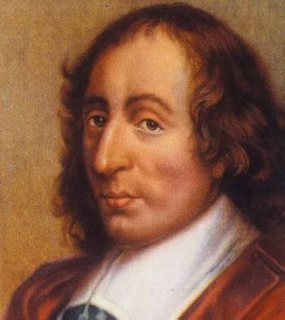
Pascal was a French mathematician, physicist, inventor, philosopher, and Catholic writer…. His two most famous works date from this period: the Lettres provinciales and the Pensées, the former set in the conflict between Jansenists and Jesuits. The latter contains Pascal's wager,... a fideistic probabilistic argument for why one should believe in God. In that year, he also wrote an important treatise on the arithmetical triangle. Between 1658 and 1659, he wrote on the cycloid and its use in calculating the volume of solids.
Introductory Comments
Why did Pascal, a brilliant mathematician and scientist, undergo so profound a religious conversion that, at the age of 31, he abandoned most of his intellectual pursuits to devote himself to religion? One obvious answer, of course, is that God Himself transformed Pascal. Fair enough. But how might a skeptic approach the same question? Well, here are a few facts to chew on.
Fact 1: Pascal suffered from severe health problems throughout his life. Chronic illness may well have heightened his awareness of mortality - and with it, his longing for religious consolation.
Fact 2: Pascal's beloved sister, Jacqueline, embraced Jansenism, a Catholic reform movement that stressed humanity's dependence on divine grace. She may have very well deepened Pascal's religious convictions.
Fact 3: Pascal laid the foundations of modern probability theory. It is would not then be surprising if he was drawn drawn to the practical question we now call Pascal's Wager: If you believe in God and God exists, you gain everything. If He does not, you lose little. So why not make the bet?
Which of these explanations comes closest to the truth? Perhaps all of them played a part. Even so, Pascal himself would almost certainly have dismissed such speculation. His answer, in the end, would have been very simple: divine grace.
Some of Pascal's Key Positions
The new sciences will yield real discoveries and useful inventions. Work on hydraulics, atmospheric pressure, and the vacuum is fascinating in itself, and it improves ordinary life. Nor should the authority of the ancients stand in the way: in matters of experiment, later generations see farther than earlier ones.
Yet science moves entirely within the material order. Reality has three orders - bodies, minds, and charity - and each infinitely surpasses the one beneath it. All the calculating machines in the world cannot produce a single act of love, and every scientific triumph is nothing beside eternal salvation.
How, then, is faith to be gained? Not by Descartes and his followers, and not by observation and experiment either. Reason can clear the ground: it can expose our misery, our restlessness, our endless diversions. But no proof compels belief. God is known through the heart rather than through argument, and the heart has its reasons, which reason does not know.
Still, one argument deserves the unbeliever's attention - not as a proof, but as a prod. Nobody gets to abstain here; we are already embarked. Bet wrongly on God and you forfeit a few pleasures. Bet rightly and you gain an infinity. Then kneel, pray, follow the practices: belief may come to follow habit.
Place in the History of Ideas
Pascal's Place in History of Ideas
Cassirer: … the doctrine Pascal seeks to establish stands in sharp contrast to the procedure by which he reaches his conclusions. The thesis he defends is the absolute powerlessness of reason which is incapable of any kind of certainty by its own efforts, and which can arrive at the truth only by means of an unconditional surrender to faith. But the very necessity of this surrender is not demanded and preached; he sets out to prove it. He does not address the believers but the unbelievers, and he meets the latter on their own ground.
Thomas Molnar: To philosophize is always to rehabilitate the essential importance of the human dimension.... This was the meaning of the Socratic quest, and also the meaning of Pas- cal's anguish at the threshold of the Cartesian revolution in science. In this respect, Pascal is an even more significant figure of philosophy than Socrates: his was the first brutal reaction to the claim of science to remove man from his position as a privileged being in creation; no- body has so far been able to improve upon his demonstration why science is unsatisfactory to give man meaning and to fill his heart with joy.
Anthony Kenny: Although Pascal believed that only faith could lead us to saving truth and that only grace could give us lasting happiness, in his philosophical writing he was not the enemy of reason that he is often made out to be.
Random Thoughts on Pascal
There is something delicious in the fact that the man who taught the world to calculate odds also produced the most famous bad argument for believing in God. Pascal's Wager treats the deity as an investment opportunity. Believe, and if God exists you collect infinite happiness forever. Believe, and if he doesn't, you're out some Sunday mornings and a few pleasures you'd have regretted anyway. Finite stake, infinite payoff, and the odds don't even matter - at those returns, only a fool bets the other way.
The objections have been piling up ever since: The wager offers a choice between the Christian God and no god at all, when the field is considerably more crowded: bet on the wrong deity and one may find oneself in worse trouble than the honest atheist. Belief, moreover, is not a purchase one can simply decide to make. Try believing right now that it is raining indoors. Pascal saw this coming and answered it - kneel, pray, take holy water, and conviction will follow habit - though the counsel that belief can be acquired the way one acquires a taste for olives has struck many readers as a cure worse than the disease.
Here is a further thought, less often heard. Any God worth the name would presumably be secure enough not to require that we believe in him at all. If so, would not the honest unbeliever, declining to fake it for the prize money, be selected as the better guest at that table?
Barth (God is infinitely incomprehensible. We can't reason our way to God.)
Bayle (The value of faith is directly proportional with its repugnancy to reason.)
Kierkegaard (Christianity must be accepted on faith alone, never on reason.)
Maimonides (All anthropomorphic descriptions of God are metaphoric.)
Pseudo-Denys (God is beyond reason. We know what He isn't, not what He is.)
Sextus Empiri. (Habit & appearance, not knowledge, determine human actions.)
Tillich (Humanism today has too much faith in man & all too little faith in God.)
Thinkers with opposing positions:
Abelard (Reason, not faith, is the foundation of most Christian beliefs.)
Democritus (Since perceptions disagree, truth does not exist or is not evident.)
Feuerbach (Our concept of God reflects our own traits and deepest wishes.)
Fichte (The living moral order is itself God. There is no other God.)
Gassendi (No one viewpoint captures all truth. Some skepticism is always good.)
Huxley (The most rational approach to religious belief is an agnostic one.)
Nicholas of C. (We gain a mystic unity with God thru intellectual intuition.)
Pyrrho (Given our human limitations, we can never be sure of what is true.)
Voltaire (We do God a disservice by belittling His gift to us of human life.)
What others said about Pascal
Carl Sagan: We are not without empathetic terror when we open Pascal’s "Pensées" and read, "I am the great silent spaces between worlds."
Strauss: There is a remarkable sentence of Pascal according to which we know too little to be dogmatists and too much to be sceptics, which expresses beautifully what Plato conveys through his dialogues.
Jacques Barzun: Pascal understands what rationalists do not, which is that the body and its feelings are primary, not mind and reason. As to the mind by itself, Pascal sets down here the distinction he develops in "Thoughts," between two types: the one, rigid, inflexible; the other, supple and born with the impulse to love, especially what is beautiful.
Charles Perrault: Everything is there [in Pascal's "Lettres provinciales"] - purity of language, nobility of thought, solidity in reasoning, finesse in raillery, and throughout an agrément not to be found anywhere else.
T. S. Eliot: [Pascal was] a man of the world among ascetics, and an ascetic among men of the world.
William Stanley Jevons: [Prior to] Pascal, who... could have conceived that the investigation of petty games of chance would have led to the most sublime branch of mathematical science - the theory of probabilities?
Oakeshott: ... though later writers were often more elaborate in their criticism, few detected more surely than Pascal that the significance of Rationalism is not its recognition of technical knowledge, but its failure to recognize any other: its philosophical error lies in the certainty it attributes to technique and in its doctrine of the sovereignty of technique....
Cassirer: Pascal declared obscurity and incomprehensibility to be the very elements of religion. The true God, the God of Christian religion, always remains a "Deus absconditus," a hidden God.
Schools: Augustinianism, Christian Theology, Fictionalism, Fideism, Skepticism, Voluntarism
Main interests: Death, Desire, Faith, Free/Unfree Will, Geometry, Habits, Happiness, Human Will, Infinity, Invention, Justice, Mathematics, Physics, Probability, Psychology, Religion, Salvation, Science, Theology, Tragedy, Will