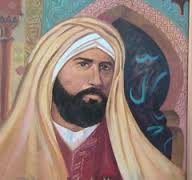
Al-Ghazali was a Persian Sunni Muslim poly- math.... Much of Al-Ghazali's work stemmed around his spiritual crises following his appoint- ment as the head of the Nizzamiyya University in Baghdad - which was the most prestigious aca- demic position in the Muslim world at the time…. He believed that the Islamic spiritual tradition had become moribund and that the [spirituality of] the first generation of Muslims had been forgotten. This belief led him to write his magnum opus... The Revival of the Religious Sciences.
Introductory Comments
Al-Ghazali was a walking oxymoron of sorts: an analytical mystic. The analytical half showed itself early. By the time he left the circle of Nizam al-Mulk - the powerful vizier and patron of scholars - al-Ghazali had already made his name as a scholar, debater, and lecturer. Yet, as he later confessed, the young man was driven more by ambition than by piety. From brilliant student of Islamic law and theology, to legal adviser and teacher, to chief professor at Baghdad's prestigious Nizamiyya madrasa, he climbed the ladder of orthodox Islam with remarkable speed.
And then, having reached the top rung, he falters. He begins to suspect that scholarship could carry him only so far - that even the most rigorous analysis and penetrating argument had their limits. So he walks away. He resigns his professorship, gives away much of his wealth, and takes up the austere life of a Sufi: prayer, self-denial, silent contemplation, and, with luck, the mystical experience and ecstatic joy of union with God.
But then - after years of prayer and privation - the story of al-Ghazali takes an even more surprising turn. Rather than remaining a mystical hermit, he eventually returns to public life with a new mission: to unite the rigor of orthodox scholarship with the spiritual depth of Sufism. In doing so, he profoundly reshapes the future of Islam. (See Random Thoughts.)
Some of Al-Ghazali's Key Positions
To reverse the slow enfeebling of the Islamic spiritual tradition, the faith needs a new grand summation - one that not only reassesses the philosophy and science inherited from earlier generations, but also embraces the Sufi, or mystical, dimension of Islam that those inheritances had neglected.
The reassessment might best begin with causality. We ordinarily assume that cause and effect are lodged in matter - that fire, by its own nature, burns cotton. Not so. Every so-called material cause and effect is in truth the work of God's direct and continual action. The fire does not burn; God burns, in the fire's presence. Hence everything we witness is, in the strictest sense, a miracle.
This reassessment also demands that we loosen our dependence on the ancient Greeks, above all on Aristotle and his Muslim followers. Greek philosophy fixed its gaze on worldly things and neglected what matters most: God. The world is not an end in itself but a school in which we learn to love Him - the first stage of a long journey toward spiritual fulfillment.
Once freed from that dependence, we come to see God at work everywhere, even in the most ordinary and mundane affairs. And this recognition deepens our bond with Him, makes Him a continual presence, and reveals Him as the one true source of human happiness.
Place in the History of Ideas
Al-Ghazali's Place in History of Ideas
Randall Collins: Al-Ghazali's philosophy is an anti-philosophy. He was the great agent of the traditionalist reaction, but he was great precisely because he was a defector from the core network, turning the weapons of philosophy against itself. Like Avicenna, whom he attacked, al-Ghazali had a commanding overview of the cultural capital of the Islamic intellectuals. He scupulously set forth their views before refuting them.... In The incoherence of Philosophy he examines the proofs of the major propositions given by his opponents and finds them wanting.... His major weapon is to attack the notion of necessary causality, using arguments like those later made famous in Europe by Hume.
Veera Balaji: [Al-Ghazali, as a practicing Sufi, believed the whirling dance of the dervishes] symbolizes the idea that everything revolves around God, that He is the center as well as the circumference of every activity. As one spins, the boundaries of the self begin to fade away, and one becomes completely absorbed in pure love. Euphoria is achieved when we lose consciousness of the self and become focused on something we are completely and ultimately related to. In this way, the Sufi dance or music is similar to Csikszentmihalyi’s concept of “Flow,” except on a higher level - the level of absorption not to a mere task, but to that task which is a metaphor for one’s commitment to Ultimate Reality.
Random Thoughts on Al-Ghazali
Al-Ghazali did more than perhaps any other figure to make mysticism a respected, load-bearing part of mainstream Islam. The achievement looks even more striking by comparison: mystical traditions within Judaism and Christianity - Kabbalah, or the contemplative path of figures like Meister Eckhart and St. Teresa of Ávila - have often sat uneasily alongside orthodoxy, sometimes flourishing, sometimes drawing suspicion or censure. Sufism, by contrast, became woven into the fabric of orthodox Islam itself, and al-Ghazali was central to that outcome. Having earned his credentials as a rigorous orthodox scholar before discovering, in the throes of a spiritual crisis, the power of Sufi practice, he was uniquely positioned to argue that law and mysticism were not rivals but partners.
Not merely compatible, he insisted - each needs the other. Strict study of the Qur'an without the Sufi's inward path risks producing dry legalism, obedience without illumination. Sufi mysticism without the Qur'an's discipline risks drifting into vague or even heretical enthusiasm, ungrounded and unaccountable. Only together, al-Ghazali argued, could the two produce genuine spiritual enlightenment. That he could make this case so persuasively - persuasively enough to shift the mainstream - likely owed something to the fact that he hadn't merely theorized the conflict between orthodoxy and mysticism. He had lived it. After all, who better to build a bridge than someone who has nearly fallen into the chasm?
Influences
Al-Ghazali was influenced by: Al-Ashari, Al-Juwayni, Al-Kindi, Al-Makki, Al-Muhasibi, Al-Shafii, Bastami, B., Junayd of B.
Al-Ghazali influenced: Abu Madyan, Al-Abdari, Al-Arabi, Al-Banna, Al-Nawawi, Al-Razi, Al-Suyuti, Aquinas, Averroes, Bedil, Abdul, Descartes, Ibn Tufail, Ibn Tumart, Kant, Maimonides, Martin, R., Nicholas of A., Pascal
Similar and opposing positions
Thinkers with similar positions:
Aristotle (Humans have a natural potential to develop rationally & morally.)
Bacon, Francis (Science is a separate discipline from other forms of thinking.)
Berkeley (All causation is due to God, not to the interactions of matter.)
James (Mystical experiences can reveal truths beyond the realm of reason.)
Leibniz (Though evil exists, God created the best of all possible worlds.)
Ockham (Though God has perfect foreknowledge, free will is still possible.)
Plantinga (Our free will is compatible with an omnipotent & omniscient God.)
Steiner (An objective, intellectually comprehensible spiritual world exists.)
Thinkers with opposing positions:
Al-Farabi (Muslims can learn much from studying Plato and Aristotle.)
Aristotle (The world was not created, but must have existed for all eternity.)
Aristotle (Being perfect, God thinks of only what is perfect & changeless .)
Averroes (God created the natural laws that explain material causation.)
Avicenna (Bodily resurrection does not occur. Only soul lives on after death.)
Bentham (Greatest happiness of greatest number is measure of right & wrong.)
Goodman (There's no sharp divisions between art, science & normal experience)
Holbach (Religion is an impediment to the moral advancement of humanity.)
What others said about Al-Ghazali
Pervez Hoodbhoy: ... the most articulate and effective opponent of physical causality was AI-Ghazali.
Randall Collins: Al-Ghazali's most enduring legacy for Islamic thought was not his acute philosophical skepticism..., but the fact that he made logical methods respectable among conservative theologians as a neutral tool....
W. M. Watt: Islam is now wrestling with Western thought as it once wrestled with Greek philosophy.... Deep study of al-Ghazali may suggest to Muslims steps to be taken if they are to deal successfully with the contemporary situation. Christians, too,... must be prepared to learn from Islam, and are unlikely to find a more sympathetic guide than al-Ghazali.
Wallace Matson: [Al-Ghazali] showed how philosophers contradicted not only the plain teaching of the Koran but also one another and even themselves - so that no trust was to be put in them.
Robert Pasnau: In responding to Ghazali’s attack on philosophy, Averroes first insists that there can be no conflict between philosophy and faith.
Frank Griffel: [Al-Ghazali’s’] "Incoherence of the Philosophers" is a significant landmark in the history of philosophy as it advances the nominalist critique of Aristotelian science developed later in 14th century Europe.
Copleston: A particular target of [Al-Ghazali's] attack was the Avicennian picture of the universe as pervaded by necessary causal relations. He objected to it, however, not in order to leave more room for human freedom but in order to maintain the doctrine of God's universal causality. [This in turn led to] an occasionalist interpretation of empirical causality.
Ibn Warraq: … he led Muslims back to an unquestioning faith in the Koran that was to be accepted literally - thus all the gains made by the rationalist Mu’tazilites were squandered….