Thomas Huxley (1825 - 1895)
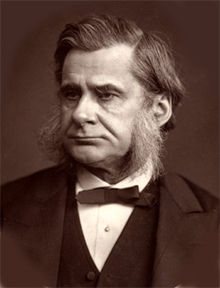
Open Huxley's interactive page (graphs of influences, similar and opposing positions, and quotes)
Background
Thomas Henry Huxley
Born: 4 May 1825 in Ealing, Middlesex, England
Died: 29 June 1895 (aged 70) in Eastbourne,
Sussex, England
Main interests: Zoology, comparative anatomy,
religion, atheism, biology, social issues, politics,
ethics, education
Alma mater: Sydenham College London, Charing
Cross Hospital
Known for: Evolution, science education,
agnosticism, Man's Place in Nature
Influences: Edward Forbes, Charles Darwin,
Charles Lyell, David Hume, Thomas Wharton
Jones
Influenced: Patrick Geddes, Henry Fairfield
Osborn, H. G. Wells, E. Ray Lankester, William
Henry Flower, Aldous Huxley, Julian Huxley,
Sir Michael Foster, Herbert Spencer, Alfred Cort
Haddon, Jack London
From Wikipedia
Huxley was an English biologist and anthropologist who specialized in comparative anatomy. He has become known as "Darwin's Bulldog" for his ad- vocacy of Charles Darwin's theory of evolution.... Huxley was slow to accept some of Darwin's ideas, such as gradualism, and was undecided about natural selection, but despite this, he was whole- hearted in his public support of Darwin. Instru- mental in developing scientific education in Britain, he fought against the more extreme versions of religious tradition.
Introductory Comments
Huxley is perhaps best remembered for a single retort. At an 1860 meeting of the British Association in Oxford, Bishop Samuel Wilberforce, attacking Darwin's new theory, turned to Huxley and asked, with smug panache, whether it was through his grandfather or his grandmother that he claimed descent from an ape. Huxley rose and answered, in substance, that he would rather have an ape for a grandfather than a man who used great gifts to pour ridicule on a serious scientific question. The hall erupted. Unfortunately, nobody took down the exchange at the time. The accounts we have were written later, some of them decades later, and they disagree about the exact words and even about who won. The story, in other words, has evolved.
Nor was the clash, for Huxley, a simple battle between science and religion. What he opposed was churchmen settling scientific questions by authority. Toward religious doctrine he was "agnostic," a word he coined. Surprisingly, he was also cautious about Darwin: he never doubted evolution, but he considered natural selection unproven (see Random Thoughts). He judged the Bible's theology unverifiable but prized its literature and moral teaching, and he wanted schoolchildren to keep reading it, minus the theology. A skeptic might object that this approach demands not the "willing suspension of disbelief" we manage so easily at the theater, but something far harder: a suspension of belief.
Some of Huxley's Key Positions
Agnosticism is not a creed but a method, and an honest one. In matters of the intellect, follow reason as far as it will take you, but claim certainty for no conclusion that has not been demonstrated. To profess knowledge we do not have, about God or anything else, is not piety. It is a moral failing.
Science begins with a candid inventory of what we know and what we do not. That does not rule out hypothesis. Going beyond the facts to guess at their meaning is how inquiry moves forward, provided the guess stays answerable to the facts and is dropped when they turn against it.
Darwin's theory is a case in point. Its force lies in how coherently it accounts for comparative anatomy, embryology, the distribution of species, and the fossil record. That species have evolved by descent is beyond reasonable doubt. Whether natural selection is the whole explanation is another matter. Until breeders can produce varieties as mutually infertile as true species, the mechanism remains a strong hypothesis rather than a proven fact.
The species that interests us most is of course our own. The proof of man's descent from other primates rests on the coherent way in which it explains comparative anatomy, the fossil record, and other facts. This descent does not diminish our dignity, which rests not on where we came from but on what we have made of ourselves.
Place in the History of Ideas
Huxley's Place in History of Ideas
Homer W. Smith: When in 1863 Thomas Huxley coined the phrase 'Man's Place in Nature," it was to name a short collection of his essays [on man and] Darwin's theory of evolution. The Origin of Species had been published only four years before, and the thesis that man was literally a part of nature, rather than an earthy vessel charged with some sublimer stuff, was so novel and so offensive to current metaphysics that it needed the most vigorous defense [of people like Huxley]. Half the civilized world was rudely shocked, the other half skeptically amused. Nearly a century has passed since the Origin shattered the complacency of the Victorian world and initiated what may be called the Darwinian revolution, an upheaval of man's ideas comparable to... Copernicus's....
H. L. Mencken: The row was over Darwinism, but before it ended Darwinism was almost forgotten. What Huxley fought for was some- thing far greater: the right of civilized men to think freely and speak freely, without asking leave of authority, clerical or lay. How new that right is! And yet how firmly held! Today it would be hard to imagine living without it. No man of self-respect, when he has a thought to utter, pauses to wonder what the bishops will have to say about it. The views of bishops are simply ignored. Yet only sixty years ago they were still so powerful that they gave Huxley the battle of his life.
Random Thoughts on Huxley
Huxley earned the nickname "Darwin's Bulldog" for mauling the enemies of evolution, but the bulldog had doubts about its master. He accepted evolution as fact. What he questioned was whether natural selection could explain it. For one thing, he thought Darwin too quick to insist that nature never jumps, and he suspected evolution does indeed at times take leaps. For another, no one had shown that selection could produce a new species. Breeders had coaxed endless varieties out of pigeons and dogs, but never two breeds unable to interbreed, the hallmark of true species. Until someone did, natural selection remained a promising hypothesis, nothing more.
A modern biologist might reply that a century and a half of research has vindicated Darwin many times over. To this, we can imagine Huxley, a great admirer of Hume, answering that overwhelming support is still not proof: no matter how many times the sun has risen, its rising tomorrow is a confidence, not a certainty. Our biologist, a little exasperated, explains that science never deals in absolute certainties, only in converging lines of evidence. And since natural selection predicts and explains so well, it must be true. Huxley, sensing an opening, jumps on "must be true" - saying that such an expression is precisely where science gives way to dogma. The biologist sighs. The bulldog, it seems, is still biting. And the moral: like species, theories must survive their predators, and the fiercest often prove their best friends.
Influences
Huxley was influenced by: Darwin, Forbes, Edward, Hume, Jones, T.W., Lyell
Huxley influenced: Flower, W.H., Foster, Sir M., Geddes, P., Haddon, A.C., Huxley, Aldous, Huxley, Julian, Lankester, E.R., London, Jack, Osborn, H.F., Spencer, Wells, H.G.
Similar and opposing positions
Thinkers with similar positions:
- Darwin (Intricate design in the natural world can be explained thru science.)
- Holbach (The universe is simply matter in motion, bound by laws of nature.)
- Humboldt, A. (Nature is a "living whole” where all organisms are interdependent)
- Lewis, C.I. (Knowledge & evaluation are essentially animal adaptive responses.)
- Montaigne (Education is crucial to the emancipation of all individuals.)
- Pinker (Mental traits are as much a product of evolution as physical traits.)
- Santayana (Mind has no causal power. All motion has merely physical causes.)
- Strauss (Dogmatic atheism is as indefensible as dogmatic orthodoxy.)
Thinkers with opposing positions:
- Comte (Science should serve the end of perfecting a new social order.)
- Davidson (Mental events (reasons & desires) can in fact cause physical events.)
- Dawkins (Genes are more important than organisms in dynamics of evolution)
- Dennett (Evolution can account for the origin of morality in our species.)
- Leibniz (The intricate interactions of nature reflect a pre-established harmony.)
- Plantinga (Evolution is not an entirely natural process. God helps guide it.)
- Rousseau (Progress in the sciences and arts has led to decay and immorality.)
- Sumner (Survival of the fittest requires we abandon liberal social reforms.)
What others said about Huxley
- H. L. Mencken: Huxley, I believe, was the greatest Englishman of the Nineteenth Century - perhaps the greatest Englishman of all time.
- Samantha Hauserman: ... Huxley proposed connections between the development of organisms and their evolutionary histories... and promoted Charles Darwin’s theory of evolution. Many called him Darwin’s Bulldog.
- G. de Purucker: The psychology of the times following the publication of Darwin's works was so strong that most thinking men could not then be brought to admit that there were any alternative explanations of... progressive development in life.... This psychological phenomenon was brought about mainly by the efforts of two men... Huxley and... Haeckel.
- Sherrie Lyons: While I previously wrote that Huxley’s agnosticism provided the framework for his scientific views, it could be equally said that his experience as a scientist provided the framework for his agnosticism.
- Lenin: [For Huxley] agnosticism serves as a fig-leaf for materialism.
- Henry Fairfield Osborn: From [1854] until 1885 Huxley's labors extended over the widest field of biology and philosophy ever covered by any naturalist with the single exception of Aristotle.
- Adrian Desmond: ... rather than shy away from the controversial aspects of evolutionary theory, Huxley played them up.... Unlike some contemporaries... who sought a reconciliation between science and theology, he framed the debate over Creation and evolution in black-and-white, either/or terms and was unforgiving of colleagues who straddled the fence.
- Sherrie Lyons: Huxley was maintaining not just that the theory of evolution provided a better description of the organic world than teachings of the church, but rather that science and theology were fundamentally incompatible.
Schools: Agnosticism, Epiphenomenalism, Naturalism, Physicalism
Main interests: Biology, Education, Environment/Conservation, Ethics, Evolution, Free/Unfree Will, Politics, Religion, Science, Zoology
Huxley's answers to philosophical questions
Education
By teaching science, particularly biological science, we make possible the future advancement of both science and society.
Epistemology
"... in matters of the intellect, follow your reason as far as it will take you, without regard to any other consideration."
Metaphysics
We're not at the mercy of our natural instincts. Our choices are at least partly free and thus we remain responsible for them.
Mind
Through a slow & gradual process, mind & its various abilities evolved along with the animal bodies possessing them.
Behavior springs from various processes in the brain. Mind is just an epiphenomenon or byproduct of these processes.
Nature
"Of moral purpose I see not a trace in nature. That is an article of exclusively human manufacture."
Our basic moral nature doesn't spring from our institutions, but is as much a product of evolution as are our physical aspects.
Political Philosophy
Though its truth can be questioned, the Bible's moral teachings and beautiful use of language justify it being taught in schools.
"The doctrine that all men are, in any sense, or have been, at any time, free and equal, is an utterly baseless fiction."
Religion and Theology
It is wrong to proclaim the "truth of any proposition unless [one] can produce evidence which... justifies that certainty."
"Agnosticism... is not a creed, but a [sound] method, the essence of which lies in the rigourous application of [reason]."
Science
"The ultimate court of appeal is observation and experiment… not authority."
All scientific theories are to some degree tentative, in that to survive they must either explain or adapt to new evidence.
Science develops through a type of natural selection in that scientific theories must survive attacks from competing theories.
"The known is finite, the unknown infinite; intellectually we stand on an islet in the midst of an… inexplicability."