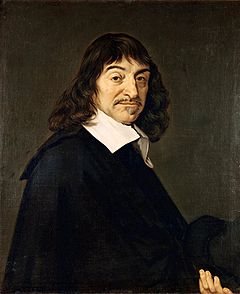
Descartes was a French philosopher, scientist, and mathematician, widely considered a seminal figure in the emergence of modern philosophy and science. Mathematics was paramount to his method of inquiry, and he connected the previous- ly separate fields of geometry and algebra into analytic geometry…. Descartes has often been called the father of modern philosophy, and is largely seen as responsible for the increased attention given to epistemology in the 17th century.
Introductory Comments
Poor Richard's Almanack was a century off when Descartes died, so he never received Franklin's assurance that early rising makes a man healthy, wealthy, and wise. He would not have been persuaded. Descartes remade mathematics, physics, and philosophy in a single career, and did much of the work horizontally. A sickly boy at the Jesuit college of La Flèche, he was excused from morning prayers and allowed to lie in until eleven. He never gave up the privilege. Mornings in bed were where he thought.
In 1649 Queen Christina of Sweden summoned him to Stockholm to instruct her in philosophy. She was nineteen and up before dawn. According to his early biographer, she set the lessons for five in the morning. Even in France that would have taxed him; this was a Baltic winter, the palace a long cold walk away. He was dead within four months.
If there's a sick joke here, it comes later. Descartes never claimed the mind ruled the body. What he believed was that reason, to some extent, could manage the machine, and that reformed medicine might stretch a life out considerably. He expected a long one. The machine failed anyway, and his corpse made the point twice over: exhumed for reburial in France, it traveled without its skull, which surfaced in Sweden generations later and now sits in a Paris museum. That's the joke: His philosophy divided mind from body; history, as a sick joke, divided the body from its head.
Some of Descartes' Key Positions
Scholastic philosophy rests on unexamined assumptions, so it is no surprise that its conclusions are unconvincing where they are intelligible at all. Philosophy must therefore begin again - on a firm foundation, and with a disciplined method.
That means doubting whatever can be doubted: the testimony of the senses, the teachings of the schools, even the existence of the material world. Push the doubt far enough and one thing survives it. A mind that doubts cannot doubt that it doubts. I think, therefore I am.
Peculiar bedrock, but bedrock all the same - and it supplies a standard as well as a starting point. Whatever is perceived as clearly and as distinctly as one's own existence may be admitted as true.
Knowing now that I exist as a thinking thing, I can examine what my mind contains - among other items, the idea of a perfect and infinite being. A finite and imperfect mind could hardly have manufactured such an idea on its own; something perfect must have put it there. Besides, a perfect being that did not exist would fall short of perfection. God, then, exists.
And a God who deceived me about the existence of bodies would be not perfect but demonic. So the physical world is real. But if mind is unextended and thinking, and body extended and unthinking, how can the two so much as touch?
Place in the History of Ideas
Descartes' Place in History of Ideas
Anthony Kenny: There is no doubt of the enor -mous influence Descartes has exercised from his own day to ours. But his relation to modern philosophy is not that of father to son, nor of architect to palace, nor of planner to city. Rather, in the history of philosophy his position is like that of the waist of an hourglass. As the sand in the upper chamber of such a glass reaches its lower chamber only through the slender passage between the two, so too ideas that had their origin in the Middle Ages have reached the modern world through a narrow filter: the compressing genius of Descartes.
Matthew Stewart: [Descartes tried] to conserve the old truths in the face of new threats. His dualism was in essence an armistice... between the established religion and the emerging science of his time.... Isolating the mind from the physical world... ensured that many of the central doctrines of orthodoxy - immortality of the soul, the freedom of will, and, in general, the "special" status of humankind - were rendered immune to any possible contraven- tion by the scientific investigation of the physical world.... For men such as Descartes, Malebranche, and Leibniz, solving the mind-body problem was vital to preserving the theological and political order inherited from the Middle Ages.... For Spinoza, it was a means of destroying that same order and discovering a new foundation for human worth.
Random Thoughts on Descartes
Can anyone think entirely anew? Descartes meant to. His first rule was to admit nothing into his judgments unless it presented itself "so clearly and so distinctly that I had no occasion to doubt it." Doubt whatever can be doubted, keep what survives, then rebuild using only material of that crystalline kind - mind, matter, animal, mineral, spirit, science, man, and God. No philosopher has announced a larger demolition.
But the tools came out of an inherited shed. Descartes learned his philosophy from Jesuit textbooks at La Flèche, and the machinery of his proofs - for instance, that a cause must hold at least as much reality as its effect - is Scholasticism, lightly repainted. Even the doubt was in fashion: Montaigne had already made a motto of asking what he knew. Augustine reached something close to the cogito twelve centuries earlier.
That is how intellectual history usually works. New movements rarely erase what came before; they rearrange it, reject parts of it, and carry the rest forward under new names. We divide history into "medieval," "Renaissance," and "modern" because such labels help us make sense of a bewildering continuity. Such labels are shorthand for broad shifts in style, method, or emphasis rather than metaphysical ruptures. To call Descartes the first modern philosopher is illuminating - provided we remember that he was also one of the last great heirs of the medieval tradition.
Albertus Mag. (Reason cannot replace faith, but can work together with faith.)
Anselm (God's existence is inferable from the mere idea of a Perfect Being.)
Augustine (Even If I am mistaken in all other beliefs, I still know I exist.)
Chalmers (There's an explanatory gap between physical & phenomenal realms)
Chomsky (Certain ideas must be innate, since no empirical origin is possible.)
Leibniz (Humans are born with certain innate ideas already in their mind.)
Thinkers with opposing positions:
Althusser (Self-consciousness springs from social ideology and practices.)
Bosanquet (The mind is the completion or perfection of the body.)
Coleridge (No radical metaphysical split exists between realms of mind & matter)
Gassendi (Understanding relies on our senses, not on our deductive reasoning.)
Kant (The existence of God cannot be deduced from the definition of God.)
Locke (Knowledge is empirical and springs from observing the actual world.)
Merleau-Ponty (The body is our site of knowing the world. It's how we know.)
Montaigne (Animals have inner lives as rich and as animated as our own.)
Newton (Action at a distance is possible: Not all laws are purely mechanical.)
Strawson (Mind and body are united in the primitive concept of personhood.)
What others said about Descartes
Schopenhauer: Descartes is rightly regarded as the father of modern philosophy... by teaching men to use their brains [instead of relying on the Bible].
Huxley: Descartes was an eminent mathematician, and it would seem that the bent of his mind led him to overestimate the value of deductive reasoning from general principles, as much as Bacon had underestimated it.
Oakeshott: [Descartes'] formulation of the technique of inquiry [was] more precise and in consequence more critical [than Bacon's]. His mind is oriented towards the project of an infallible and universal method..., but since the method he propounds is modelled on that of geometry, its limitation when applied, not to possibilities but to things, is easily apparent.
Foucault: In the uniform clarity of his closed senses, Descartes has broken with all possible fascination, and if he sees, he knows he really sees what he is seeing.
Searle: Descartes may have made a lot of mistakes, but he was right about this: you cannot doubt the existence of your own consciousness.
Cassirer: Descartes discovered and defined the new "Archimedian" point from which the conceptual world of scholastic philosophy could be raised out of its hinges. And thus we date the beginning of modern philosophy from [him].
Leibniz: [Descartes] has given us only some beautiful beginnings, without getting to the bottom of things. It seems to me that he is still far from the true analysis and the general art of discovery. For I am convinced that his mechanics is full of errors, that his physics goes too fast, that his geometry is too narrow, and that his metaphysics is all these things.
Pascal: I cannot forgive Descartes; in all his philosophy, he did his best to dispense with God. But he could not avoid prodding God to set the world in motion with a snap of his lordly fingers; after that, he had no more use for God.