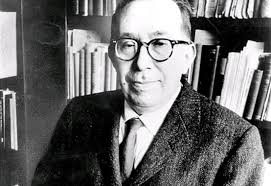
Influences: Socrates, Plato, Aristotle, Cicero, Al
Farabi, Maimonides, Machiavelli, Hobbes,
Spinoza, Mendelssohn, Lessing, Rousseau, Kant,
Rosenzweig, Hegel, Nietzsche, Heidegger,
Cassirer, Schmitt, Voegelin, Kojève, Husserl
Influenced: Berkowitz, Berns, Benardete, Bloom,
Cropsey, Galston, Manent, Jaffa, Kojève, Lilla,
Mansfield, Fortin, Brague, Pangle, Pippin,
Rorty, Rosen, Schmitt, Shulsky, Smith, Voegelin
From Wikipedia
Trained in the neo-Kantian tradition with Ernst Cassirer and immersed in the work of the phe- nomenologists Edmund Husserl and Martin Heidegger, Strauss established his fame with path-breaking books on Spinoza and Hobbes.... In the late 1930s his research focused on the rediscovery of esoteric writing, thereby a new illumination of Plato and Aristotle, retracing their interpretation through medieval Islamic and Jewish philosophy, and encouraging the application of those ideas to contemporary political theory.
Introductory Comments
Most readers treat a great book the way diners treat a menu: scan for the main items, then order. Strauss read like a safecracker, ear to the page, listening for the faint click of a hidden meaning. A lifetime with Plato, Al-Farabi, Maimonides, and Machiavelli yielded what he regarded as a forgotten truth. Many philosophers before the modern age did not write plainly. They offered a surface teaching respectful of the gods and the laws, and beneath it a deeper one reserved for readers alert to a strange contradiction or a telling silence. Fear of persecution was one motive and civic prudence another. But this "art of writing" was also a way of teaching, since it forced gifted readers to think for themselves.
What Strauss heard made him a stern critic of modernity. From Machiavelli onward, he argued, Western thought lowered its sights from how to live well to how to live safely and comfortably. It ended by doubting that reason could say anything about the good at all. A science that separates facts from values can tell us how to get what we want, but not whether we should want it. Relativism followed, and behind relativism lurked nihilism. Yet this critic of modernity defended modern democracy, and he denied that the ancients held ready-made solutions. He sought to recover their questions, not their answers. Whether the hidden teachings he found were really there, or partly supplied by the safecracker himself, remains very much an open question.
Some of Strauss's Key Positions
Questions about human nature, knowledge, and the good are inseparable from politics, because every community rests on shared opinions about what is just and sacred. Philosophy questions those opinions, so it stands in permanent tension with the city. Few people are suited to philosophy. For most, seeing society's founding beliefs dissolved would be disorienting and potentially destabilizing.
Philosophers have therefore long written with prudence. Many premodern authors wrote on two levels. An exoteric teaching, meant for the public, supported conventional piety. An esoteric teaching, meant for careful readers, was conveyed between the lines.
But philosophers should not rule. What philosophy needs from politics is freedom, and liberal democracy, for all its flaws, secures that freedom better than any viable alternative.
Modern political thought broke with the classics by lowering its sights from virtue to security and comfort. Its successive "waves," led by Machiavelli, Hobbes, and Rousseau, culminated in two doctrines: Historicism holds that all thought is bound to its time. Social science separates facts from values. Together they deny that reason can know what is right by nature, which leaves us with a troubling relativism. The remedy is not to restore antiquity but to recover the question of natural right through careful study of the great books.
Place in the History of Ideas
Strauss's Place in History of Ideas
Perry Anderson: [Strauss thought that the] capacity to discover truth is restricted to a few, and to endure it exhibited by scarcely more. The best regime will therefore reflect differ- ences in human excellence, and be led by an appropriate élite. But although the highest virtue is philosophical contemplation of the truth, this does not mean - contrary to a super- ficial reading of the Republic - that the just city will be ruled by philosophers. For philosophy gazes without faltering, not only at the neces- sary conditions of political order, discomfiting as these may be to demotic prejudice, but at the far more terrible realities of cosmic disorder: the absence of any divine authority, the delusion of any common morality, the transience of the earth and its species - every insight that religion must deny and society cannot survive.... Leisured gentlemen instructed in rule - but not raised to truth - by philoso- phers should uphold a rational order of political stability against levelling temptations.
Jeet Heer: But just how "sinister" was Leo Strauss himself? The answer depends on how a reader approaches his books. If you read Strauss with a well-disposed spirit, he can be interpreted as a genuine friend of American liberal democracy.... But if you read Strauss with a skeptical mind, the way he himself read the great philosophers, a more disturbing picture takes shape.
Random Thoughts on Strauss
Philosophy has an odd relationship with its own past. Physicists rarely read Newton, and nobody thinks less of them for it. A philosopher who has never read Plato, though, is missing something, and Strauss thought he knew what: the big questions themselves. Cut off from its history, philosophy risks becoming a guild of clever people solving puzzles they have set for one another. Meanwhile, justice, virtue, and the good life gather dust in the attic. Treat the great thinkers as museum pieces or ideological suspects, and the result is scholars fluent in footnotes and deaf to the questions. Strauss offered a corrective worth heeding: read slowly, on the assumption that the author may be wiser than the reader.
Still, the safecracker has a way of finding exactly what he came looking for, and his reading was hardly free of suspicion. Strauss himself insisted the ancients offered questions rather than recipes, but some disciples treated him as a guru rather than a gadfly, and the Great Books as scripture rather than conversation. Reverence for the past can curdle into contempt for the present. Modern science, mass democracy, and technologies the ancients never imagined are not mere symptoms of decline. They raise questions Plato never had to face. Perhaps the right posture is the one Strauss urged on readers: patience, humility, and the suspicion that the other party knows something we don’t. The trick is to extend that courtesy to the present as well as the past.
Horkheimer (The study of society calls for cultural, not quantifiable, analysis.)
MacIntyre (A just and virtuous society needs a reliable set of moral beliefs.)
Petrarch (Despite its pagan beliefs, we can learn much from classical antiquity.)
Plato ("Noble lies" are needed to encourage our leaders to act justly.)
Rawls (In politics the ideal of public reason requires shared public values.)
Thinkers with opposing positions:
Bakunin (To be free, every form of hierarchical authority must be rejected.)
Bosanquet (The state has more reality than the individual persons within it.)
Comte (The study of society should be scientific, quantifiable, and objective.)
Hitchens (Religion is violent, irrational, intolerant & allied to racism & sexism.)
Machiavelli (The sovereign should base policies on pragmatism, not morality.)
Popper (The search for truth should be completely fact-based and objective.)
Schmitt (In "exceptional" situations the ruler must be above the law.)
What others said about Strauss
Nathan Tarcov: Strauss can remind us of the permanent problems, but we have only ourselves to blame for our faulty solutions....
Alan Wolfe: ... Leo Strauss and the right-wing German philosopher Carl Schmitt... found it easier to defend secrecy, elitism, and dictatorship than to endorse anything resembling egalitarian principles.
Dante Germino: He admits that to seek today simply to imitate classical political philosophy would be neither feasible nor desirable, since new situations call for fresh approaches to things political; but he sees a return to the premodern classics as a necessary precondition of the elaboration of a political philosophy relevant to contemporary problems.
Shadia Drury: [Strauss teaches that] perpetual deception of the citizens by those in power is critical because they need to be led, and they need strong rulers to tell them what's good for them.
Jenny Strauss Clay: He was a conservative insofar as he did not think change is necessarily change for the better.
Edward Feser: Strauss was [neither] an orthodox believer [nor] a convinced atheist. Since whether... to accept a... divine revelation is itself one of the "permanent" questions, orthodoxy [remains] as defensible as unbelief.
Schmitt: [Strauss believed that] because man is by nature evil, he, therefore, needs dominion. But dominion can be established, that is, men can be unified only in a unity against - against other men. Every association of men is necessarily a separation from other men.... [T]he political [then] is not the constitutive principle of the state..., but a condition of the state.
Nicholas Xenos: Strauss was somebody who wanted to go back to a previous, pre-liberal, pre-bourgeois era of blood and guts, of imperial domination, of authoritarian rule, of pure fascism.
Main interests: Classics, Epistemology, Government, History of Ideas, History of Philosophy, Metaphysics, Political Philosophy, Political Theory, Power, Punishment, Religion, War, Welfare State