Electric WebOpen the interactive pageAll thinkersAbout

William James (1842 - 1910)

Cambridge, United States · 1800-1899 · Wikipedia

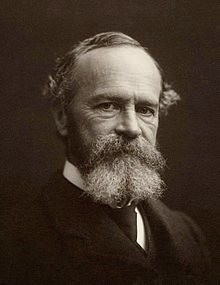
William James

Open James's interactive page (graphs of influences, similar and opposing positions, and quotes)

Background

William James
  Born:  January 11, 1842 in New York City, NY
  Died:  August 26, 1910 (aged 68), Tamworth NH
  Alma mater:  Harvard University
  Schools:  Pragmatism, Functional psychology,
     Radical empiricism
  Main interests:  Pragmatism, psychology,
     consciousness, philosophy of religion,
     epistemology, meaning
  Notable ideas:  The Will to Believe, pragmatic
     theory of truth, radical empiricism, James–
     Lange theory of emotion, psychologist's
     fallacy, brain usage theory
  Influences:  Emerson, Peirce, Hume, Darwin,
     African Spir, Swedenborg, Schiller, Hartley,
     Renouvier, Helmholtz, Janet, Mach, Agassiz
  Influenced:  Dewey, Husserl, Schiller, Bergson,
     Santayana, Putnam, Rorty, Wittgenstein,   
     M. Cohen, Durkheim, Du Bois, Russell, Carter
 
From Wikipedia
 
James was an American philosopher and psychol- ogist. The first educator to offer a psychology course in the United States, he is considered to be one of the leading thinkers of the late 19th centu- ry, one of the most influential philosophers and is often dubbed the "father of American psychology." … He wrote widely on many topics, including epistemology, education, metaphysics, psycholo- gy, religion, and mysticism. Among his most influential books are The Principles of Psycholo- gy... and The Varieties of Religious Experience....
Introductory Comments
 
In his twenties, James came close to drowning in his own questions. His medical training had taught him to see human beings as machines, physiology all the way down, and he could find no room in that picture for freedom, purpose, or moral responsibility. If every thought was just the twitch of a nerve, why strive? Why choose? His diaries and letters from these years record a depression deep enough that he thought about suicide.
 
The way out began, fittingly, with an act of will. In 1870, after reading the French philosopher Charles Renouvier, James wrote in his diary that his "first act of free will shall be to believe in free will." It was not a proof. It was a decision to stop waiting for one, and much of his later philosophy grows from that seed.
 
Work finished what resolve began. In 1872 Harvard offered him a post teaching physiology, and the lecture hall suited him. Questions that had tormented him in private became, before an audience, sparks to light in others. In encouraging his students, he seems to have encouraged no one more than himself. The gloom never vanished entirely, but the anguished young man became the warm, magnetic teacher his students remembered. It may not have hurt that he enjoyed being liked. "[W]e have an innate propensity to get ourselves noticed, and noticed favorably, by our kind." He was describing human nature in general. One suspects he had consulted a reliable source.
Some of James's Key Positions
 
Nothing can be known except through experience, but experience is richer than earlier empiricists allowed. Relations such as "and," "but," and the pull of one moment into the next are experienced as directly as colors and sounds. Even the split between knowing mind and known object is a distinction drawn within experience.
 
Consciousness is never a static thing. It is a "stream." Even the present moment flows. The "specious present" is not a knife-edge but a short span that still holds the just-past. It is a function that experience performs.
 
As to truth, Peirce's is right: an idea's meaning lies in its practical consequences, and an idea becomes true as it leads us successfully through experience, "in the long run and on the whole." A belief about gears that gets the bicycle running qualifies. Likeweise, a belief about God or the afterlife that helps us lead more fulfilling lives. However, a belief that "works" only because we ignore the evidence against it does not qualify.
 
Nor does this mean that truth in religious and moral matters is mere comfort. Some questions, religious and moral ones among them, cannot be settled by evidence yet demand a decision. On those questions, we have the right to let our "passional nature" decide. This is a defense of the right to believe, not a claim that comfort makes a belief true.

Place in the History of Ideas

James's Place in History of Ideas
 
Bruce Kuklick: James went on to apply the pragmatic method to the epistemological problem of truth. He would seek the meaning of "true" by examining how the idea functioned in our lives. A belief was true, he said, if it worked for all of us, and guided us expeditious- ly through our semihospitable world. James was anxious to uncover what true beliefs amounted to in human life, what their "cash value" was, and what consequences they led to. A belief was not a mental entity which somehow mysteriously corresponded to an external reality if the belief were true. Beliefs were ways of acting with reference to a precarious environment, and to say they were true was to say they were efficacious in this environment. In this sense the pragmatic theory of truth applied Darwinian ideas in philosophy; it made survival the test of intellectual as well as biological fitness.
 
A. J. Ayer: In sum, he was tough-minded in his approach to questions of natural facts but tender-minded when it came to morals and theology. It was not so much a question of his having a divided temperament as of there being a conflict between his sentiments and his reason. He wated to retain his tender-minded beliefs, but not at the price of relaxing his intellectual standards. What chiefly attracted him to pragmatism was that it seemed to him the only philosophy that made this possible.
Random Thoughts on James
 
Philosophy has its share of quarreling families, but few as affectionate as the one that produced pragmatism. Peirce hatched the idea in the 1870s. His friend James made it famous two decades later, crediting Peirce at every turn, and then promptly carried it somewhere Peirce had no wish to go. For Peirce, pragmatism was a tool for clarifying ideas. Want to know what it means to call a diamond "hard"? Ask what would happen if you tried to scratch it. A concept means nothing beyond its conceivable effects. Truth was a separate matter. Peirce defined it as the opinion that inquirers would eventually agree on if investigation ran long enough. Until then, every belief stays provisional.
 
James took the method out of the laboratory and into the sickroom and the church. Ideas, he said, must show their "cash value" in lived experience. In "The Will to Believe," he went further. When a momentous question such as God's existence cannot be settled by evidence, yet still demands an answer, we may rightly let our hopes break the tie. He dedicated the book to Peirce, a gesture Peirce may have had mixed feelings. In 1905, watching his word pass through the hands of popularizers, Peirce renamed his own doctrine "pragmaticism" - a name "ugly enough to be safe from kidnappers."
 
So which truth do you prefer? James's version is an ally at your side through life's trials. Peirce's is a stern judge, waiting at the end of an inquiry that may never end.

Influences

James was influenced by: Agassiz, Darwin, Emerson, Hartley, Helmholtz, Hume, Janet, Mach, Peirce, Renouvier, Schiller, Spir, Swedenborg

James influenced: Bergson, Dennett, Dewey, Du Bois, Durkheim, Husserl, Mead, Putnam, Rorty, Royce, Russell, Santayana, Wittgenstein

Similar and opposing positions

Thinkers with similar positions:

Thinkers with opposing positions:

What others said about James

Schools: Common Sense Realism, Empiricism, Fideism, Holism, Mysticism, Perennial Philosophy, Personalism, Pluralism, Pragmatism, Process Philosophy, Social Liberalism, Voluntarism

Main interests: Causality, Community, Consciousness, Death, Desire, Epistemology, Faith, Free/Unfree Will, Friendship, Habits, Health, Human Will, Immortality, Memory, Mind, Perception, Personal Identity, Psychology, Religion, Semiotics, Spirituality, Universals, Will
James's answers to philosophical questions

Art and Aesthetics

What is beauty? Is it completely subjective? If not, how can it be objectively assessed?
Beauty is objective insofar as what pleases us in a work of art also expresses a natural, inner harmony we have with it.
How does art go beyond representation? Need the arts be representational at all?
The artist rejects all aspects of his subject "which do not harmonize with each other and with the main purpose of his work."

Education

What is the personal value of an education? How does it aid or enrich the individual?
Ideally, an education should help develop a well-rounded, productive and happy individual.

Epistemology

From what source or sources does knowledge spring? Sensation? Reason? Intuition? Or what?
Nothing can be known without reference to experience. Both percept and concept are states of consciousness.
If experience is inherently subjective or phenomenological, how can we know anything?
Strictly speaking, we can't distinguish between experience and reality, since experience is equivalent to reality.
Can anything be known without reference to experience? What about "pure" deduction?
Theoretically speaking, we only know what is sensed or deduced. But on living, practical matters, we know much more.
To what extent can we rely on logic or reason? To what extent should we rely on logic or reason?
Trust results more than theories: "Pragmatism unstiffens all our theories, limbers them up and sets each one at work."
What is truth? Is it objective or relative or a bit of both? By what standard should it be judged?
The truth regarding any belief is determined by its consequences: Utility and truth are almost synonymous concepts.
Is truth something discovered or something constructed? Or does this depend on the topic?
True beliefs are discovered by studying their consequences: Beliefs that prove most useful or practical are true.
Do different types of truths require different ways of understanding?
"To no one type of mind is it given to discern the totality of truth. Something escapes the best of us...."
What distinguishes belief from knowledge? How are beliefs acquired and how are they used?
Our most powerful beliefs go beyond cold reason and science by appealing also to our aesthetic and emotional needs.
What connection, if any, exists between truth and practical consequences?
Truth is the "cash value" of an idea: True ideas are ones that lead to useful or beneficial consequences.
What is intuition and can it be a source of truth? When, if ever, should it be trusted?
Intuitions in and of themselves are at most hypotheses. We still must "go to our senses" to determine what is real.

Ethics

Is there any truth to the claim that all our decisions ultimately spring from self-interest?
Philosophers who say pleasure is the goal of all conduct confuse the pleasure of achievement with the achievement itself.
Is the meaning we find in life something discovered or created? Or is there no meaning here?
"Be not afraid of life. Believe that life is worth living, and your belief will help create the fact."

History

Regarding leadership, do great men shape the times or do the times shape great men?
The true genius or great man isn't the product of society: He's a spontaneous force whose influence is entirely original.

Language

What is the role of metaphor in language and in thought? How do metaphors have meaning?
Metaphors reveal analogies without explication. At their best, as in Shakespeare, they can both astonish and delight us.
To what extent can language capture or equal or at least point to reality?
To possess words seems a way "to possess the universe." Words like 'matter,' 'reason,' 'energy' are "so many solving names."
Are there matters that transcend or go beyond the limits of what language can express?
"It would be an awful universe if everything could be converted into words, words, words."

Metaphysics

What is being? What does it mean for something "to be"? Is being the same as existing?
In a strict and ultimate sense of the word "existence," anything that can be conceived exists as an object in some sense.
What is time? Is it something absolute that can exist on its own or is it inherently relative?
Time is objective & subjective: "The time- and space-relations between things do stamp copies within" & remain in memory.
Does time flow? If so, in what sense? If not, why do we think it does?
By bringing a bit of the past into the perceived present, the "specious present" helps create the sensed flow of seamless time.
What is space? Can it exist independent of matter? If not, how is it related to matter?
Our idea of spatial relations is due to the "extensive quality given immediately in certain particular sensations."
What is causation and does the "law" of causality imply universal determinism?
Though the meaning of causality isn't clear, the principle represents a need for deep connections between phenomena.
Does free will really exist? If so, how is it consistent with universal causality?
We don't live in a "block universe" where causal necessity pervades everything and no room is left open for free will.
Is the supposed dualism of mind and matter real or can the two "realms" be reduced to one?
"The chasm which yawns between [mind & matter] is less easily bridged over by the mind than any interval we know."
Are we living in a pluralistic world or is there an essential oneness to all being?
We live in a pluralistic world where multiple realms of being and ways knowing are possible.
What makes something an individual thing or being? Or is there no clear criteria here?
"... the sense of sameness from the point of view of the mind's structure" is crucial. Else, all would be "unbroken flux."
Is metaphysics actually possible or are the questions here beyond human understanding?
Scientific metaphysics will not be possible until we comprehend how so much of everyday world view is metaphysical.

Mind

What is mind? Is it a substance or a process? Does it have parts? Does it serve a function?
The mind is a stream of consciousness from which we create our world and isolate "things" according to our interests.
Is the mind the same as the brain? If not, what is their causal connection?
The mind is "influenced in some mysterious way by brain states," but responds with "conscious affections of its own."
What are mental representations and what exactly do they represent?
"Sensations, aware of mere qualities, involve the mystery [of consciousness] as much as [complex] thoughts... involve it."
Who or what is that being we call self? And is our sense of self-identity justified?
Our sense of personal identity springs the continuity of consciousness, but this continuity is itself just a feeling.
What is the intellect? How does it differ from other aspects of mind? What are its functions?
Like all parts of the mind, the intellect has practical ends: to achieve a particular result or to gratify a special curiosity.
Is mind a mere by-product or epiphenomenon? Or does it have causal powers of its own?
Though we can empirically correlate mental states with workings of the brain, the mind clearly has powers of its own.
Is understanding the nature and workings of consciousness beyond our human ability?
Our consciousness is but one special form. All about it must lie other entirely different potential forms of consciousness.

Nature

Is there a spiritual or vitalistic element in nature, or is nature a purely physical process?
The world can't be explained solely in mechanical/mathematical terms: We must make room for free will & spirituality.
Are the numerous species of plants and animals immutable or do they evolve over time?
New forms of life represent only a redistribution of original and unchanging materials - not new natures or capacities.
What place do humans have in nature? What, if anything, sets them above other animals?
Many animals can learn from experience. We differ from them mainly in our ability to associate ideas by similarity.

Philosophy

What is philosophy anyway? And what function does it serve?
"Philosophy is at once the most sublime and the most trivial of human pursuits."
How should the discipline of philosophy be best approached and/or pursued?
"There is only one thing a philosopher can be relied upon to do, and that is to contradict other philosophers."
What is the difference between philosophy and science? What, if any, are their connections?
Philosophers seek to know why things happen the way they do, whereas scientists focus on how things happen.
What is the role of logic in the pursuit of philosophy? What are its limitations here?
The burden called clarity: "Philosophy is an unusually stubborn attempt to think clearly."
Is philosophy a logical discipline, a humanistic pursuit, an intuitive leap, or a hybrid of sorts?
"The history of philosophy is to a great extent that of a certain clash of human temperaments."

Psychology

What are the major functions or forces at work in human psychology?
"The deepest principle in human nature is the craving to be appreciated."
To what extent are we conscious of the various forces at work in human psychology?
We're confused about emotions: Emotions don't cause physical reactions. Rather, physical reactions cause emotions.
To what extent does reason determine our actions? To what extent do impulse and desire rule?
Though we pride ourselves as being rational animals, man is in fact that creature richest in instinctive impulses.
What is the will? What role does will play in human psychology? What are its constraints?
By focusing or directing the mind towards its ends, the will also helps organize the mind and prepare it for action.
Which is more important in understanding human behavior: nature or nurture?
Humans are full of instincts, but these instincts often contradict one another. Therefore, we must still choose between them.
How can we best understand the nature of our various emotions and their many interactions?
Psychology can go no further than correlating "various sorts of thought or feeling with definite conditions of the brain."
How should one deal with normal distress, depression and other forms of emotional turmoil?
Freedom of thought: "The greatest weapon against stress is our ability to choose one thought over another."
What is the best approach to leading a productive and well adjusted life?
"Be not afraid of life. Believe that life is worth living, and your belief will help create the fact."
What role does habit play in our lives? How can it prove useful? How might it be detrimental?
"There is no more miserable human being than one in whom nothing is habitual but indecision."
Is happiness actually possible? If so, how is it achieved? If not, what is our alternative?
"Action may not always bring happiness, but there is no happiness without action."

Religion and Theology

What explains the origin of religion: revelation, reason, fear, awe, story-telling, fellowship?
"The pivot round which the religious life... revolves is the interest of the individual in his private personal destiny."
What is spirituality? Does it require belief in God? Does it entail a certain approach to life?
"In mystic states we both become one with the Absolute and we become aware of our oneness."
What role does faith play in religion? Is it more important than reason?
"[In the] religious sphere, articulate reasons are cogent for us only when our inarticualte feelings [are in agreement.]"
Did God create the universe and/or design nature? If so, is God still at work in the world?
"The God whom science recognizes [is One] of universal laws exclusively, a God who does a wholesale, not a retail business."
Is agnosticism or atheism a viable position, especially considering the high stakes?
"Better risk loss of truth than chance of error, - that is your faith-vetoer's exact position." Why bet against religion?

Science

Does science offer the best way to know about the world? What are its strengths and limits?
Science must be "reminded that her purposes... may be enveloped in a winder order, in which she has no claims at all."
What exactly is scientific truth? How reliable are such truths? How objective are they?
Scientific findings are always tentative - subject to change with the discovery of new data or more complete theories.
Is science compatible with religion? If they conflict, which one should we believe?
"... the days are over when it could be said that for Science herself the heavens declare the glory of God...."
Do living things evolve over time? If so, is this due to a process of natural selection?
We see evidence of evolution in the study of men & animals, especially in matters of instinct, emotion & intelligence.

Society

If human beings are social animals, what needs are met by society - and what are not?
As gregarious animals, we not only like "to be in sight of our fellows, [but also] get ourselves… noticed favorably by our kind."