Paul Tillich (1886 - 1965)
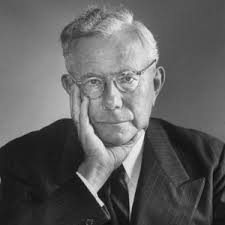
Open Tillich's interactive page (graphs of influences, similar and opposing positions, and quotes)
Background
Paul Tillich
Born: August 20, 1886 in Starzeddel, Germany
Died: October 22, 1965 (aged 79) in Chicago,
Illinois, United States
Nationality: German American
Occupation: Theologian and philosopher
School: Christian existentialism
Main interests: Ontology, "Ground of Being",
Religion, Theology
Notable ideas: The Protestant Principle, God
above God, New Being, Kairos
Influences: Søren Kierkegaard, Martin
Heidegger, Martin Buber, Friedrich
Schleiermacher, Georg Hegel, Rudolf Otto,
Friedrich Schelling, Jakob Böhme, Johann
Fichte, Kurt Goldstein, Martin Kahler, Edmund
Husserl, Sigmund Freud, Karl Marx
Influenced: Reinhold Niebuhr, Thomas Merton,
Martin Luther King
From Wikipedia
Paul Tillich was a German-American Christian existentialist philosopher and Lutheran Protestant theologian who is widely regarded as one of the most influential theologians of the twentieth century…. Among the general public, Tillich is best known for his works The Courage to Be and Dynamics of Faith, which introduced issues of theology and culture to a general readership. In academic theology, he is best known for his major three-volume work Systematic Theology, in which he developed his "method of correlation"....
Introductory Comments
Tillich asks his readers to perform what may be the most dizzying somersault in modern theology. He wants them to stop thinking of God as a being, not even the Supreme Being, and to think instead of the power by which anything exists at all. God is not an entity we might bump into, however metaphorically. God is the "ground of being," the ontological voltage humming beneath every entity, from which tables, electrons, thoughts, and even our capacity to ask "Does God exist?" draw their being. Hence Tillich's verdict on proofs of God's existence: "It is as atheistic to affirm the existence of God as it is to deny it."
Reactions have run from admiration to bafflement to thinly veiled disgust. Admirers saw Tillich rescuing theology from naïve supernaturalism, and making faith credible to the modern mind. For a time this made him something rare: a theologian read by the general public. Critics complained that a ground of being has no hands to act and no ears to hear, and so offers nothing one might pray to. Others have accused Tillich of dressing up German Idealism as Christian theology, leaving behind a conception of God that seems suspiciously closer to Eastern mysticism than to the personal God of the Bible. In the end, his interpreters remain divided between those who find his vision profoundly liberating and those who suspect a magnificent philosophical shell game - where God is to be found both everywhere and nowhere at the same time.
Some of Tillich's Key Positions
Being is the most fundamental question thought can ask, and the most mysterious. It is also the question at the heart of religion. God is not a being, not even the highest or most perfect one, since any being stands alongside others, is limited by them, and is subject to the same structures. God is being-itself: the ground and power of being in everything that is.
It follows that God does not "exist" in the ordinary sense. To exist is to be a finite thing standing out against nonbeing, and God is the ground of all such things, not one of them. Arguing for God’s existence therefore misunderstands God’s nature.
Because God is being-itself, the categories we apply to people and things (time, space, cause, substance) cannot apply to God literally. The one nonsymbolic statement about God is that God is being-itself. Everything else is symbolic. Symbols are not mere signs, however. They participate in the reality they point to.
This means we must rethink our relation to God. Human beings are finite, yet aware of their finitude, and so driven to go beyond it. That drive shows itself as ultimate concern: a concern that is unconditional and claims the whole person. God is the name for what concerns us ultimately. Our relation to God is therefore existential. It is bound up with the threat of meaninglessness and with the courage to affirm life in the face of that threat.
Place in the History of Ideas
Tillich's Place in History of Ideas
Danijel Tolvajčić: His influence is immense, especially in the United States of America, where he emigrated in 1933 after Hitler came to power. Historians of contemporary religious thought hold him to be one of the most significant Protestant authors of the second half of the 20th century. This should not come as a surprise, for truly few authors dealt with such a wide range of topics; namely, Tillich wrote about ontology, German idealism, the philosophy of history, sociology, depth psychology, theory of art, interdependence of culture and religion, the possibility of meeting between socialism and Christianity, and especially by building a theological system (by systematic theology). The question of the relationship of philosophy and theology is inseparably tied to this last... topic.
Marc A. Krell: Buber and Tillich each took similar paths toward their common destination of religious socialism. Both had been influenced early in their careers by the 19th century German philosopher Nietzsche's rejection of bourgeois culture in his classic book, Thus Spoke Zarathustra, and were further influenced by Karl Marx's doctrine of human self-estrange- ment and objectification in capitalist society while rejecting his anti-religious bias. Moreover, Buber and Tillich, along with all religious socialists, rejected the Marxist "revolutionary dictatorship" of the proletariat.
Random Thoughts on Tillich
Ask people whether they believe in God and you will get an answer. Ask them what they would give up everything for and you may get the truth. Tillich thought the second question was the real one. Faith, as he understood it, is not believing improbable things on thin evidence. It is being grasped by an ultimate concern: something that claims us unconditionally, organizes our days, and promises to make our finite lives mean something. By that measure, the world is far more religious than its census forms suggest. The executive who sacrifices health and family to the quarterly numbers is devout. So is the patriot ready to die for the flag, and the aesthete who would rather starve than live without beauty. Each has found a god, whether or not anyone calls it one.
This sounds dangerously permissive, as if any obsession, from nation to net worth, could qualify as divine. But Tillich was no relativist on the point. Anything finite raised to ultimacy is an idol, and idols share an unfortunate habit: sooner or later they let their worshippers down. Nations fall, fortunes evaporate, and the career that was supposed to justify a life ends with a retirement lunch. Only the ground of being itself can bear the full weight of a human life. So Tillich's idea works like a diagnostic. Ask what you stake your life on, and you learn something about yourself. Ask whether it can carry the load, and you learn something about it. A consecrated Rorschach test, perhaps, but one with a right answer.
Influences
Tillich was influenced by: Bohme, J., Buber, Fichte, Freud, Goldstein, K., Hegel, Heidegger, Husserl, Kahler, M., Kierkegaard, Marx, Nicholas of C., Otto, R., Paul of Tarsus, Schelling, Schleiermacher
Tillich influenced: King, Merton, Niebuhr
Similar and opposing positions
Thinkers with similar positions:
- Aquinas (Philosophy & revelation are different means of reaching same truth.)
- Barth (God is infinitely incomprehensible. We can't reason our way to God.)
- Duns Scotus (Existence or being is the most basic & universal concept we have.)
- Heidegger (The central question is that of being, or what it means to exist.)
- Ockham (Faith, not reason, provides the foundation for Christian beliefs.)
- Paul of Tarsus (Our faith must focus on the centrality of Christ as Redeemer.)
- Plantinga (Man isn't sufficient unto himself. We need God’s Word & guidance.)
Thinkers with opposing positions:
- Borges (Man's search for meaning in a seemingly infinite universe is fruitless.)
- Feuerbach (God is for us the outward projection of a human's inward nature.)
- King (God is personal and our relationship with Him is also personal.)
- Nicholas of C. (We gain a mystic unity with God thru intellectual intuition.)
- Pyrrho (Avoiding dogmatic beliefs frees us from mental disturbance.)
- Pythagoras (Each soul is immortal and upon death enters into a new body.)
- Sartre (The existential reality we face is the isolated self and the death of God.)
- Schleiermacher (Religion is above all & essentially an intuition & a feeling.)
- Spinoza (God is not transcendent. Everything in Nature is part of God.)
What others said about Tillich
- A. Unhjem: Like Spinoza, he was a "God-intoxicated man" who wanted to help his fellow human beings recapture a relevant and dynamic religious faith.
- Kenneth Hamilton: [Tillich, as a] philosopher, casting the net of ontology, believes that he has caught God in his net. What kind of a God is it who makes himself available to this technique?
- Leonard F. Wheat: Tillich's chief claim to fame will be that he fooled a lot of people... Tillich is a complete atheist.... Intellectually he despises Christianity.... Still, being the son of a clergyman and having a fondness for religious life, Tillich [will] have his cake and eat it too. He is going to remain with the Church for the purpose of undermining Christianity from within.
- King: His Christian existentialism gave us a system of meaning and purpose for our lives in an age when war and doubt seriously threatened all that we had come to hold dear.
- Danijel Tolvajčić: ... he is undoubtedly in the tradition of existential thought extending from Augustine to Heidegger.
- John Herman Randall Jr.: [Barth's "Systematic Theology" is] beyond doubt the richest, most suggestive, and most challenging philosophical theology our day has produced.
- Joseph G. Trabbic: [When he talks about God being whatever we treat as our “ultimate concern,”] Tillich is looking at the human side of the equation. In other words, he’s talking about what we treat as divine. He’s not talking about what truly deserves to be called “divine.” This is why Tillich explains this concept of God as a “phenomenological description.”
- Don Cupitt: [Tillich, following Nietzsche’s trail] saw himself as a Christian theologian writing after the death of God, and who knew that old-style culture-Christianity had come to an end with World War I.
Schools: Christian Existentialism, Christian Humanism, Christian Theology, Existentialism, Fideism, Historicism, Personalism, Romanticism
Main interests: Alienation, Ethics, Faith, History, Immortality, Metaphors, Metaphysics, Mythology, Religion, Salvation, Spirituality, Theology, Tragedy, War
Tillich's answers to philosophical questions
Ethics
"... meaninglessness is no threat so long as enthusiasm for the universe and for man as its center is alive."
The ultimate courage is the courage to affirm one's being in spite of the constant threat of death or nonbeing.
Metaphysics
"Individualism is the self-affirmation of the individual self as individual self without regard to its participation in its world."
Mind
Unfortunately, with "the intellectualization of man's spiritual life... the word 'spirit' was lost and replaced by mind or intellect."
Philosophy
The central issue of all philosophy comes down to the question of being - what it means to be, especially for finite beings.
Religion and Theology
Religion is not a belief in God. Religion, in its deepest sense, is the concern "about one's own being and being universally."
"Being religious means asking passionately the question of the meaning of our existence and being willing to receive answers."
Unlike a profance attitude toward the world, a spiritual attitude involves a finite being's ultimate concern for being itself.
"'God'... is the name for that which concerns man ultimately.... Whatever concerns a man ultimately becomes a god for him."
Faith is not opposed to reason. Rather, faith transcends reason in an ecstatic passion for what is ultimate.
God is not the being who created the world. Rather, God is the Gound of Being which is manifest throughout the world.
"Faith, if it takes its symbols literally, becomes idolatrous! It calls something ultimate which is less than ultimate."
"... if you know that God means depth, you cannot then call yourself an atheist..., for you cannot... say: Life has no depth."
We should not approach the Bible as a literal document, since the Bible speaks of God as a being, rather being-itself.
Sex and Gender
"The first duty of love is to listen."