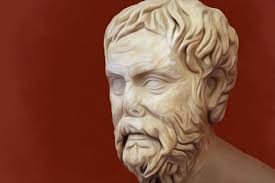
Pyrrho (c. 360 BC - c. 270 BC)
Open Pyrrho's interactive page (graphs of influences, similar and opposing positions, and quotes)
Background
Pyrrho
Born: c. 360 BC in Elis, Greece
Died: c. 270 BC in Elis, Greece
Era: Ancient philosophy
Region: Western Philosophy
Schools: Pyrrhonism, Scepticism
Main interests: Scepticism, ethics, poetry,
epistemology
Influences: Democritus, Gautama Buddha,
Protagoras, Socrates, Plato, Anaxarchus
Influenced: Arcesilaus, Crates of Athens,
Carneades, Timon of Phlius, Epicurus, David
Hume, Aenesidemus, Sextus Empiricus,
Theodorus the Atheist, Montaigne,
Nausiphanes, Mersenne, Gassendi
From Wikipedia
Pyrrho was a Greek philosopher of Classical antiquity, credited as being the first Greek skeptic philosopher and founder of Pyrrhonism…. Most sources agree that the primary goal of Pyrrho's philosophy was the achievement of a state of ataraxia, or freedom from mental perturbation, and that he observed that ataraxia could be brought about by eschewing beliefs (dogma) about thoughts and perceptions. However, Pyrrho's own philosophy may have differed significantly in details from later Pyrrhonism.
Introductory Comments
Legend has it that Pyrrho, traveling east with Alexander's expedition, came upon India's "naked sages" - the gymnosophists - scattered across the hills and valleys, each leading a holy and solitary life, each seeking self-mastery through a disciplined indifference to circumstance. Whether the story holds any truth, some scholars hear a family resemblance between Pyrrho's skepticism and the discipline of these ascetics: a suspension of judgment about the senses, a refusal to lean on any doctrine, a hunger for peace of mind through the quieting of the mind.
It is tempting to picture Pyrrho squatting in the dust, learning their methods. But if he did, he missed - or ignored - their point. For the Indian sage, tranquility was not the destination but the road: a path toward release, toward union with the ultimate reality underlying all things. For Pyrrho, by contrast, peace of mind was the whole point - not a stepping-stone but the destination. The later Greek schools that inherited his sensibility, Stoicism and Epicureanism, were likewise therapeutic rather than illuminative: cures for anxiety and/or methods for well-being, not maps to ultimate reality.
And the difference lingers. Consider yoga. In India it is a way of life: physical, mental, and spiritual all at once. In America it is exercise and stress relief - not a path to liberation, but a Wednesday-morning workout among sweaty strangers.
Some of Pyrrho's Key Positions
True philosophy should lead us to ataraxia - freedom from mental disturbance. We reach this tranquility by suspending judgment, declining to commit ourselves to beliefs about ourselves, others, or the world.
This refusal, however, may not extend to certain "negative" claims. Philosophy (on one reading of Pyrrho) teaches that reality is by nature indeterminate and unknowable. Because reality is indeterminate, our sense perceptions and opinions cannot capture it, and so they are unstable and untrustworthy. Yet these negative claims are themselves presented as true: we cannot know what the world is, but we can know what it is not.
The evidence for this unknowability lies in disagreement itself. The wise quarrel as much as the foolish, and to every assertion an equally well-grounded contradiction can be opposed. Since scales never tip, the path to ataraxia is to live without commitments - telling oneself, when a belief beckons, that the matter "no more is than is not," or that it "both is and is not."
In shedding our beliefs we also shed our desires, for desire grows from the opinion that one thing is better than another. Free of that opinion, we are free of craving - and so we remain in repose, untouched by what others suffer as the terrible reversals of fortune.
Place in the History of Ideas
Pyrrho's Place in History of Ideas
Anthony Gottlieb: Rather appropriately for a man who claimed to know nothing, little is known about [Pyrrho]. It was not until 500 years after his death... that the main surviving skeptical texts were written…. Yet even at so late a date, the character of skepticism remained essentially Hellenistic. That is to say, it was a philosophy of life aimed to produce ataraxia - freedom from disturbance.... Even in its latest and most sophisticated form, it still claimed to draw its inspiration from the distant figure of Pyrrho.
Archibald Alexander: [Pyrrho and the] skeptics arrived at this state of apathetic reserve chiefly by means of polemical discussion, by which, like their predecessors the Sophists, they sought to involve their opponents in logical contradictions. They agreed with the [Sophists] in regarding man as the measure of the universe. But while the [Sophists] sought to magnify the power and supremacy of man, the skeptics sought rather to convict him of complete ignorance....
Wallace I. Matson: [Pyrrho believed that] if there is no reality beyond convention, there can be no objection to behaving in an entirely conventional way. Thus skepticism in philosophy was the ally of conservatism in morals and politics.
Mary Mills Patrick: Pyrrho was eminently a moralist. He was also to a great degree an ascetic…. He lived his philosophy.
Random Thoughts on Pyrrho
Pyrrho's radical skepticism - refusing all beliefs about both particular things and the world at large - might seem to make him an epistemologist, a theorist of what we can know. But Pyrrho approached skepticism as a kind of therapy. If mental disturbance is bound up with our beliefs, then perhaps we can win inner peace by believing nothing at all about anything whatever. But does this make sense? Can such whole-sale doubt really deliver peace of mind?
Santayana argues that we all rely on "animal faith" - an instinctive trust in the world as given, an acceptance of our place in it, no questions asked. If he is even partly right, then complete skepticism is beyond us. Pyrrho would probably concede the point, saying that skepticism is a spectrum: We can never reach the end of the spectrum, but we find peace to whatever degree we can approach it. But that suggests that the two spectrums - skepticism and peace of mind - run parallel to each other. If so, complete skepticism equals complete peace. But imagine a world in which you believed in nothing - no spoons, no trees, no earth, no sky, no you - just a whirl of meaningless images. Would not such a whirl prove so disorienting, so dizzying, you'd want to drop to the ground and hold on tight - only to find that there is no you to drop and no ground to hold? Where is the peace in that? The two spectrums may intersect at certain points, but they do not overlap.
Influences
Pyrrho was influenced by: Anaxarchus, Bryson, Buddha, Democritus, Plato, Protagoras, Socrates
Pyrrho influenced: Aenesidemus, Arcesilaus, Carneades, Crates of A., Epicurus, Gassendi, Hume, Mersenne, Montaigne, Nausiphanes, Sextus Empiri., Theodorus, Timon of P.
Similar and opposing positions
Thinkers with similar positions:
- Bayle (Reason is a guide that too often leads one astray. Be skeptical.)
- Cavell (Skepticism reflects the fundamental limits of human knowledge.)
- Democritus (Since perceptions disagree, truth does not exist or is not evident.)
- Epictetus (We should accept calmly and dispassionately whatever happens.)
- Gassendi (No one viewpoint captures all truth. Some skepticism is always good.)
- Hume (All our empirical judgments are based on uncertain grounds.)
- Montaigne (Be a little skeptical when considering all views, even one's own.)
- Protagoras (No absolute truth exists - only what people deem to be the truth.)
- Sextus Empiri. (Habit & appearance, not knowledge, determine human actions.)
- Socrates (We should question assumed truths to see if they are in fact true.)
Thinkers with opposing positions:
- Descartes (Everything we perceive both clearly and distinctly must be true.)
- Jacobi (Though external world can't be directly known, it can be taken on faith.)
- Malebranche (Ethical principles are eternal and universal in application.)
- Mead (Communicative rationality is an essential and ongoing social process.)
- Pascal (Skepticism is a product of the devil and we must fight against it.)
- Reid (When philosophy contradicts common sense, it should be dismissed.)
What others said about Pyrrho
- Nietzsche: The power, the freedom that comes from the strength and super-strength of spirit, proves itself through skepticism.
- Diogenes Laërtius: [Pyrrho] said that nothing is either fine or ignoble or just or unjust; and... in all cases that nothing is the case in reality, but that humans do everything by convention and habit; for each thing is no more this than that.
- Russell: The Sophists... had been led by the ambiguities and apparent contradictions of sense-perception to a subjectivism not unlike Hume's. Pyrrho seems... to have added moral and logical skepticism to skepticism as to the senses. He is said to have maintained that there could never be any rational ground for preferring one course of action to another.
- Aristocles: [Pyrrho taught] we should be adoxastoi (without views), aklineis (uninclined toward this side or that), and akradantoi (unwavering in our refusal to choose), saying about [each] one that it no more is than it is not….
- Russell: Skepticism was a lazy man's consolation, since it showed the ignorant to be as wise as the reputed men of learning.
- Anthony Gottlieb: Pyrrho himself wrote nothing, but still made an impression on his contemporaries.... His impact is attested by the usual round of barmy anecdotes, which mostly focussed on the... extremes of his detachment.
- Paul Elmer More: The great philosophies, however rich their contents may be, rest finally on the simplest common-places of experience; and it is the honor of Pyrrho that he grasped the conscious sense of ignorance inherent in the minds of all men, penetrated to its source, and applied it relentlessly where other men faltered or drew back.
- Aristocles: According to Timon, Pyrrho declared that things are equally indifferent, unmeasurable and inarbitrable. For this reason neither our sensations nor our opinions tell us truths or falsehoods.
Schools: Pyrrhonism, Quietism, Skepticism
Main interests: Epistemology, Ethics, Poetry
Pyrrho's answers to philosophical questions
Epistemology
Real knowledge does not exist. Sensory experience cannot be trusted and reason is inherently deceptive.
Sensory experience deals only with appearances. We can never know what things are in and of themselves.
Don't worry about truth. Since things in themselves are indifferent, unstable and indeterminate, there is no truth about things.
Since there are no positive truths, it makes no sense to talk about their coherence. Only laws and conventions can cohere.
Judgment creates conflict. Peace of mind can be achieved only through suspending all judgment.
Ethics
Since moral beliefs falsely assume one can know that some things are better than other things, they can never be proven true.
Since truth is unattainable, all we have are laws and traditions to guide us in our behavior. We must respect these.
Philosophy
True philosophy should lead us to a state of ataraxia, or freedom from mental disturbance.
Psychology
Ataraxia or the freedom from all mental disturbance is achieved through avoiding all dogma and all beliefs in general.
Society
Since truth is unattainable, we rely on society to provide us with enough customs and conventions to guide us in life.
Society is held together by the laws and conventions it endorses. Without these guideposts, people would feel lost.
Societies can't rely on reason, since reason itself is not reliable. Instead, societies are held together by laws & traditions.