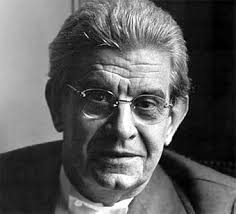
Lacan was a French psychoanalyst and psychia- trist….. His work made a significant impact on continental philosophy and cultural theory in areas such as post-structuralism, critical theory, feminist theory, and film theory, as well as on the practice of psychoanalysis itself. Lacan took up and discussed the whole range of Freudian concepts, emphasizing the philosophical dimension of Freud's thought and applying concepts derived from structuralism in linguistics and anthropology to its development in his own work….
Introductory Comments
Few thinkers have left smudgier fingerprints on postwar thought. Post-structuralism, feminist theory, film studies, and psychoanalysis itself all bear Lacan's traces, whether they welcome them or not. His central claims sound strange at first and then oddly familiar. The self we cherish is a flattering illusion, first glimpsed in a mirror. The unconscious is structured like a language, and not even our own language at that. Desire feeds on lack and is never satisfied. None of this is nonsense. It is Freud reread through the linguistics of the day, with a strong dash of Hegel picked up at Alexandre Kojève’s celebrated Paris lectures.
The trouble is the delivery. Lacan hid his pearls in an avalanche of riddles, and his prose often reads less like an argument than an incantation, less a chain of reasons than a hall of mirrors. His seminars were theatrical events. His therapy sessions could end after a few minutes, a habit that helped get him pushed out of the psychoanalytic league in 1963. To his detractors, all this adds up to a charlatan who discovered that obscurity can pass for depth. Some go further and treat him as the emblem of a whole culture of French theory that mistook the performance of erudition for the demonstration of truth. The physicist Alan Sokal and the philosopher Jean Bricmont pressed that case hard in Fashionable Nonsense. And even admirers concede that Lacan seemed to court misreading, almost as a career strategy: Better to be endlessly interpreted than definitively refuted.
Some of Lacan's Key Positions
Psychoanalysis must return to Freud. Ego psychology, which aims to strengthen the ego and adapt the patient to society, betrays his central discovery: the unconscious, which shows we are not masters in our own house.
The ego is not the true self but an illusion. In the "mirror stage," the clumsy infant sees a unified image of itself and takes that image as its identity. Strengthening the ego only fortifies this mistake.
The unconscious is structured like a language. Dreams, slips, and symptoms work through wordplay, substitution, and displacement, so they must be read like texts. That language is not private. We are born into a symbolic order of language, law, and kinship that speaks through us.
Experience runs on three registers. The Imaginary holds images and rivalries, the Symbolic holds language and law, and the Real is whatever resists words altogether.
Desire is the desire of the Other: we want what others want, and we want to be what they desire. It circles a lost object that we never possessed, and fantasy stages it, framing reality itself.
Because the unconscious is woven of language, literature is a privileged place to read it. The aim of analysis is neither insight nor adjustment but confronting the truth of one's own desire.
Place in the History of Ideas
Lacan's Place in History of Ideas
Matthew Sharpe: It would be fair to say that there are few twentieth century thinkers who have had such a far-reaching influence on subsequent intellectual life in the humanities as Jacques Lacan. Lacan’s "return to the meaning of Freud" profoundly changed the institutional face of the psychoanalytic movement intern- ationally…. Both inside and outside of France, Lacan’s work has also been profoundly important in the fields of aesthetics, literary criticism, and film theory. Through the work of Louis Pierre Althusser (and more lately Ernesto Laclau, Jannis Stavrokakis, and Slavoj Zizek), Lacanian theory has also left its mark on political theory, and particularly the analysis of ideology and institutional reproduction.
Dylan Evans: As I became more familiar with Lacan's teachings, the internal contradictions and lack of external confirmation became ever more apparent. And as I tried to make sense of Lacan's bizarre rhetoric, it became clearer to me that the obfuscatory language did not hide a deeper meaning, but was in fact a direct manifestation of the confusion inherent in Lacan's own thought. But whereas most of Lacan's commentators preferred to ape the master's style, and perpetuate the obscurity, I wanted to dissipate the haze and expose whatever was underneath - even if it meant seeing that the emperor was naked.
Random Thoughts on Lacan
Lacan's account of sexual difference is both provocative and maddening. Take his famous declaration: "there is no sexual relationship." It does not mean that men and women never meet; they clearly do, often with considerable enthusiasm. The French word rapport also means "ratio," and Lacan's point is that no formula can write the sexes as complementary halves. They are not puzzle pieces cut to fit, and every pairing passes through language, fantasy, and the unconscious. Central to all this is the phallus, which for Lacan is not an organ but a signifier - a symbol nobody actually possesses. "Masculine" and "feminine" thus become positions the mind takes up, not facts stamped on the body at birth.
Critics find all this too clever by half. Biologists point to chromosomes, hormones, and anatomy, which produce robust patterns across cultures that don't vanish because a Parisian analyst renames them. Evolutionary psychologists add that many sex differences in desire and behavior look like adaptations shaped over millions of years, not tricks of grammar. Lacanians reply that their master never denied any of this. His claim was only that for creatures who talk, the body is never just a body, because it is always already wrapped in meaning. The debate resembles an argument over whether the ocean is "really" water or "really" a word. The Lacanian notes that it only becomes "the sea" once someone names it. The biologist replies that it gets your shoes wet either way.
Butler, Judith (Terms "gender" and "sex" are socially and culturally constructed.)
de Beauvoir (Women's oppression is due to the social construction of gender.)
Derrida (Western culture imposes implicit hierarchies on a text's meaning.)
Fuller (There is no wholly masculine man and no purely feminine woman.)
Gramsci (The bourgeoisie spreads its politics more thru culture than violence)
Irigaray (Many problems are due to the misuses of language regarding women.)
Jung (Symbols and rituals shape a large part of our psychology and culture.)
Marcuse (The realization of man's erotic nature is liberation for humanity.)
Mead (The mind and self emerge from the social process of communication.)
Saussure (Linguistic signs only have meaning in relation to other signs.)
Zizek (Idealogies spring from symbolic depictions of reality, not from reality.)
Thinkers with opposing positions:
Adler (Freud overstated role of sexual impulses and motives in psychology.)
Brentano (There is no such thing as an unconscious mental act.)
Jung (The collective, not personal, unconscious is most determinant.)
Nussbaum (The claim that gender is just a cultural construct is not plausible.)
Paglia (Sex and gender are not social constructs. They are rooted in biology.)
What others said about Lacan
Zizek: As a Marxist, let me add: if anyone tells you Lacan is difficult, this is class propaganda by the enemy.
Kevin Mulligan: Lacan's synthesis of Freud, Hegel and structuralism was often held to contain deep truths about the nature of desire in general and the way women live, or have lived, should or should not live in particular.
Norman N. Holland: Lacan's most widely quoted maxim is, "The unconscious is structured like a language," and like that sentence, Lacan's whole oeuvre rests on a certain idea of language. His proclaimed "return to Freud" meant remedying Freud's failure to use "modern" linguistics. "Modern" linguistics for Lacan, however, means turn-of-the-century linguistics... Saussure's.
Malcolm Bowie: [Lacan's so-called "return to Freud' revealed] a complete pattern of dissenting assent to the ideas of Freud…. Lacan's argument is conducted on Freud's behalf and, at the same time, against him.
Camille Paglia: But if you read Lacan, this is the result. Your brain turns to pudding.
Lisa Appignanesi: Lacan systematically questioned those psychoanalytic developments from the 1930s to the 1970s, which were increasingly and almost exclusively focused on the child's early relations with the mother….
Adrian Johnston: Sometimes referred to as "the French Freud," he is an important figure in the history of psychoanalysis. His teachings and writings explore the significance of Freud’s discovery of the unconscious both within the theory and practice of analysis itself as well as in connection with a wide range of other disciplines.
Chomsky: Quite frankly I thought [Lacan] was a total charlatan. He was just posturing for the television cameras in the way many Paris intellectuals do. Why this is influential, I haven’t the slightest idea.
Main interests: Alienation, Art and Aesthetics, Communication, Desire, Ethics, Film Theory, Habits, Language, Literature, Metaphors, Mind, Popular Culture, Psychoanalysis, Psychology, Semiotics, Sexuality, Social Philosophy