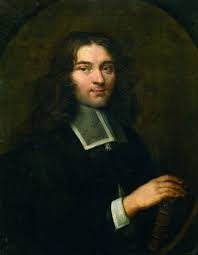
Pierre Bayle (1647 - 1706)
Open Bayle's interactive page (graphs of influences, similar and opposing positions, and quotes)
Background
Pierre Bayle
Born: 18 November 1647 in Carla-le-Comte,
Kingdom of France
Died: 28 December 1706 (age 59) in Rotterdam,
Dutch Republic
School: Scepticism
Main interests: Religion, theology, ethics,
history, literary criticism, epistemology
Influences: René Descartes, Baruch Spinoza,
Strato of Lampsacus
Influenced: Marquis de Condorcet, Denis
Diderot, Frederick the Great, George Berkeley,
David Hume, Pierre des Maizeaux, Bernard
Mandeville, Pierre Louis Maupertuis, John
Toland, Giambattista Vico, Voltaire, Baron
d'Holbach, Thomas Jefferson, John Locke,
Gottfried Wilhelm Leibniz, Benjamin Franklin,
Montesquieu, Gotthold Ephraim Lessing,
Benito Jerónimo Feijóo
From Wikipedia
Bayle was a French philosopher, author, and lexicographer. He is best known for his Historical and Critical Dictionary, whose publication began in 1697.…. Bayle is commonly regarded as a forerunner of the Encyclopédistes of the mid-18th century. Bayle was a notable advocate of religious toleration, and his skeptical philosophy had a significant influence on the subsequent growth and development of the European Age of Enlightenment. Leibniz's theodicy was formed in response to Bayle.
Introductory Comments
Few philosophers have leaned so hard on conscience as Bayle did. For him it was not one moral authority among several but the highest, outranking magistrate, custom, and Church alike. The claim was less pious than it sounds. Bayle's point was that a sincere conscience binds absolutely even when it is wrong, because a mistaken conscience has no way of detecting its own mistake - from the inside, error feels exactly like truth. To punish a man for obeying it is therefore to punish him for the one thing he could not have avoided doing. The Church may declare him mistaken, but it must not - as it did to his Bayles's brother - condemn him to a prison cell.
Bayle pressed the point further still. Conscience is not merely the highest authority; it is the oldest, the seedbed from which the others grew. Long before anyone thought to write a law, empanel a court, or ordain a priest, that still, small voice was already at work, nagging at people to behave. Institutions came afterward, as scaffolding around something that was standing on its own. In Bayle's phrase, in mankind's youth "there was no other God, religion, or lawful magistracy, than conscience." Which puts the usual order of things on its head: the Church does not confer moral authority on the individual conscience, but borrows what the conscience had first. As to where conscience came from, Bayle's answer was God: the natural light stamped on every mind at creation, legible to Christian, pagan, and atheist alike.
Some of Bayle's Key Positions
Religious toleration is no danger to the state; persecution is. It breeds resentment, sedition, and finally civil war - and the principle that licenses one church to coerce licenses every rival church to do the same.
Toleration also rests on the rights of the erring conscience. A sincerely mistaken conscience cannot detect its own error; from the inside it feels exactly like a correct one. To punish a man for obeying it is to punish him for doing what he was bound to do.
Reason, meanwhile, is better at demolishing than building - a Penelope forever unraveling by night the web she wove by day. Nowhere is it weaker than in religion. How can the misery stitched into human life be squared with a God both all-powerful and perfectly good? The Manichaeans, who traced the world to two warring principles, at least fit the evidence. Judged by argument alone they are stubbornly hard to refute. However, where reason cannot follow, faith must lead.
Yet even faith can't make us better people, and church doctrine does not govern conduct as tidily as the pious suppose. Men act from passion, habit, and fear of disgrace far more than from their principles; Christians sin daily against doctrines they sincerely hold. A society of atheists might therefore prove as orderly and decent as a Christian one - and idolatry may corrupt a people more thoroughly than unbelief does.
Place in the History of Ideas
Bayle's Place in History of Ideas
Thomas M. Lennon: If Bayle doubts, he does so on a highly contingent and non-theoretical basis. He is prepared to accept what he finds to be evident, but the fact of the matter is that he does not find it very often, at least not in phi- losophy. In history, on the other hand, there is a kind of certainty appropriate to the domain that is often enough to be found. The Diction- naire itself cannot be interpreted except as stupendous testimony to the ability of an individual to overcome passion and prejudice and arrive at historical truth - so much so that Bayle's historical method has been viewed by the literature as a form of Cartesianism, despite the Cartesians' own dismissal of history.
Cassirer: According to Bayle, nothing is more erroneous and harmful than the prejudice that historical truth can and must be accpeted like a stamped coin on trust and faith. It is rather the function of reason to stamp its own coin and always to examine each indiviual product with the greatest care.
Jean Delvolvé: The very originality of Bayle’s ideas, their lack of systematic construction, their diffusion in the mass of a work that is prolix to excess, their intentionally obscured and enveloped exposition… - all these reasons hindered the comprehension of Bayle by his contemporaries and have hindered him taking his rightful place in the history of.… thought.
Random Thoughts on Bayle
Though perhaps no philosopher put conscience at the center of his philosophy more than Bayle did (see Introductory Comments), there is one awkward complication: Conscience may be sacred, but it is hardly unanimous. If every human being possessed exactly the same moral instincts, history would contain far fewer wars, inquisitions, and Thanksgiving dinners exploding into politics. As is painfully obvious, our consciences can pull us in very different directions. One person's sacred duty becomes another person's dangerous heresy. Bayle knew this from painful experience, having lived through an age in which Christians eagerly persecuted other Christians, each side convinced that conscience - and God - stood firmly on its side.
Bayle's answer was both simple and surprisingly modern. Since no institution can guarantee that its beliefs are infallible, none has the right to coerce the sincere conscience of another. Society is safer when individuals are allowed to follow their own convictions than when governments or churches attempt to manufacture agreement by force. Bayle was under no illusion that this tolerance would eliminate disagreement. Quite the opposite: disagreement is part of the human condition. His hope was merely that people would learn to treat one another's consciences as inviolable, even when they believed those consciences to be mistaken. That is a modest ideal, perhaps - but compared with burning one another at the stake, it represents remarkable moral progress.
Influences
Bayle was influenced by: Descartes, Spinoza, Strato of L.
Bayle influenced: Berkeley, Condorcet, Des Maizeaux, Diderot, Feijoo, B.J., Feuerbach, Franklin, Frederick, Gibbon, Holbach, Hume, Jefferson, Leibniz, Lessing, Locke, Mandeville, Maupertuis, Melville, Montesquieu, Pope, A., Toland, John, Vico, Voltaire
Similar and opposing positions
Thinkers with similar positions:
- Berkeley (Locke fails in his distinction between primary & secondary qualities.)
- Grotius (Differences in religious doctrine are a purely private matter.)
- Habermas (Reason plays a constructive role in moral, political & social systems.)
- Hobbes (In the state of nature all men are in constant battle with one another.)
- Jefferson (There should be a wall of separation between Church and State.)
- Kierkegaard (Belief in God cannot be based on reason. Faith requires a leap.)
- Montaigne (When asking big questions, remain skeptical of all answers.)
- Socrates (We should question assumed truths to see if they are in fact true.)
- Voltaire (Think for yourself and let others enjoy the privilege of doing so too.)
Thinkers with opposing positions:
- Descartes (Belief in the external world can be based on the veracity of God.)
- Einstein (Those convinced of the truth of their religion are never tolerant.)
- Harris (Religious toleration can't justify beliefs based on no evidence or reason.)
- Horkheimer (Rationality doesn't inevitably lead to progress in morality & law.)
- Leibniz (Since God created the best of all possible worlds, evil is not His fault.)
- Mead (Communicative rationality is an essential and ongoing social process.)
- Popper (Unlimited tolerance must lead to the disappearance of tolerance.)
What others said about Bayle
- Voltaire: The greatest master of the art of reasoning that ever wrote, Bayle, great and wise, all systems overthrows.
- John Herman Randall Jr.: He loved to show the excellent arguments that could be put forward for refuted and forgotten theories. Above all, he delighted to show up men's superstitious beliefs.
- Cassirer: [Bayle] does not wish to disturb the content of faith, and he refrains from any explicit criticism of this content. But he violently assails that attitude which considers every means fair in the defense of faith, which mixes up truth and fancy, insight and prejudice, reason and passion, in so far as they can be useful… [in] the main goal of apologetics.
- Wilhelm Windelband: He worked systematically to show that all dogmatic doctrines were contrary to reason; he laid bare their contradictions with penetrating keenness.
- John Herman Randall Jr.: Perhaps Bayle's basic principle is the independence of morals from any theological or religious sanction.
- Thomas M. Lennon: Only in one domain [of Bayle's philosophy] is anything like strictly Cartesian infallibility to be found, and that is morality. There, the individual conscience is inviolate.
- Anthony Gottlieb: Bayle’s main reason for doubting that a society of atheists would be terminally immoral is that people mostly act according to their inclinations and characters, not in accordance with the principles that they officially profess. How else could one explain the existence of wickedness in Christian countries?
- Wilhelm Windelband: The pioneer of the French Enlightenment was Pierre Bayle, whose Dictionnaire turned the views of the cultivated world completely in the direction of religious skepticism....
Schools: Fideism, Pyrrhonism, Skepticism
Main interests: Epistemology, Ethics, Free/Unfree Will, History, Literary criticism, Religion, Theology
Bayle's answers to philosophical questions
Epistemology
Though strict reason can be trusted, claims to reason, especially in religion and philosophy, are too often misguided.
"I know too much to be a skeptic and too little to be a dogmatist."
Ethics
"To love someone is to desire to transform oneself into everything that is good for that person."
History
"Properly speaking, history is nothing but the crimes and misfortunes of the human race." Hence, that is its focus.
Law
Were there no laws, there'd be no justice. "One must be stark mad, to believe that mankind can subsist without magistrates."
Metaphysics
Matter may not exist "for whether it doth or doth not..., God could equally communicate to us all the thought we have.”
Philosophy
Given all the conflicting views on important matters, a good starting point is to simply lay out these views for all to see.
Political Philosophy
Problems in the state don't arise from toleration of multiple religions, but rather from presecution of certain religions.
Religion and Theology
"There was no other God, religion, or lawful magistracy, than conscience."
Since there's evil in the world, it's hard to see how God could be both all-powerful & all good. Yet we must believe so.
Reconciling an omnipotent & beneficent God with all the evils we find in the world "surpasses our philosophical lights."
An atheist can be as moral as a Christian. People act according to their natural inclincations, not their religious beliefs.
It's hard to see how creatures created by an all-powerful & omniscient God could be totally responsible for their acts.
"... Gentleness and Long-suffering... constitute the distinguishing and essential Character of the Gospel."
"It is only common prejudice that induces us to believe that atheism is a fearful state."
Society
"It is thus tolerance that is the source of peace, and intolerance that is the source of disorder and squabbling."