Pseudo-Denys (c. 470 - c. 530)
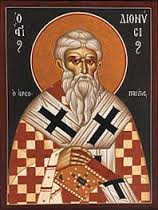
Open Pseudo-Denys's interactive page (graphs of influences, similar and opposing positions, and quotes)
Background
Pseudo-Dionysius the Areopagite
Born: c. 470 probably in Syria
Died: c. 530 probably in Syria
Other names: Dionysius, Denys, Pseudo-Denys
Schools: Neoplatonism, Christian theology,
Christian mysticism
Main interests: Religion, theology, mysticism
Influences: Plotinus, Iamblichus, Proclus, Origen,
Gregory of Nyssa, Basil of Caesarea, Clement
of Alexandria, Parmenides
Influenced: Aquinas, Maximus the Confessor,
Johannes Scotus Eriugena, Meister Eckhart,
Nicholas of Cusa, Albertus Magnus, Anselm,
Bonaventure, Richard Hooker, Mirandola,
Marsilio Ficino, Adam of Dryburgh, René
Guénon, John of Scythopolis, John of Damascus,
Germanus of Constantinople, John Tauler, Jean
Gerson, Julian of Norwich, Teresa of Ávila,
Marguerite Porete, Jan van Ruusbroec
From Wikipedia
PseudoDionysius was a Greek author, Christian theologian and Neoplatonic philosopher of the late 5th to early 6th century.... The author pseudepi- graphically identifies himself in the corpus as "Dionysios," portraying himself as Dionysius the Areopagite, the Athenian convert of Paul the Apostle mentioned in Acts 17:34. In the early sixth century, a series of writings of a mystical nature, employing Neoplatonic language to elucidate Christian theological and mystical ideas, was ascribed to the Areopagite.
Introductory Comments
Pseudo-Dionysius was perhaps the most influential impostor in the history of Western philosophy. (Hence the "Pseudo.") In his writings he presented himself as Dionysius the Areopagite, the first-century convert of St. Paul mentioned in Acts. In reality, he was almost certainly a late fifth- or early sixth-century Syrian monk deeply familiar with the works of Proclus. The deception was presumably intended to lend his books instant authority and apostolic prestige. Still, we should not be too hard on this mischievous monk. Pseudonymous writing was far more common in the ancient world than it is today, and many authors chose to write in the voice of revered figures from the past.
And why not project ourselves into the past? We read dead thinkers precisely to bring them back to life. Is this not its own kind of time travel? As engaged readers, we enter into an imaginary dialogue with long-dead writers, responding to them in our minds as they respond to us in theirs. So too with our Syrian monk. By assuming the identity of one of St. Paul's converts, he could, in effect, speak directly with Paul himself. Better still, he could place the language and concepts of Proclus's Neoplatonism into the mind of an early Christian and thereby suggest a deep harmony between Christianity and a philosophical tradition that had not yet even come into existence. Yes, it is all a bit convoluted. But in the history of ideas, time and place can sometimes be as slippery as the mind itself.
Some of Pseudo-Dionysius's Key Positions
The One that is both the source and the goal of all being is, of course, God. Yet the divine unity does not exclude the three distinctions of Father, Son, and Holy Spirit.
The mystery of God is fundamental and, in the end, absolute. Just as the Neoplatonic One lies beyond all understanding, so God stands "beyond being," "beyond life," and "beyond intellect." The categories we use to grasp the world that flows from God cannot be applied to God Himself. Hence the way of negation (apophatic theology): we approach God more truly by saying what He is not than by saying what He is.
Yet negation is not the whole story. The affirmative way (cataphatic theology) has its place too: the symbols, names, and rituals of Christianity carry deeper, esoteric meanings that can gradually draw the soul toward a mystical awareness of God and His creation. Working through these sacred symbols, we begin to sense how all things proceed from God and return to Him - the Neoplatonic rhythm of procession and return, recast as the drama of creation and salvation.
As the soul draws nearer to God, however, even the divine names and symbols fall away one by one. In the final approach we must abandon speech and thought altogether and enter the "darkness" beyond knowing. What remains is not comprehension but an ecstatic union.
Place in the History of Ideas
Pseudo-Dionysius's Place in History of Ideas
William Turner: [Pseudo-Dionysius's works] contain the last exposition of Christian Neo-Platonism. The ineffable superiority of God with respect to the world, the emanations of creatures from God, the arrangement of all created beings in a scale of gradual descent from God, the final return of all things to their first source, the return of man to God by means of contemplative ecstasy - all these Neo-Platonic elements are present in the philosophy of Dionysius.
Copleston: [Pseudo-Denys believed] God wills all things proceed from Himself and by so doing gives existence to the world.... The procession of things from God is completed in a series of steps, and through them we arrive at a hierarchical ordering of being.... The closer a being stands to God, the more fully it shares in Him and so much the greater is its inner unity.
Andrew Louth: Dionysius/Denys' vision is remarkable because, on the one hand, his under- standing of hierarchy makes possible a rich symbolic system in terms of which we can understand God and the cosmos and our place within it, and, on the other, he finds room within this strictly hierarchical society for an escape from it, beyond it, by transcending symbols and realizing directly one's relationship with God as his creature, the creature of his love. There is space within the Dionysian universe for a multitude of ways of responding to God's love.
Random Thoughts on Pseudo-Dionysius
By bringing together two very different traditions - Christianity and Neoplatonism - Pseudo-Dionysius created a vision that was both more mystical than the former and more imaginable than the latter. Consider first Christianity. On one level, the story told in the Gospels is wonderfully concrete: God sacrifices His only begotten Son so that humanity may be redeemed from its fallen condition. But once Neoplatonic ideas enter the picture, the story acquires new depths and mysteries. Instead of imagining God primarily in anthropomorphic terms as a divine craftsman fashioning the world, we begin to think of creation as a kind of overflowing, a procession from a God who remains forever beyond our comprehension. How this procession occurs is itself a mystery - as is God.
Neoplatonism, for its part, gets something just as valuable in return: a plot. By linking Neoplatonic metaphysics to the narratives and symbols of Christianity, Pseudo-Dionysius made an austere philosophy easier to picture and to feel. When contemplating redemption, the Christian Neoplatonist could look to Christ on the Cross. When contemplating the hierarchy of reality, she could look to the ranks of Seraphim, Cherubim, Archangels, Angels, and Saints. Pseudo-Dionysius gave an abstract metaphysics flesh and imagery, and gave Christian imagery a vast metaphysical backdrop. Or, if one prefers the shorter version: he gave Neoplatonism a story, and Christianity a cosmos grand enough to house it.
Influences
Pseudo-Denys was influenced by: Basil of C., Clement of A., Gregory of N., Iamblichus, Origen, Parmenides, Plotinus, Proclus
Pseudo-Denys influenced: Adam of D., Albertus Mag., Anselm, Aquinas, Bonaventure, Dante, Eckhart, Eriugena, Ficino, Gerson, John, Guenon, Rene, Hooker, John of Damas., Maximus the C., Milton, Nicholas of C., Pico, Tauler, John
Similar and opposing positions
Thinkers with similar positions:
- Albertus Mag. (To truly know the moral good we must know the eternal Good.)
- Bayle (The value of faith is directly proportional with its repugnancy to reason.)
- Eckhart (Personal detachment allows us to sense God's presence within us.)
- Eriugena (God is both the ground of all things and the end or goal of all things.)
- Ficino (The soul is immortal and seeks to ascend to a spiritual union with God.)
- Maimonides (God is beyond reason. We know what He isn't, not what He is.)
- Murdoch (The Good is real and the moral life is a journey from illusion to reality.)
- Plotinus (The One, being perfect & eternal, is stable, uniform and unchanging.)
- Proclus (The One is beyond reason. We know what It isn't, not what It is.)
Thinkers with opposing positions:
- Anselm (Reason cannot replace faith, but can work together with faith.)
- Averroes (The individual's soul ends when he or she dies. It is not eternal.)
- Boethius (Logic is an important discipline and tool when doing philosophy.)
- Darwin (It is absurd to talk of one animal being higher than another.)
- Franklin (The only religion that's at all defensible is pure and simple deism.)
- Holbach (The universe is simply matter in motion, bound by laws of nature.)
- Williams, B. (Values are internal. They exist in ourselves - not "in the world.")
What others said about Pseudo-Denys
- Copleston: [Pseudo-Denys believed that] just as all light and all life partake of the sun, so all being, all life, all values and all beauty participate in God.
- Kevin Corrigan: [Dionysius's work was a forgery: Instead of being a disciple of St. Paul, as he claimed,] Dionysius must have lived in the time of Proclus, most probably being a pupil of Proclus, perhaps of Syrian origin….
- Anthony Gottlieb: [Pseudo-Dionysius said we should subtract] all everyday concepts from our idea of [God].... The point of this is to plunge us into a "super-essential darkness" in which we are stripped of our ordinary ways of thinking and so try to grope beyond them. Such intellectual deprivation will leave us in a fit state to receive mystical enlightenment....
- Paul Rorem: [In his] "Mystical Theology" [Pseudo-Dionysius] denies and moves beyond all our concepts or "conceptual" attributes of God and concludes by abandoning all speech and thought, even negations.
- Luther: Dionysius is most pernicious; he platonizes more than he Christianizes.
- L. Michael Harrington: [A]lmost every word he employs resonates with the whole history of ancient thought, from the Christian Platonism of the Fathers… to the Neoplatonism of Plotinus, Iamblichus, and Proclus….
- Ralph McInerny: The most striking point about Dionysius is his insistence that the object of his concern is wholly beyond the ability of man to comprehend. The language Scripture uses to speak of God cannot express with any degree of adequacy what he is; a fortiori the attempts of men to speak of God must fail.
- W. T. Jones: The Middle Ages treated... Pseudo- Dionysius... with the greatest reverence. This created a... problem, for... Neoplatonic metaphysics and Christian orthodoxy are in many respects deeply antagonistic.
Schools: Augustinianism, Christian Mysticism, Christian Theology, Divine Illumination, Emanationism, Mysticism, Neoplatonism, Pythagoreanism
Main interests: Religion, Spirituality, Theology, Wisdom
Pseudo-Denys's answers to philosophical questions
Epistemology
Our senses cannot reveal the ultimate reality: "In preeminence, the cause of all that is sensible is not anything sensible."
Reason cannot reveal the ultimate reality: "In preeminence, the cause of all that is intelligible is not anything intelligible."
Language
"Entering the [divine] darkness that surpasses understanding, we shall find ourselves brought… to perfect silence...."
Metaphysics
Causality aims at the exemplary: In every cause there is an element of a striving for the beautiful and the good.
Religion and Theology
"We pray that we may come unto this Darkness which is beyond light, and… to know That which is above... knowledge."
God is beyond our understanding. We can not know what He is in Himself. We can only know what He is not.
God is not responsible for evil in this world, since evil is nothing in itself: it is just a distance or removal from God.
God did not so much create the universe, as the universe represents an overflowing of God into lower forms of reality.
The mysterious symbols and designations of Christianity can lead us to a mystical awareness of God and His creation.
Jesus too is a divine mystery: "No one knows the Son except the Father, and no one knows the Father except the Son…."
Sacred words and symbols can lead us to a mysterious understanding beyond our own merely human capacities.