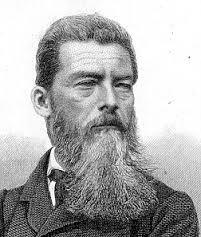
Ludwig Feuerbach (1804 - 1872)
Open Feuerbach's interactive page (graphs of influences, similar and opposing positions, and quotes)
Background
Ludwig Feuerbach
Born: 28 July 1804 in Landshut, Bavaria (now
Germany)
Died: 13 September 1872 (aged 68) in
Rechenberg near Nuremberg, Germany
Alma mater: University of Heidelberg,
University of Erlangen (Dr.phil.habil., 1828)
Schools: Dialectical materialism, Secular
humanism
Main interests: Religion, Christianity
Notable ideas: Religion as the outward
projection of human inner nature
Influences: Hegel, Karl Daub, Schleiermacher,
Friedrich Heinrich Jacobi, Augustine, Johann
Eduard Erdmann, David Strauss
Influenced: Marx, Engels, Max Stirner, Buber,
Nietzsche, Bruno Bauer, Richard Wagner,
Bakunin, Joseph Dietzgen, Karl Barth, Edmund
Montgomery, George Eliot
From Wikipedia
Feuerbach was a German anthropologist and philosopher, best known for his book The Essence of Christianity, which provided a critique of Christianity that strongly influenced genera- tions of later thinkers, including Charles Darwin, Karl Marx, Sigmund Freud, Friedrich Engels, Mikhail Bakunin, Richard Wagner, Frederick Douglass, and Friedrich Nietzsche.… Many of his philosophical writings offered a critical analysis of religion. His thought was influential in the development of historical materialism.….
Introductory Comments
Ever since people began imagining gods, the gods have borne a suspicious family resemblance to the people imagining them. Xenophanes noticed it in the sixth century BCE: Thracians give their gods blue eyes and red hair, Ethiopians give theirs dark skin and flat noses, and if oxen could draw, their gods would come out looking remarkably like oxen. For Xenophanes this was a scandal, proof that the popular gods were frauds. Twenty-four centuries later Feuerbach takes the same observation and turns it into a research program. Of course the gods look like us, he says. Hence the inversion at the heart of The Essence of Christianity: theology is anthropology in disguise. When a believer says God is loving, just, and wise, he is not describing a being beyond himself. He is describing the best human being he can conceive - not himself exactly, but the perfected creature none of us ever quite manages to be - and then hanging that figure in the sky, enlarged to infinity. Religion, on this reading, is humanity's self-portrait, hung too high to be recognized.
Feuerbach was a materialist without apology - no God, no soul, no realm above this one - but he offers the projection thesis as diagnosis rather than mockery: By locating our virtues in heaven, we impoverish ourselves on earth; by prizing revelation over reason, we loosen our grip on truth; and by indulging superstition, we endanger the very humanity that religion, at its best, was trying to express.
Some of Feuerbach's Key Positions
The world is material, governed by material forces. Spiritual beings - God among them - do not exist. Yet religion is no mere illusion. Christianity and its rivals have shaped human conduct and belief for centuries, and whatever else they may be, they are real powers in a material world.
To understand religion, then, study it as an anthropologist would: ask what work it does in human life. God appears as lawgiver, as judge, as the power of love, as any number of things, and each version shapes its believers differently. Theology, properly examined, turns out to be anthropology.
The crucial discovery is that God is humanity's own image, projected outward and enlarged. Wisdom, justice, morality, love - these are divine only in the sense that they are human ideals, perfections of the species that no single person embodies. God does not lend us his attributes; we lend him ours, then kneel before the loan. And the transaction costs us something. The more a man heaps onto God, the less he keeps for himself, impoverishing himself to enrich his own projection.
Religion carries other dangers as well. Belief in revelation undermines the commitment to reason and corrodes the love of truth, since what is accepted on authority need not be tested. Religion breeds superstition, and superstition can license cruelty.
Place in the History of Ideas
Feuerbach's Place in History of Ideas
Scruton: [Feuerbach saw social relationships as] the "species-life" of man. Only man has species-life, since only man finds his nature, through the recognition of himself as a social, and therefore socially determined, being. It is this conception of species-life that created a materialist version of Hegel’s philosophy of man.
Robert C. Solomon: Feuerbach attacked Hegel and idealism generally for their perverse "inversion" of reality - taking abstract ideas and intangibles as more real then flesh-and-blood people and the seemingly solid world of objects, and he suggested that Hegel had stood the world on its head, and that it was time to set it back on its feet again.... He did not deny the the existence of consciousness, but put it back in its place in the world, as the biological consequence of our brains, combined with our social and physical circumstances.
Dale DeBakcsy: For many people, [he] is the grey but necessary grit shoved between the foundation stones of Hegel and Marx in the edi- fice of modern philosophy. The phrase "transi- tional figure" haunts Feuerbach literature as if he were little more than a just-functional MC holding the stage until the real act comes along. This is hardly a fair fate for the man whose critique of religion revolutionized philosophical theology, and who then pushed that critique into an all-out war against philosophy itself....
Random Thoughts on Feuerbach
Suppose Feuerbach is right that God is humanity's projected self-portrait - our finite love, justice, and wisdom cast onto an Infinite Screen. The question still remains: why make the projection so lopsided? We didn't just idealize ourselves; we idealized ourselves to such an extent that we felt compelled to worship the idealization. Isn't that a bit weird? If Feuerbach is right, we have drawn a ridiculously exaggerated picture of ourselves, and then fell to our knees before that picture, looking up in awe at our own creation. Feuerbach thought this alienation was a kind of theft - man robbing himself to enrich an illusion - but that only sharpens the mystery. What is it about self-regard that seems to require this detour through self-abasement before it can be expressed at all?
That question matters beyond theology, because the same pattern shows up wherever people worship something that is, on inspection, largely their own creation - a nation, a leader, an ideology, even a brand. Feuerbach's insight suggests a standing diagnostic: whenever we find ourselves prostrate before something suspiciously flattering, it's worth asking whether we're worshipping a god or just admiring ourselves in an unusually elaborate mirror. Perhaps the deepest irony is that Feuerbach, in trying to bring God down to earth, revealed just how high humanity has raised itself above the earth. Up and down at the same time: we may be the only animal capable of flattering itself straight into a kneeling position.
Influences
Feuerbach was influenced by: Augustine, Daub, Karl, Erdmann, J.E., Hegel, Jacobi, Schleiermacher, Strauss, David
Feuerbach influenced: Bakunin, Barth, Bauer, Bruno, Buber, Dietzgen, J., Eliot, George, Engels, Herzen, Marx, Montgomery, Nietzsche, Stirner, Wagner
Similar and opposing positions
Thinkers with similar positions:
- Dawkins (We, not God, are responsible for giving life meaning and purpose.)
- Edwards (Emotion plays an important part in religion, especially in conversion.)
- Freud (Much of religion is actually human projection and wish fulfillment.)
- Maimonides (All anthropomorphic descriptions of God are metaphoric.)
- Marx (The comfort of religion is illusory & keeps the masses quietly enchained.)
- Russell (No empricial evidence nor rational argument proves God's existence.)
- Santayana (All human values, including those of ethics, have a natural basis.)
- Schleiermacher (Religion is above all & essentially an intuition & a feeling.)
Thinkers with opposing positions:
- Barth (God's perfection makes Him infinitely different from us.)
- Dostoyevsky (Without religion, we will drown in our own irrational impulses.)
- Ficino (All things in the great chain of being spring ultimately from God.)
- Hegel (God is the fullest reality, arising out of ourselves, the world, and nature.)
- Nicholas of C. (We gain a mystic unity with God thru intellectual intuition.)
- Philo (God, not man, is the source of all meaning and purpose in life.)
- Plotinus (The purely contemplative part of the Soul is its higher & eternal part.)
- Royce (The Absolute is temporal, personal & the source of community & love)
What others said about Feuerbach
- W. Windelband: Feuerbach had looked upon "spirit" or the "idea " as the "other-being of Nature," and as abstract and unreal as the theological ghost.
- Marx: [Feuerbach] founded genuine materialism and positive science by making the social relationship of “man to man” the basic principle of his theory.
- Roger Scruton: Christianity itself is a species of self-projection. Men project out of themselves, and make into properties of a divine being, the perfections which are really theirs. These perfections have no objective reality outside man’s social life, but there they can have real existence.
- Wilhelm Windelband: Feuerbach now inverts the Hegelian system, and the result is a nominalistic materialism. The actual reality is the individual known to the senses; everything universal... is but an illusion of the individual.
- John H. Randall: Feuerbach claimed to be the philosopher of common experience, moderating the speculative impulse with a sturdy empricism.
- Kierkegaard: ... it is wrong of established Christendom to say that Feuerbach is attacking Christianity; it is not true, he is attacking the Christians by demonstrating that their lives do not correspond to the teachings of Christianity.
- Roger Scruton: [Feuerbach thought that in] removing his perfections from himself, and installing them in a transcendent world, man makes his own perfection seem unobtainable, since it now lies outside the sphere of his social action. Hence he becomes estranged from his own nature, and conscious of himself as an incomplete and limited being.
- Anthony Kenny: Feuuerbach agrees with Hegel that religion represents an essential, but imperfect, stage pf human self-consciousness. But Hegel's own philosophy, according to Feuerbach, is yet another form of alienation....
Schools: Atheism, Continental Philosophy, Dialectical Materialism, Hegelianism, Humanism, Naturalism, Physicalism, Secular Humanism, Young Hegelians
Main interests: Anthropology, Religion
Feuerbach's answers to philosophical questions
Metaphysics
"I hate the idealism that wrenches man out of nature; I am not ashamed of my dependency on nature...."
"I know further that… I shall one day cease to be. But I find this very natural and am therefore perfectly reconciled to the thought."
Mind
To exercise our intellect is not to be god-like, but to be human: "The joys of theory are the sweetest intellectual pleasures of life."
Nature
"[T]he workings of nature affect not only my surface, my skin, my body, but also my core… my spirit and my heart."
Philosophy
Love of truth: "To theology, ... only what it holds sacred is true, whereas to philosophy, only what holds true is sacred."
"Speculation is philosophy intoxicated; let philosophy get sober again." And once sober, let it deal with the real material world."
Religion and Theology
"Religion is the dream of the human mind. But even in dreams we find ourselves not in emptiness or in heaven, but on earth."
We say "in our upside-down world that nature sprang from God, whereas, we should say... God was abstracted from nature."
"Man is the true God and Savior of Man." That is, God is simply an outward projection of man's ideal version of himself.
"The divine being is nothing else than... human nature purified, freed from the limits of the individual man, made objective."
Faith tries to make ignrance a virtue: "The idea of God is the ignorance which solves all doubt by repressing it."
"It does not follow that goodness, justice, wisdom, are chimeras because the existence of God is a chimera...."
The Christian belief in immortality is mistaken. We live in an entirely material world - where death of the body is final.
Belief in miracles and revelations "poisons, nay destroys, the divinest feeling in man, the sense of truth."
"Christ is the joyful certainty of feeling that [the heart's] wishes hidden in [our conception of] God have truth and reality."
"The true atheist... is the man for whom the attributes of divinity, such as love, wisdom and justice, are nothing."
Atheism is the essence of religion, for "religion... believes in nothing else than the truth and divinity of human nature."
Society
"Wherever morality is based on theology…, the most immoral, unjust, infamous things can be justified and established.”