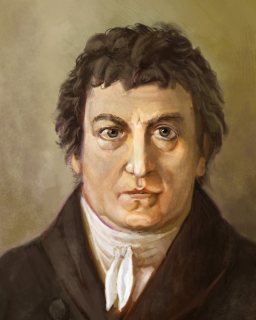
Fichte was a German philosopher who became a founding figure of the philosophical movement known as German idealism, which developed from the theoretical and ethical writings of Immanuel Kant…. Fichte was an important philosopher in his own right due to his original insights into the na- ture of... self-awareness. Fichte was also the orig-inator of thesis-antithesis-synthesis, an idea that is often erroneously attributed to Hegel. Like Des- cartes and Kant before him, Fichte was motivated by the problem of subjectivity and consciousness.
Introductory Comments
"May God protect us from our friends," Kant wrote in 1799; "against our enemies we can defend ourselves." He was quoting an Italian proverb, and he was talking about Fichte. It had begun far more happily. In 1792 an anonymous book appeared - Attempt at a Critique of All Revelation - written in such fluent Kantian idiom that readers took it for Kant's long-promised work on religion. Kant graciously named the unknown young author, and Fichte woke up famous.
But then, slowly, Fichte began to go his own way. Kant's "Copernican" turn had objects conform to the conditions of our knowing: space, time, causality, substance are the mind's own contribution, the forms that make experience possible at all. But beyond the appearances, Kant declared, lie things in themselves, real though forever unknown. Fichte at first accepted this distinction between the knowable and the unknowable, but then thought better of it. A something we can never reach, doing no work we can trace, is a hypothesis that costs more than it buys. So Fichte pulled the metaphysical rug from under the world - and left, his critics said, nothing but the self. Why say anything so counterintuitive? Partly, perhaps, it was due to the earnest inward Lutheran piety of Fichte's upbringing. German Pietism, like German Idealism, urged the self to merge with a higher reality. A place where one is no longer dragged down by those heavy and mindless things-in-themselves.
Some of Fichte's Key Positions
Kant was right that the human world is phenomenal: we never meet the world raw, only the world as the mind presents it. His mistake was what he added - "things in themselves," behind the appearances and forever out of reach. To say such things cause our sensations is to take causality, a concept that earns its keep only inside experience, and apply it beyond experience. Unwarranted on Kant's own terms - and handing the skeptic everything he needs to undermine our knowledge.
Better to drop things in themselves. The phenomenal world is not a veil hung over reality; it is reality. The question of how appearances match the things behind them is no longer there.
This does not make experience a passive show. The world is the work of the I's own activity, carried out by the productive imagination below the threshold of awareness - which is why it arrives feeling given rather than made. The I posits itself and, in the same stroke, a not-I over against it.
Nor is the I a thing. It is an activity, a striving, whose theoretical powers serve its practical vocation: the world is the material of our mind made sensible. Nor are we sealed inside our own heads. A free subject cannot discover its freedom unaided; it must be summoned to act by another who treats it as free. Self-consciousness is a social achievement: to posit others is to posit ourselves, and to posit ourselves is to posit others.
Place in the History of Ideas
Fichte's Place in History of Ideas
Russell: Kant's immediate successor, Fichte, abandoned "things in themselves," and carried subjectivism to a point which seems almost to involve a kind of insanity. He holds that the Ego is the only ultimate reality, and that it exists because it posits itself; the non-Ego, which has a subordinate reality, also exists only because the Ego posits it. Fichte is not important as a pure philosopher, but as the theoretical founder of German nationalism, by his Addresses to the German Nation, which were intended to rouse the Germans to resistance to Napoleon after the battle of Jena. The Ego as a metaphysical concept easily became confused with the em- pirical Fichte; since the Ego was German, it followed that the Germans were superior to all other nations.... On this basis he worked out a whole philosophy of nationalistic totalitarian- ism, which had great influence in Germany.
Roger Scuton: According to Fichte, Kant had shown that there are but two possible philos- ophies: idealism and dogmatism. The idealist looks for the explanation of experience in intel- ligence, the dogmatist in the "thing-in-itself." Kant had shown that idealism can explain everything that dogmatism explains, while making no assumptions beyond the reach of observation. The dispute between the two concerns whether "the independence of the thing should be sacrificed to that of the self, or... the self to that of the thing."
Random Thoughts on Fichte
To understand Fichte and the German Idealists generally, it helps to know something of German Pietism, that peculiar brew of mysticism, near-pantheism, and a faith in a striving, ever-unfolding spiritual life. Fichte fused this Pietist sensibility with a reworked Kant to produce the first great monument of German Idealism. His starting move was to drop Kant's "thing in itself" as a pointless encumbrance: if all we ever know is the reality perceived and conceived within the self, then the self simply is reality. Each self creates its own world - and its very first act of creation is to posit not only itself but also a "not-self," the conceptual space in which self and other selves interact.
But notice what's been given up. If self, others, and world are all, at bottom, mental positings, what stops the whole edifice from drifting free of any check on belief? Released from those "needless" things-in-themselves, German Idealism surged off in directions Kant would scarcely have recognized. The self was no longer that modest, boxed-in Cartesian thing; it could now aspire to merge with something grander - Spirit, Nation, History itself. That aspiration fed, among much else, the Romantic movement. Some historians and philosophers - Karl Popper most famously - have gone further, tracing a more troubling lineage from this same self-positing, freewheeling Spirit all the way to 20th-century Fascism. It's a serious argument, but a contested one. The connecting line is worth drawing, but only in pencil.
Bergson (Intuition gives our minds direct access to the nature of reality.)
Coleridge (Higher reason can lead us to truths that go beyond common thought.)
Cousin (Both sensibility and reason are needed to make sense of the world.)
Croce (All mental activity - indeed all reality - is founded on intuition.)
Kant (Judgments based on experience also rely on innate categories of mind.)
Malebranche (What's immediately perceived are ideas in the mind, not things.)
Proclus (All truth is interior. The objects of knowledge are inside the soul itself.)
Thinkers with opposing positions:
Barth (God is personal, but personal in an incomprehensible way.)
Davidson (Though mind springs from matter, it can't be reduced to matter.)
de Beauvoir (We can neither escape our personal freedom nor give it away.)
Durkheim (In modern society, the individual is the focus of rights & duties.)
Eriugena (God is both the ground of all things and the end or goal of all things.)
Hobbes (All things, including humans and their minds, are entirely material.)
Lotze (The world is not made up of mental images, but rather empical facts.)
Ortega (We are in no way free when we submerge our individuality in a group.)
Santayana (Mind has no causal power. All motion has merely physical causes.)
What others said about Fichte
Russell: In Kant, and still more in Fichte, the subjectivist tendency that begins with Descartes was carried to new extremes....
Windelband: For Fichte and his successors, the conception of the thing-in-itself thus became indifferent.... An object exists only for a subject; and the common ground of both is the reason, the I which perceives itself and its action.
William Turner: Thus [for Fichte] the thing-in-itself is absorbed, so to speak, in the subject, and instead of ultimate dualism we have idealistic monism. The... Ego alone, is real. We need not go beyond experience to find the ultimate reality, but in our analysis of experience we abstract the Ego, which is, therefore, transcendental though not transcendent.
Roger Scruton: Fichte’s philosophy rests not so much in argument as in impetuous explosions of jargon, in which that fabricated verb "to posit" (setzen) kaleidoscopes into a thousand self-reflecting images.
Hermann Weyl: Fichte, by his stubbornness in pursuing an idea, blind to nature and facts, was swept away into increasingly abstruse abstractions.
Schopenhauer: [Fichte is] the father of sham philosophy, of the underhand method that by ambiguity in the use of words, incomprehensible talk and sophisms, tries to… befool those eager to learn.
Berlin: Fichte [develops] a theological conception of the self; he says that the true, free self is not the empirical self which is clothed in a body and has a date and a place, it is a self which is common to all bodies, it is a super-self, it is a larger, divine self which he gradually begins to identify, now with nature, now with God, now with history, now with a nation.
Robert Blakely: He made no hesitation in pluming himself on his great skill in the shadowy and obscure, by often remarking to his pupils, that "there was only one man in the world who could fully understand his writings"....