Alexis Tocqueville (1805 - 1859)
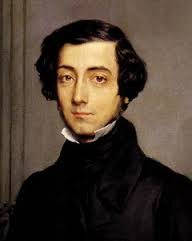
Open Tocqueville's interactive page (graphs of influences, similar and opposing positions, and quotes)
Background
Alexis de Tocqueville
Born: 29 August 1805 in Paris, French Empire
Died: 16 April 1859 (aged 53) in Cannes, French
Empire
Alma mater: University of Paris
School: Classical liberalism
Notable works: Democracy in America,
The Old Regime and the Revolution
Main interests: History, political philosophy,
sociology, politics, religion
Notable ideas: Voluntary association, mutual
liberty, soft despotism
Influences: Montesquieu, Voltaire, Rousseau,
Malesherbes, Pascal, Burke, Aristotle, Plato,
Locke
Influenced: Max Weber, John Stuart Mill,
Friedrich Hayek, Camillo Benso, Emmanuel
Todd, Raymond Aron, Pierre Manent, Harvey
Mansfield, Hannah Arendt, Virgil Nemoianu
From Wikipedia
Tocqueville was a French aristocrat, diplomat, political philosopher, and historian. He is best known for his works Democracy in America… and The Old Regime and the Revolution. In both, he analyzed the living standards and social conditions of individuals as well as their relationship to the market and state in Western societies. Democracy in America was published after Tocqueville's travels in the United States and is today consid- ered an early work of sociology and political science.
Introductory Comments
In May 1831 two young French magistrates, Tocqueville and his friend Beaumont, stepped off a ship in New York with an official commission to study American prisons, including experiments with solitary confinement. But the commission was largely a pretext. What Tocqueville had come to see and understand was the experiment those prisons sat inside. Nine months and some seven thousand miles later, he had his master key: equality of conditions, the fact from which everything else in America seemed to follow.
What Tocqueville made of this key was neither the sneer of the émigré nor the rapture of the reformer. He admired the townships, the juries, and the endless voluntary associations through which Americans governed themselves, and he judged their liberty real. Yet he came away uneasy. Stripped of the ranks that once told people who they were, Americans measured themselves against one another by what they had earned, and grew restless in the midst of their prosperity. Lacking any authority standing above the crowd, they trusted the majority's opinion more than their own reason - conformity in thought, mediocrity in taste. And Tocqueville thought he could see where that might end: not in a tyrant, but in a mild and tutelary state that relieves its citizens of the trouble of governing themselves, and citizens content to let it. He had crossed the ocean to inspect prisons. He left worried that a free people might build one for itself and never even notice.
Some of Tocqueville's Key Positions
Freedom is learned by practice, not conferred by statute. Citizens should be free of arbitrary government, but the ballot alone is a thin liberty. What trains a people in self-rule is the daily work of it - the New England township, the jury box, the voluntary association formed to build a church, open a school, or fight the sale of liquor.
The chief danger to freedom is the tyranny of the majority, which works less through law than through opinion. Where the majority is held to speak for the people, dissent looks like impiety; the dissenter is not imprisoned but ignored, isolated, left alone with his heresy. Nowhere is there less independence of mind than in America.
Individualism breeds a quieter danger too. It is the retreat of each citizen into a small circle of family and friends, leaving public affairs to the state. Over such a people grows a power "absolute, minute, regular, provident, and mild," which does not tyrannize so much as enervate. Administrative centralization can be itself a form of despotism.
The remedies here are not a disciplined governing class but a thicket of counterweights: decentralized administration, freedom of the press and of association, an independent judiciary, a legal profession whose habits supply the steadiness democracy lacks, and what he called self-interest rightly understood - the citizen's discovery that serving others serves himself.
Place in the History of Ideas
Tocqueville's Place in History of Ideas
Lord Acton: Tocqueville was a Liberal of the purest breed - a Liberal and nothing else, deep- ly suspicious of democracy and its kindred, equality, centralization and utilitarianism. Of all writers he is the most widely acceptable, and the hardest to find fault with. He is always wise, always right, and as just as Aristides. His intel- lect is without a flaw, but it is limited and constrained. He knows political literature and history less well than political life; his originality is not creative, and he does not stimulate with gleams of new light or... suggestiveness.
Friedrich Hayek: It is the burden of the argu- ment of Tocqueville's great work, Democracy in America, that democracy is the only effective method of educating the majority.... This seems also to explain the puzzling contrast between Tocqueville's persistent faultfinding with democracy on almost all particular points and the emphatic acceptance of the principle which is so characteristic of his work.
Alan S. Kahan: ... Tocqueville thought that organized religion was the only possible long-term counterweight to some of the main threats democracy faced: materialism on the one hand and religious fanaticism on the other.... Religion taught people that there were things in the universe more important than money, and encouraged them to... concentrate on higher and more distant goals.
Random Thoughts on Tocqueville
For all his worrying, 25-year-old Tocqueville found plenty in America to cheer. Town meetings delighted him, and so did the national mania for forming associations - to found a seminary, plant a school, encourage sobriety. Here was the one reliable antidote to the individualism he feared: citizens coaxed out of their private circles and taught, by doing, that public life is their business. The churches pleased him too. In France religion had married itself to the old regime and was hated accordingly. In America, having no political power to lose, it had kept its moral authority.
Then there were the women. What struck him first was the unmarried American girl - frank, self-possessed, reasoning her way through a world her French counterpart would have been carefully shielded from, and losing nothing by it. What she did next he admired rather more than a modern reader will: on marrying, she withdrew into the household, and Tocqueville thought her right to. His praise was for the clear and proud division of labor, freely entered. Still, one wonders what else was at work in his enthusiasm for American women. Perhaps a young nobleman was unused to being looked at squarely by women who had no idea what his surname was worth and no interest in finding out. In an aristocracy, a man is received according to rank and family. In a democracy, he has to be received as himself. Unnerving, surely. But for a young French aristocrat with a curious and open mind, perhaps also strangely exciting.
Influences
Tocqueville was influenced by: Aristotle, Burke, Locke, Malesherbes, Montesquieu, Pascal, Plato, Rousseau, Voltaire
Tocqueville influenced: Arendt, Aron, Raymond, Benso, Camillo, Hayek, Manent, Pierre, Mansfield, H., Mill, Nemoianu, Todd, E., Weber
Similar and opposing positions
Thinkers with similar positions:
- Burke (In representative democracy leaders should lead, not just represent.)
- Carlyle (Democracy is just the way to choose the best representatives to rule.)
- Dewey (To function well, democracy requires an engaged & educated citizenry)
- Habermas (Both democracy & science rely on free & rational communication.)
- Hayek (Only free market capitalism is consistent with freedom & democracy.)
- Herzen (Humans should never be sacrificed on an altar of glorious abstractions)
- Mill (Political freedom is negative in that it's the absence of restraint.)
- Weber (Democracy needs to be guided by an intellectual elite.)
Thinkers with opposing positions:
- Arendt (Representatives should represent their constituents, not lead them.)
- Bentham (Representatives should represent their constituents, not lead them.)
- Dewey (Participation, not representation, is the essence of democracy.)
- Evola (Liberal democracy represents an ignoble trend towards mediocrity.)
- Godwin (The goods that benefit us must be regulated by justice alone, not laws.)
- Goldman (Revolution is a violent process, but also at times a necessary one.)
- Maistre (A strong government requires loyality to a strong monarch and church.)
- Proudhon (As we seek justice in equality, so society seeks order in anarchy.)
What others said about Tocqueville
- Salisbury: Tocqueville, whose bias if anything was in favor of democracy,… speaks as strongly upon this subject as the bitterest caricaturist could have....
- Hayek: Nobody saw more clearly than de Tocqueville that democracy as an essentially individualist institution stood in an irreconcilable conflict with socialism.
- Marvin Zetterbaum: ... "Democracy in America" established Alexis de Tocqueville as one of the foremost analysts of the problem of democracy. Tocqueville was the first writer of modern times to undertake a comprehensive investigation of the way in which the democratic principle, equality, functions as a first cause, shaping or affecting every aspect of life within society.
- Gladstone: De Tocqueville was the Burke of his age, and his treatise upon America may well be regarded as among the best books hitherto produced for the political student of all times and countries.
- Marvin Zetterbaum: Tocqueville's purpose in the "Democracy" is to show men how they might be both equal and free....
- Harriet Grote: M. de Tocqueville [is] a small and delicate-looking young man and a most engaging person. Full of intelligence and knowledge.... In conversing he displays a candid and unprejudiced mind....
- James Bryce: The more one reads Tocqueville, the more admiration does one feel for his acuteness, for the delicacy of his analysis, for the elegant precision of his reasonings, for the limpid purity of his style; above all for his love of truth and the elevation of his views. He is not only urbane, but judicial; not only noble, but edifying.
- Marvin Zetterbaum: Tocqueville's defense of the utility of religion does not lead him to advocate a state religion; on the contrary, he draws from political considerations the necessity of the separation of church and state.
Schools: Classical Liberalism
Main interests: Community, Democracy, Freedom of the press, Government, History, Ideology, Justice, Law, Political Philosophy, Political Theory, Politics, Progress, Public Administration, Punishment, Religion, Revolution, Social Criticism, Social Philosophy, Social Theory, Will
Tocqueville's answers to philosophical questions
History
"History is a gallery of pictures in which there are few originals and many copies."
Democracy is not always progress: "Nothing is so irresistible as the tyrannical power commanding in the name of the people."
Law
If we do not acknowledge basic human rights, we cannot define, let alone condemn, governmental abuse.
"[Liberty] considers religion as the safeguard of morality, & morality as the best security of law & [best pledge] of freedom."
"When I refuse to obey an unust law..., I simply appeal from the sovereignty of the people to the sovereignty of mankind."
Nature
"Though man resembles the animals in many respects, one [trait] is peculiar to him alone: he improves himself...."
Political Philosophy
Representative democracy is best: The people can express their views in elections, but they should not rule directly.
"Trade [neutralizes] all violent passions. Trade loves moderation, delights in compromise, and is most careful to avoid anger."
Equality is the driving force in a democracy, but when equality conflicts with liberty, democracies should choose liberty.
Capitalism is a wonderfully productive system, but it must not be interfered for with for selfish or political reasons.
"I am neither of the revolutionary party nor of the conservative.... Liberty is my foremost passion."
No type of government can guarantee human rights if the people ruled are intent only on pursuing petty pleasures.
Unlike the French Revolution, the American Revolution was not marked by disorderly passions, but by a love of order & law.
Church should separate itself from civil government. Its proper power springs from its appeal to the heart of the people.
No matter how much some may try "to make all citizens equal," people will always strive "to rise above the common level."
Beware socialism: "[W]hile democracy seeks equality in liberty, socialism seeks equality in restraint and servitude."
Psychology
"What is called family pride is often founded on the illusion of self-love. A man wishes to perpetuate & immortalize himself."
Religion and Theology
"Liberty cannot be established without morality, nor morality without faith."
Society
The continual progress of democracies towards a more just equality of conditions is destined by Divine Providence.