Galileo (1564 - 1642)
Open Galileo's interactive page (graphs of influences, similar and opposing positions, and quotes)
Background
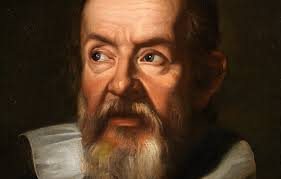
Galileo Galilei
Born: 15 February 1564 in Pisa, Duchy of
Florence, Italy
Died: 8 January 1642 (aged 77) in Arcetri, Grand
Duchy of Tuscany, Italy
Alma mater: University of Pisa (no degree)
Institutions: University of Pisa, University of
Padua
Main interests: Astronomy, physics, engineering,
natural philosophy, mathematics
Influences: Aristotle, Nicolaus Copernicus,
Giordano Bruno, Avicenna, Nicole Oresme
Influenced: Johannes Kepler, Christiaan
Huygens, Evangelista Torricelli, Robert Boyle,
Vincenzo Viviani, Benedetto Castelli, Mario
Guiducci, Thomas Hobbes, Isaac Newton,
Blaise Pascal, Italo Calvino, Francis Bacon,
Marin Mersenne, Pierre Gassendi, Nicholas Fabri
de Peiresc, John Wilkins, John Wallis
From Wikipedia
Galileo was an Italian astronomer, physicist and engineer, sometimes described as a polymath. He was born in the city of Pisa, then part of the Duchy of Florence. Galileo has been called the father of observational astronomy, modern-era classical physics, the scientific method, and modern sci- ence…. Galileo's championing of Copernican helio- centrism was met with opposition from within the Catholic Church and from some astronomers. The matter was investigated by the Roman Inquisition in 1615…. He was... forced to recant.
Introductory Comments
On January 7, 1610, Galileo turned his telescope toward Jupiter and noticed "three fixed stars, totally invisible by their smallness," strung out beside the planet in a neat straight line. Three nights later one of these faint pinpricks had vanished. Within days a fourth had appeared, and Galileo drew his startling conclusion: these were no fixed stars at all, but moons wheeling around Jupiter. Here was a little system of worlds circling something other than the earth.
The implications rippled outward and, over the following century, swelled into a tsunami. Galileo's discovery did not, by itself, prove that the earth moves, but it demolished one of the oldest objections to Copernicus, the commonsense insistence that all heavenly motion must center on us. And it unsettled something far larger than an astronomical diagram. The Catholic Church had placed earth at the very heart of creation's story. If it is not, then perhaps neither are we.
A species shunted to the margins might be a species God has no special reason to notice. Our moral values, which we had imagined echoing through the cosmos, might merely be rattling around inside our own skulls - while beyond them stretches a universe cold, vast, and supremely indifferent. These fears were not the immediate result of Galileo's discovery, but the result of the Copernican tsunami to come. A tsunami kicked off by four barely perceptible dots near Jupiter.
Some of Galileo's Key Positions
Natural philosophers have placed too much weight on the search for the underlying "why" of things. For science to advance, it should instead study the measurable properties and patterns of phenomena. Such measurements reveal the hidden relationships, or laws, that govern nature. This is not to banish causes altogether; it is to insist that we first describe how a phenomenon behaves, before speculating about why - and to distrust the hidden, "occult" causes that explain everything and predict nothing.
The best tool for uncovering these laws is mathematics. Indeed, nature's laws are inherently mathematical, written not in words but in the language of geometry and number. Science has two other primary tools. The first is careful observation, aided by instruments such as the telescope. The second is the well-designed experiment, which yields precise, measurable results. Observation and experiment supply the raw material, and mathematics the laws.
By such means we have found powerful evidence for Copernicus's claim that the earth revolves around the sun. To many this is both shocking and heretical, since it seems to defy the plain testimony of the senses and the teachings of the Church. Yet in astronomy and physics, the demonstrated findings of science deserve more credence than the authority of Aristotle or the pronouncements of theologians.
Place in the History of Ideas
Galileo's Place in History of Ideas
Cassirer: For Galileo, [unlike Aristotle and the Scholastics,] the unity of nature… follows from the unity of physics which, in turn, is guaran- teed by the unity of geometry and mathemat- ics. Because there are general axioms for measurement and for the exact and empirical determination of quantities, the world of the measurable contains no oppositions that cannot be resolved. We must understand the fall of a stone and the movements of the stars by the same basic norms; and by these same norms we must define both heaven and earth.
I. Bernard Cohen: His conflict with the Catholic Church arose because deep in his heart Galileo was a believer. There was for him no path of compromise, no way to have separate secular and theological cosmologies. If the Copernican system was true as he believed, what else could Galileo do but fight with every weapon he had in his arsenal... to make his Church accept a new system of the universe.... In the contrast between Galileo's heroic stand when he tried to reform the cosmological basis of orthodox theology and his humbled, kneeling surrender when he disavowed his Copernicanism, we may sense the tremendous forces attendant on the birth of modern science.
Einstein: It has always hurt me to think that Galilei did not acknowledge the work of Kepler.... That, alas, is vanity.
Random Thoughts on Galileo
Einstein is celebrated for his thought experiments, but Galileo was performing the same trick three centuries earlier - running experiments in the laboratory of the mind when no real apparatus would do. Take the one he aimed at Aristotle's doctrine of falling bodies. Aristotle held that heavier objects fall faster than lighter ones. Now imagine two balls of different weights tied together by a string. By Aristotle's logic the lighter ball, falling more slowly, should drag on the heavier one and slow the pair down. Yet the two balls joined together also form a single, heavier object - which, by that same logic, ought to fall faster than the heavy ball alone. The heavy ball is thus made to fall both slower and faster than itself: a plain contradiction. The tidy way out, Galileo saw, is that weight makes no difference at all.
Or take the puzzle of how the earth can hurtle through space without our feeling the slightest breeze. Shut two friends below deck, Galileo proposed, with butterflies fluttering, fish swimming in a bowl, and water dripping steadily from a bottle into a basin. Let the ship sit at rest, and note how everything behaves. Then let it sail smoothly ahead at any constant speed you like - no lurching, no turning. Nothing changes. So too, we might glide along with the spinning earth and never feel a thing. To sum up: Long before Einstein pictured himself riding a beam of light, Galileo was already down in the ship's hold, watching the butterflies.
Influences
Galileo was influenced by: Aristotle, Avicenna, Bruno, Copernicus, Nicholas of C., Oresme, N.
Galileo influenced: Bacon, Francis, Boyle, Calvino, Italo, Castelli, B., Einstein, Gassendi, Guiducci, M., Hawking, S., Hobbes, Huygens, Kepler, Mersenne, Newton, Pascal, Peiresc, N.F., Torricelli, Viviani, V., Wallis, John, Wilkins, John
Similar and opposing positions
Thinkers with similar positions:
- Albertus Mag. (The pursuit of science is consistent with religious devotion.)
- Bacon, Francis (We must pursue science to further our understanding of nature.)
- Bruno (The Bible should be followed for its moral teaching, not cosmology.)
- Collingwood (Methods of the humanities are not like those of science.)
- Democritus (Everything is the result of natural laws related to matter & motion)
- Epicurus (Only believe what's tested thru direct observation and deduction.)
- Iamblichus (The key to understanding the workings of nature is mathematics.)
- Popper (Basic statements in science are not mere reports of passive sense data.)
Thinkers with opposing positions:
- Aristotle (Final Causes or purposes are at work everywhere in our world.)
- Berkeley (Causation is due to God, not to the interactions of matter.)
- Blake (Pursuit of science can lead to a sterile and atheistic worldview.)
- Carnap (Scientific knowledge can be reduced to a series of sense-data claims.)
- Edwards (God alone is the only real cause at work in the world - not matter.)
- Humboldt, A. (Nature is dynamic and interdependent - not simple mechanics.)
- Marcel (Science & technology threaten to destroy the mystery of being.)
- Tillich (Faith in God is man's ultimate concern, even for the nonbeliever.)
What others said about Galileo
- Einstein: .... Galileo became the father of modern physics and in fact of the whole of modern natural science.
- Cassirer: Galileo asserts that in the field of mathematics man reaches the climax of all possible knowledge - a knowledge which is not inferior to that of the divine intellect.
- Florian Cajori: ... Galileo pursued principally dynamics. Galileo was the first to abandon the Aristotelian idea that bodies descend more quickly in proportion as they are heavier; he established the first law of motion; determined the laws of falling bodies; and, having obtained a clear notion of acceleration..., was able to prove that projectiles move in parabolic curves.
- Hobbes: Galileus in our time... was the first that opened to us the gate of natural philosophy universal, which is the knowledge of the nature of motion. So that [none] can the age of natural philosophy be reckoned higher than to him.
- Kant: A light was kindled amongst the investigators of nature when Galilei let balls of a definite weight roll down the inclined plane.
- Aram D'Abro: Galileo was the first scientist to recognise clearly that the only way to further our understanding of the physical world was to resort to experiment... (Democritus and Archimedes excepted).
- Feyerabend: The church at the time of Galileo was much more faithful to reason than Galileo himself, and also took into consideration the ethical and social consequences of Galileo's doctrine. Its verdict against Galileo was rational and just, and revisionism can be legitimized solely for motives of political opportunism.
- R. D. Laing: Galileo's program offers us a dead world: Out go sight, sound, taste, touch, and smell, and along with them have since gone esthetic and ethical sensibility, values, quality, soul, consciousness, spirit.
Schools: Atomism, Rationalism
Main interests: Astronomy, Cosmology, Engineering, Geometry, Mathematics, Physics, Power, Science
Galileo's answers to philosophical questions
Epistemology
"[Unless the mind] is stimulated by images of things acting upon it from without, all remembrance of them passes... away."
"Where the senses fail us, reason must step in."
"To be humane, we must ever be ready to pronounce that wise, ingenious and modest statement 'I do not know'."
"Two truths cannot contradict one another…. All truths combine into one coherent and consistent system or whole."
"... with regard to those few [things] which the human intellect does understand, [his] knowledge equals the Divine...."
Language
"Names and attributes must be accommodated to the essence of things, and not the essence to the names..."
Metaphysics
The question of causation often leads nowhere. Science should instead study the nature and properties of phenomena.
Nature
"The sun, with all [the planets] dependent on it, can still ripen a bunch of grapes as if it had nothing else in the universe to do."
Religion and Theology
"God [is no] less excellently revealed in Nature's actions than in the sacred statements of the Bible."
I don't believe that God, who has endowed us with senses, reason and intellect, would ever want us to forgo such gifts.
"Nature... is inexorable and immutable; she never transgresses the laws imposed upon her."
We will often err in our interpretation of Scripture "if we always stopped short at the literal signification of the words."
Science
Science studies the properties of nature in order to discover, when possible, the mathematical laws at work in nature.
Science can explain all objective phenomena, but does not deal with purely subjective qualities like taste and sound.
Science is inductive in that in relies on careful observation, but also analytic in that it tries to discover laws of nature.
The "vain presumption of understanding everything can have no other basis than never understanding anything."
A physicist needn't theorize as to causes of physical actions, but must instead mathematically describe physical actions.
"To understand the Universe, you must understand the language in which it's written, the language of Mathematics."
"The prohibition of science would be contrary to the Bible, which" teaches how God's greatness is seen in all his works.