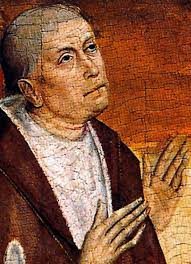
Nicholas of Cusawas a German Catholic cardinal and polymath active as a philosopher, theologian, jurist, mathematician and astronomer. One of the first German proponents of Renaissance human- ism, he made spiritual and political contributions in European history. A notable example of this is his mystical or spiritual writings on "learned ignorance," as well as his participation in power struggles between Rome and the German states of the Holy Roman Empire.
Introductory Comments
15th-century Europe was a world in transition, straddling the late Middle Ages and the early Renaissance, and Nicholas of Cusa embodies that in-between moment as well as anyone. He was schooled both in medieval Scholasticism and in the humanism then stirring in Italy, and his books look in two directions at once: toward the hidden nature of God, and toward the actual nature of the world that flows from him. God, Nicholas argued, is absolutely One and Infinite, and so must remain forever beyond the reach of creatures like us, who know only the many and the various. And yet we are not shut out entirely. We can draw nearer to God through a kind of "learned ignorance" that knows itself to be ignorant and that, in its humility, clears a space for a mystical awareness of God as the Oneness underlying all being.
But this mystical sense of the One never dampened Nicholas's delight in the many. The world of richly diverse things - measurable, orderly, and waiting to be discovered - fascinated him no less than the God behind it. And Nicholas was himself a discoverer. His speculations helped prepare the ground for later developments as varied as Copernican heliocentrism and non-Euclidean geometry. He guessed that the stars are distant suns, each perhaps attended by its own worlds, and he insisted that mathematics is the key that unlocks the hidden order - the rationality of God's creation. For Nicholas, the One and the many were not rivals but two faces of a single divine whole.
Some of Nicholas of Cusa's Key Positions
In creating the world, God "unfolded" into all things, so that the universe becomes the sensible expression of the divine. Yet even as God unfolds into the world, he also "enfolds" all things within himself. God is thus present in everything without being reducible to anything - immanent in every creature yet forever beyond it. If we know how to look, we can glimpse traces of him everywhere, though the glimpsing is never a grasping.
To know such a God, ordinary reasoning simply fails. Reason does its work among finite, measurable things. But the infinite offers no common measure to reason with, and so the finite mind boggles. What is needed instead is "learned ignorance": a humbled mind that recognizes the limits of its own knowing and, in that very humility, draws nearer to God than any syllogism could. For in the infinite, the opposites that divide all finite things - greatest and least, center and circumference - finally coincide.
And because an infinite universe can have no fixed center and no outer edge, the earth cannot sit at the middle of things; indeed, there is no middle for it to occupy. The celestial bodies are not perfect spheres, nor are their orbits perfect circles, and all of them are in motion - the earth very much included. And no motion is ever absolute, for it can be judged only relative to an observer, who invariably imagines himself to be the one standing still. (Sound familiar?)
Place in the History of Ideas
Nicholas of Cusa's Place in History of Ideas
Theosophy Trust, Great Teachers Series: Draw- ing from Pythagoras, Dionysius the Areopagite, and Meister Eckhart, Nicholas of Cusa kept alive the mystic flame of intuition and passed it to individuals as different as Copernicus. Whilst struggling for moral reform within a decaying structure, he subtly laid the foundation of human dignity upon which both the Renais- sance and the Reformation would be built.
Thomas J. McFarlane: The fundamental insight that inspires Nicholas's thought... comes not from his wide learning, but from a mystical illumination in 1437 during a journey home from Constantinople. This gift from God, as he describes the vision, provided him with the key that allowed him to talk about the ineffable, and provided a way of viewing opposites as coincident from the point of view of infinity.
Cassirer: Cusanus summarizes all these thoughts in a pregnant metaphor. The human mind, he writes, is a divine seed that comprehends in its simple essence the totality of everything know- able; but in order for this seed to blossom and bear fruit, it must be planted in the soil of the sensible world. The basic character of that "copulative theology" sought by Cusanus lies in this reconciliation of mind and nature, of intel- lect and sense. With complete consciousness of method, he now opposes this to all theology that is merely "disjunctive,"... and divisive.
Random Thoughts on Nicholas of Cusa
Anyone with a taste for oxymorons must find the title of Nicholas's On Learned Ignorance irresistible. Ignorance by itself is nothing to boast about. But an ignorance that knows itself to be ignorant - well, that is another matter entirely. Socrates held that admitting one's ignorance is the beginning of wisdom, and mystics across the centuries have said much the same: to reach enlightenment we must first empty the mind, shedding our pretensions to knowledge so that we can be receptive to the reality around us and within us.
Nicholas argues along similar lines. Our journey toward God must begin with a confession of how little we know of him. The finitude of the human mind can never encompass God's infinitude; human frailty can never take the measure of his omnipotence; and the restless, scattered human spirit can never contain his perfect Oneness. God's nature lies so far beyond our reach that the admission of ignorance becomes itself a form of reverence - a bow before the divine mystery.
And that admission does more than humble us; it makes room. As nature is said to abhor a vacuum and rushes to fill it, so a humble spirit that owns its own ignorance is somehow filled in turn. As a hollow tree trunk draws a whole menagerie of creatures into its shelter, so an empty but knowing ignorance draws in intimations of God. The trick, it seems, is that we must first be emptied before we can be filled.
Albertus Mag. (The pursuit of science is consistent with religious devotion.)
Avicenna (The pursuit of science is consistent with religious devotion.)
Barth (God is infinitely incomprehensible. We can't reason our way to God.)
Bonaventure (All the sciences are but the handmaids of theology.)
Chrysippus (The universe itself is God or the universal outpouring of His soul.)
Erasmus (Everything of value in pagan culture is consistent with Christianity.)
Eriugena (God has created the world out of his own being.)
Fichte (Intuition gives our minds direct access to the ground & nature of reality.)
Petrarch (Despite its pagan beliefs, we can learn much from classical antiquity.)
Proclus (Though souls descend into the material world, a divine Unity exists.)
Thinkers with opposing positions:
Bruno (God is not transcendent. Everything in Nature is part of God.)
Darwin (It is absurd to talk of one animal being higher than another)
Diderot (The universe is simply matter in motion, bound by laws of nature.)
Feuerbach (Our concept of God reflects our own traits and deepest wishes.)
Frege (Logic is the appropriate measure of what can or cannot be.)
Jefferson (I accept Jesus's precepts but not the corruptions of Christianity.)
What others said about Nicholas of C.
Copleston: [Nicholas was] a transition-thinker, a philosopher of the Renaissance, who combined the old [Scholastism] with the new [humanism].
J. Hirschberger: The... scholastic technique of question and response, the syllogistics and the cult of authority fostered by the... Schools were foreign to [Nicholas]; in fact, he hoped and sought to liberate philosophy from [all of this].
Cassirer: Nicholas of Cusa finds his fundamental conception of humanity (humanitas) embodied in the idea of Christ. The humanity of Christ becomes the bond of the world and the highest proof of its inner unity; for it is Christ's humanity which bridges the chasm between the infinite and the finite, between the creative first princple and created being.
Thomas J. McFarlane: According to Nicholas, this logic of infinitude unites opposites, transcends comparison, overcomes limits of discursive reasoning, and goes beyond both positive and negative theology.
E. T. A. Hoffmann: [Nicholas of Cusa was] true founder of German philosophy.
Norman Moore: In medicine [Nicholas] introduced an improvement which [is] in use to this day. This improvement was the counting of the pulse which up to his time had been felt and discussed in many ways but never counted.
David John De Leonardis: Cardinal Cusa claimed that God sent a variety of prophets into the world in order to reveal Himself to humanity. To achieve this goal these prophets created a variety of faiths.... For Cusa since the diversity of faiths are merely different ways of articulating the same underlying truth, there is no real basis for mutual attacks over these differences.
Clyde Lee Miller: Nicholas anticipated many later ideas in mathematics, cosmology, astronomy and experimental science while constructing his own original version of systematic Neoplatonism.
Schools: Christian Humanism, Christian Mysticism, Christian Theology, Divine Illumination, Emanationism, Mysticism, Platonism, Pythagoreanism, Scholasticism