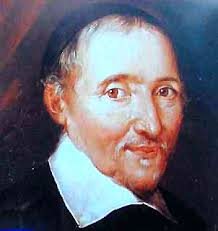
Pierre Gassendi (1592 - 1655)
Open Gassendi's interactive page (graphs of influences, similar and opposing positions, and quotes)
Background
Pierre Gassendi
Born: 22 January 1592 in Champtercier,
Provence, France
Died: 24 October 1655 (aged 63) in Paris,
France
Schools: Empiricism, Modern Epicureanism,
Atomism
Main interests: Logic, science, physics, religion,
ethics, astronomy, mathematics, epistemology,
psychology, education
Influences: Aristotle, Epicurus, Lucretius,
Galileo Galilei, René Descartes, Johannes Kepler,
Nicolas-Claude Fabri de Peiresc, Patricius
Influenced: Walter Charleton, Thomas Hobbes,
John Locke, Gottfried Leibniz, François Bernier,
Kenelm Digby, Nathaniel Highmore, Francis
Glisson, Thomas Willis, Robert Boyle, Isaac
Newton, David Hume, Thomas Reid, Christiaan
Huygens, Cyrano de Bergerac
From Wikipedia
Gassendi wrote numerous philosophical works, and some of the positions he worked out are considered significant, finding a way between skepticism and dogmatism. Richard Popkin indicates that Gassendi was one of the first thinkers to formulate the modern "scientific outlook", of moderated skepticism and empiri- cism. He clashed with his contemporary Descartes on the possibility of certain knowledge. His best known intellectual project attempted to reconcile Epicurean atomism with Christianity.
Introductory Comments
A cathedral provost who spends his career rehabilitating Epicurus invites suspicion, and Gassendi has never lacked for suspicious readers. On one account he belongs to a 17th-century freethinking underground - pious in public, corrosive in private. The case is circumstantial but not silly. Epicurus was, in early modern Europe, practically a byword for atheism. Gassendi revived his atomism, defended pleasure as the natural end of life (within the bounds of virtue), and described a universe running on regular natural laws. Take those three together, the argument goes, and orthodoxy quietly loses its footing.
Others find this reading strained. Gassendi was an ordained priest who held his cathedral post for decades and professed his faith to the end. His moral philosophy sits comfortably alongside Christian ethics, and he said plainly that his target was Aristotle, not the Church. The subversive reading also has a nasty habit of being bullet-proof: Whatever further evidence you give against it, becomes further evidence of Gassendi's cunning in concealing his unbelief, which makes the thesis unfalsifiable. There is an even better reason to doubt Gassendi's doubters. His amendments to Epicurus made the atoms finite and created, put God behind their motion, restored providence, and gave humans an immaterial soul and a free will - breaking with Epicurus in very fundamental ways. A man smuggling atheism past the censors does not perform that much structural surgery.
Some of Gassendi's Key Positions
Progress in science and philosophy requires patient observation joined to a tough-minded skepticism. Nothing has retarded that progress more than uncritical deference to Aristotle. Knowledge begins in the senses, and from particulars reason climbs by induction toward general notions - though induction always reaches further than the evidence beneath it.
The senses deliver appearances only, never the inner essences of things. This is no counsel of despair. Between the dogmatist, who claims too much, and the Pyrrhonist, who claims nothing, lies a workable middle path. This path leads to conclusions that are probable rather than certain, but probability is enough to build a science on.
The most important probable theory is also the oldest: the theory of inivisible atoms moving through space and gathering together in material objects. But Epicurus needs correcting. The atoms are finite in number, created by God and set moving by him. The soul that animates the body is material and shared with the beasts; whereas the rational soul is immaterial, immortal, and free.
Descartes also needs revising. He was right that thinking proves the thinker exists, wrong to suppose it proves what the thinker is. "I walk, therefore I am" would serve as well. The mind is known through its acts, and reason cut loose from the senses cannot be trusted.
Place in the History of Ideas
Gassendi's Place in History of Ideas
William B. Ashworth, Jr.: Gassendi is not nearly as well-known as his contemporary Rene Des- cartes, but in their day they were considered near equals, proponents of two different me- chanical philosophies. Gassendi, unlike Des- cartes, was an atomist. It was Gassendi who revived ancient atomism and made it respect- able. Ever since Democritus proposed the idea in ancient Greece, atomism had always been associated with atheism, since it presents a world of soul-less matter, interacting at ran- dom, with no purpose or design. Gassendi, him- self a Catholic priest, made atomism theologi- cally respectable, suggesting that God created atoms and endowed them with motion, fore- seeing their interactions, and using them as secondary causes to achieve divine ends.
Peter J. King: Gassendi especially rejected Descartes' use of universal doubt, and his appeal to knowledge gained through reason alone. Systematic doubt was acceptable, but to doubt everything was unreasonable - indeed, not clearly possible. As a special case of that, perhaps, he held the Aristotelians and Descartes alike guilty of rejecting the help of as wide a range of writers as possible: Epicurus of course, but also Plato, Democritus, and other ancient writers.... As for reaching knowledge through the use of reason alone, Gassendi's mature view was that, though reason must play its part, all knowledge must start with the senses....
Random Thoughts on Gassendi
Newton's remark about standing on the shoulders of giants comes from a letter to Robert Hooke, and it has never quite escaped the suspicion of being less a tribute than a barb. Newton named no giants. But one of the unnamed has a decent claim to be Gassendi. The route runs through Walter Charleton, whose Physiologia of 1654 was substantially Gassendi in English. Newton read it at Cambridge, and his student notebook shows the atoms and the void arriving together. Gassendi's space - incorporeal, real, indifferent to whether anything occupies it - stands behind Newton's absolute space, and Gassendi's atoms behind the corpuscles of the Opticks. Gassendi had also argued that a body set moving in a void would continue in a straight line indefinitely, which is Newton's first law arriving forty-five years early.
And yet the two men wanted different things from physics. Gassendi held that atoms explained everything, yet could never be seen. Atomism therefore would remain always a probable hypothesis. Newton did not answer Gassendi's skepticism so much as step around it. The Principia describes how gravity acts with ruthless precision while refusing to say what gravity is; "I feign no hypotheses" is as modest a sentence as anything Gassendi wrote. The difference lies in where each man placed his modesty. Gassendi was sure of the cause and resigned to never seeing how it works. Newton - thanks to mathematics - was exact about how things work and silent about the cause.
Influences
Gassendi was influenced by: Aristotle, Descartes, Epicurus, Galileo, Kepler, Lucretius, Patricius, Peiresc, N.F., Pyrrho
Gassendi influenced: Bernier, F., Boyle, Charleton, W., Cyrano de B., Digby, Kenelm, Glisson, F., Highmore, N., Hobbes, Hume, Huygens, Leibniz, Locke, Newton, Reid, Willis, Thomas
Similar and opposing positions
Thinkers with similar positions:
- Bacon, Francis (We must pursue science to further our understanding of nature.)
- Boethius (God's perfect foreknowledge is compatible with human free will.)
- Democritus (Everything is composed entirely of various imperishable atoms.)
- Epicurus (Contentment is gained thru moderation and living a measured life.)
- Hume (We only really know the immediate impressions of our senses.)
- Locke (Knowledge springs from experience of the actual world around us.)
- Montaigne (Be a little skeptical when considering all views, even one's own.)
- Ockham (Universals are just concepts. Only concrete individual things are real.)
- Socrates (We should question assumed truths to see if they are in fact true.)
Thinkers with opposing positions:
- Abelard (Reason, not faith, is the foundation of most Christian beliefs.)
- Aristotle (4 causes are at work in nature: material, formal, efficient and final.)
- Descartes (Everything we perceive both clearly and distinctly must be true.)
- Hegel (History follows the dictates of reason and the dialectics of ideas.)
- Kant (Humans are born with certain innate ways or categories of thinking.)
- Malebranche (The ideas through which we perceive objects exist in God.)
- Pascal (Skepticism is a product of the devil and we must fight against it.)
What others said about Gassendi
- Gibbon: [Gassendi was] the greatest philosopher among literary men, and the greatest literary man among philosophers.
- William B. Ashworth, Jr.: Through Gassendi, atomism would come to England, where it became a fundamental part of the mechanical philosophies of Robert Boyle and Isaac Newton.
- Randall Collins: [Gassendi] occupied the attention space too close to Descartes to keep up an independent identitiy.... He criticized his rival Descartes with the skeptical argument that the criterion of clear and distinct truth needs a further criterion of what is clear and distinct, but he was unable to stop the juggernaut of Cartesian rationalism....
- Antonia Lolordo: Gassendi's first biographers... describe him as gentle, easy-going, sociable, candid, and - importantly for someone dependent on patronage and the good will of other intellectuals - humble.
- Anthony Gottlieb: [Gassendi's views influenced Locke,] particularly their emphasis on the role of sensory experience in the formation of knowledge.
- Anthony Kenny: Gassendi sought to show that the philosophy of the pagan Epicurus was no more difficult to reconcile with Christianity than was the philosophy of the pagan Aristotle.
- Saul Fisher: And while Gassendi also sought to communicate anew the ideas of Epicurus, the Stoics, and other earlier thinkers, his resulting amalgam of perspectives provides a modern view of his own making, one of the touchstones of philosophy and science in his times: our access to knowledge of the natural world is dependent on... information provided by senses.
- John Herman Randall Jr.: [Gassendi's] combination of strong interest in mechanistic science with little critical modification of religious beliefs was common enough in that age, and is in this.
Schools: Atomism, Christian Theology, Empiricism, Epicureanism, Physicalism, Skepticism, Voluntarism
Main interests: Astronomy, Education, Epistemology, Ethics, Logic, Mathematics, Physics, Psychology, Religion, Science, Theology
Gassendi's answers to philosophical questions
Epistemology
The senses are more fundamental than the intellect, for "there's nothing in the intellect which has not been in the senses."
Perceptions arise when atoms from our surroundings hit our sense organs in a way that mirror the world around us.
Empirical evidence is the surest source of all knowledge and is the foundation upon which science is built.
The intellect can reach general notions unavailable to the senses, but the senses remain the sole source of knowledge.
Ethics
Happiness is the final aim of life. However, being the harmony of soul & body, perfect happiness is not possible in this life.
"I was born without knowing why, I have lived without knowing why, and I am dying without either knowing why or how."
Metaphysics
The universe consists of indivisible tiny particles created by God. Though countless, these atoms are finite in number.
If Descartes' claim is correct that the mind is a thinking substance lacking extension, how can mind be attached to the body?
Nature
As Cicero admonished us, "man was destined for other things than for seizing and cutting the throats of other animals."
Religion and Theology
Though we live in a material universe made up of atoms, we have an immaterial and immortal soul.
Science
Though science is based on the senses, it also involves inductive reasoning - analysis rising from lower to higher notions.
"If we know anything we know it by mathematics…."