Isaac Newton (1642 - 1727)
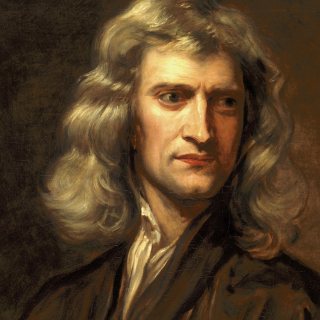
Open Newton's interactive page (graphs of influences, similar and opposing positions, and quotes)
Background
Isaac Newton
Born: 25 December 1642 in Woolsthorpe,
Lincolnshire, England
Died: 20 March 1727 (aged 84) Kensington,
Middlesex, England
Fields: Physics, Natural philosophy, Alchemy,
Theology, Mathematics, Astronomy, Economics
Alma mater: Trinity College, Cambridge
Influences: Euclid, Bacon, Descartes, Galileo,
Copernicus, Pascal, Kepler, Boyle, Huygens,
Isaac Barrow, Gerolamo Cardano, Henry More,
Ibn Tufail, Henry Briggs, Thomas Street,
Maimonides
Influenced: Edwards, Jefferson, Berkeley, Hume,
Kant, Voltaire, Maupertuis, Émilie du Châtelet,
William Wollaston, Einstein, Edmond Halley,
Abraham de Moivre, Neil deGrasse Tyson,
William Whiston, David Brewster, Willem 's
Gravesande, Thomas Bayes
From Wikipedia
Newton was an English polymath active as a mathematician, physicist, astronomer, alchemist, theologian, and author.... He was a key figure in the Scientific Revolution and the Enlightenment that followed…. Newton also made seminal contributions to optics, and shares credit with… Leibniz for formulating infinitesimal calculus…. In the Principia, Newton formulated the laws of motion and universal gravitation that formed the dominant scientific viewpoint for centuries until it was superseded by the theory of relativity.
Introductory Comments
Newton wrote perhaps a million words on theology, and roughly as many on alchemy - considerably more, in either case, than he ever wrote on physics. He worked through the prophecies of Daniel and Revelation with the same patience he brought to a geometrical proof, hunting for the interpretive key that would make the symbols yield a single consistent reading. He tried to repair ancient chronology, using the slow precession of the earth's axis to date the voyage of the Argonauts. And he expected the prophesied sequence to run its course: tribulation, the return of Christ, a new age. He even fixed a date - but a late one, 2060 at the earliest. Then there is the alchemy: three decades at the furnace, notebooks crammed with recipes and coded names.
How to square this with the man who gave us the Principia? The question says more about us than about him. "Pseudoscience" and "mysticism" are our categories, and Newton would have recognized neither. In his century, decoding a prophecy, purifying a metal, and computing an orbit were three approaches to one enterprise - reading the secrets God had hidden in his two books, scripture and nature. Ours is the compartmentalized mind, not his. Harder still to grant is that the fluidity may have paid: a mechanical philosopher, committed to matter shoving matter, had every reason to reject an invisible force reaching across empty space. An alchemist did not.
Some of Newton's Key Positions
One set of laws governs the fall of an apple and the sweep of the planets: three laws of motion, joined to universal gravitation. Written as mathematics, they make nature predictable - the tides, the wobble of the earth's axis, the return of a comet decades hence.
Gravity itself remains a puzzle. That an invisible force should reach across empty space, with nothing between to carry it, is hard to credit. But the mathematics holds and agrees with observation. Better to describe how gravity behaves than to invent causes and call them knowledge.
Light yields less readily. It must be coaxed - trapped in a darkened room, split by a prism - before it confesses that white light is a mixture of colors. Even then the deepest questions outrun the evidence, and are best posed as queries rather than settled as conclusions.
None of this makes the universe a soulless machine. Blind chance does not set the planets circling one way in nearly one plane. Such "wonderful uniformity" is the effect of choice - by a Being present everywhere and at all times.
Church doctrine, though, is not sacrosanct. The Trinity is a 4th-century invention. Christ is God's exalted mediator, but subordinate - a creature, not the Creator. To worship him as God is idolatry.
Place in the History of Ideas
Newton's Place in History of Ideas
John L. Casti: A law explains a set of observations; a theory explains a set of laws. The quintessential illustration of this jump in level is the way in which Newton's theory of mechanics explained Kepler's law of planetary motion. Basically, a law applies to observed phenomena in one domain (e.g., planetary bodies and their movements), while a theory is intended to unify phenomena in many domains. Thus, Newton's theory of mechanics explained not only Kepler's laws, but also Galileo's findings about the motion of balls rolling down an inclined plane, as well as the pattern of oceanic tides.
John Maynard Keynes: Newton was not the first of the age of reason. He was the last of the magicians, the last of the Babylonians and Sumerians, the last great mind that looked out on the visible and intellectual world with the same eyes as those who began to build our intellectual inheritance rather less than 10,000 years ago.... [H]e looked on the whole universe and all that is in it as a riddle, as a secret which could be read by applying pure thought to certain evidence, certain mystic clues which God had laid about the world to allow a sort of philosopher's treasure hunt to the esoteric brotherhood. He believed that these clues were to be found partly in... certain papers and traditions handed down by the brethren in an unbroken chain back to... Babylonia.
Random Thoughts on Newton
What does Newton's life teach us about the relation between religion and science? Newton had his own view: the two were one pursuit, a way of thinking God's thoughts after him. But his opinion isn't the question. The question is whether the traffic between his physics and his theology was real. Motivation is the easy case. He told Bentley he had written the Principia with an eye to the arguments it might furnish for belief in a deity. Content is more interesting. Newton's absolute space is not a container but the place where God is - omnipresent in a geometrical sense. And a universe where God is everywhere is also a universe where the same law holds everywhere. Theology and physics are hard to pry apart.
The traffic ran both ways. The more intricate the system proved, the stronger the design argument looked. And where it fell short, Newton put God to work: the orbits would accumulate irregularities requiring occasional correction. Leibniz pounced. What craftsman builds a clock that needs winding? Hence the irony. Newton was no deist - he wanted an attentive God, not a retired one. But he had made divine activity a hypothesis about celestial mechanics, and hypotheses can be disposed of. Laplace showed the irregularities to be self-correcting, and the God who filled the gaps had nowhere left to stand. What further need is there of a God whose law now runs the world without him? Newton may not have been the father of deism, but he built the house deism moved into.
Influences
Newton was influenced by: Bacon, Francis, Barrow, Isaac, Boyle, Cardano, G., Copernicus, Descartes, Euclid, Galileo, Huygens, Ibn Tufail, Kepler, Maimonides, Pascal
Newton influenced: Berkeley, Chatelet, Edwards, Einstein, Gravesande, Halley, E., Hume, Jefferson, Kant, Maupertuis, Voltaire, Whiston, W., Wollaston
Similar and opposing positions
Thinkers with similar positions:
- Averroes (Intricate design in the natural world must be due only to God.)
- Channing (Trinity theories are both illogical and unsupported by the Bible.)
- Democritus (Everything is composed entirely of various imperishable atoms.)
- Lotze (Universal mechanical laws suggests the work of a universal mind.)
- MacIntyre (God is both the source and the pinnacle of justice and natural law.)
- Pythagoras (The key to understanding the workings of nature is mathematics.)
Thinkers with opposing positions:
- Al-Kindi (Time and space are both finite. God created them.)
- Augustine (Time is subjective and exists only in our apprehension of reality.)
- Bayle (We have no rational explanation as to how space & time are constituted.)
- Darwin (Intricate design in the natural world can be explained thru science.)
- Democritus (Everything is the result of natural laws related to matter & motion)
- Descartes (Action at a distance is impossible: All laws are purely mechanical.)
- Einstein (Despite Newton's claims, absolute space and time do not exist.)
- Marcel (Science & technology threaten to destroy the mystery of being.)
- Parmenides (Movement thru the void is impossible, since the void cannot exist.)
- Sorel (Science is imaginary creation, not an accurate explanation of reality.)
What others said about Newton
- Pope: Nature and nature's laws lay hid in night; God said "Let Newton be" and all was light.
- Joseph-Louis Lagrange: Newton was the greatest genius that ever existed, and the most fortunate, for we cannot find more than once a system of the world to establish.
- Whitehead: Throughout the middle ages, under the influence of Aristotle,... science was entirely misconceived. Newton had the advantage of coming after a series of great men, notably Galileo, who in the previous two centuries had reconstructed... science and had invented the right way of thinking about it. He completed their work.
- Locke: Newton was really a very valuable man, not only for his wonderfull skill in mathematicks but in divinity too and his great knowledge in the scriptures where in I know few his equals.
- Voltaire: Before Kepler, all men were blind, Kepler had one eye, and Newton had two eyes.
- Cassirer: [For Newton] the path of physical investigation does not lead from top to bottom, from axioms and principles to facts, but rather from the latter to the former.
- Einstein: In order to put his system into mathematical form at all, Newton had to devise the concept of differential quotients and propound the laws of motion in the form of total differential equations - perhaps the greatest advance in thought that a single individual was ever privileged to make.
- Fritz Leiber: Everyone knows Newton as the great scientist. Few remember that he spent half his life muddling with alchemy, looking for the philosopher's stone. That was the pebble by the seashore he really wanted to find.
Schools: Atomism, Christian Theology, Rationalism
Main interests: Alchemy, Astronomy, Causality, Classics, Cosmology, Economics, Geology, Geometry, Invention, Magic, Mathematics, Optics, Physics, Power, Science, Theology, Universals
Newton's answers to philosophical questions
Epistemology
"Truth is ever to be found in the simplicity, and not in the multiplicity and confusion of things."
Metaphysics
"Absolute, true and mathematical time, of itself, and from its own nature flows equably without regard to anything external."
"Absolute space [is] always similar & immovable," unlike relative space, which "senses determine by its position of bodies."
Though the cause of phenomena is often hidden, it is enough for science to discover the precise nature of phenomena.
Nature
"Nature is pleased with simplicity. And nature is no dummy."
Philosophy
"Philosophy is such an impertinently litigious lady that a man had as good be engaged in lawsuits as have to do with her."
Religion and Theology
Faith vs. Philosophy: "We are not to introduce divine revelations into philosophy, nor philosophical opinions into religion."
Blind necessity could not create the variety of things we see. The diversity and suitability of things are due only to God.
Belief in the trinity is misguided. Jesus was a divine mediator between God and man, but was subordinate to God.
"Atheism is so senseless and odious to mankind, that it never had many professors."
"I have a fundamental belief in the Bible as the Word of God, written by those who were inspired."
Science
Though induction is not as certain as is logical/mathematical demonstration, yet it guides our scientific understanding.
Experiments provide science with empirical evidence upon which mathematics can be applied and theories confirmed.
Simplicity and science: "Truth is ever to be found in simplicity, and not in the multiplicity and confusion of things."
The physicist job is to mathematically describe the processes of nature - not to invent hypotheses as to their causes.
People's actions can't be easily explained. "I can calculate the motion of heavenly bodies, but not the madness of people."
Mathematics plays an essential role in physics because the workings of nature are inherently mathematical.
"[I may have now & then found] a prettier shell than ordinary, [but] the great ocean of truth lay all undiscovered before me."
"Gravity explains the motions of the planets, but it cannot explain who sets the planets in motion."