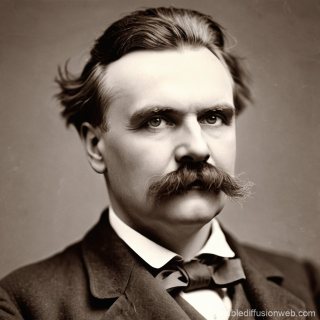
Nietzsche's work encompasses philosophical polemics, poetry, cultural criticism and fiction, while displaying a fondness for aphorisms and irony. Prominent elements of his philosophy include his radical critique of truth in favor of perspectivism; a genealogical critique of religion and Christian morality and a related theory of master-slave morality; the aesthetic affirmation of life in response to both the "death of God" and the profound crisis of nihilism; the notion of Apollon- ian and Dionysian forces; and… the will to power.
Introductory Comments
Before he was a philosopher, Nietzsche was a philologist, and a precocious one. The University of Basel made him professor of classical philology in 1869, at 24, before he had even earned his doctorate. Philology, as he practiced it, was the painstaking study of ancient texts: working out what an author actually wrote and tracing words and ideas back to their sources. One early project untangled the sources of Diogenes Laertius, the ancient gossip-collector whose Lives remains our main window on many Greek philosophers. Long after leaving the university, Nietzsche still called himself a teacher of slow reading, though by then he had turned the philologist's habits on bigger game. Ask where a word came from, and you may learn where a value came from. In On the Genealogy of Morality he claims to find that "good" once meant "noble" and "bad" merely "common."
The training also shaped his most famous doubt. The line usually quoted, "there are no facts, only interpretations," comes from his private notebooks. The published version is more philological. In Beyond Good and Evil he accuses physicists of mistaking their "laws of nature" for nature's own text, when the laws are really an interpretation of it: bad philology, he says. Here lies the irony. A philologist's job is to get back to the original text, but Nietzsche came to suspect there was no original, only readings of readings. The world he leaves us has no bedrock. It is both a dangerous world and an exhilarating one.
Some of Nietzsche's Key Positions
Truth as philosophers have traditionally conceived it, a picture of reality as it is in itself, seen from no particular standpoint, is beyond reach. Every belief is an interpretation shaped by the needs and drives of whoever holds it. This applies to morality, religion, art, history, and philosophy alike. Yet interpretations are not all equal; some are more honest or life-affirming than others.
God is dead, and we have killed him. Science has made belief in God untenable. But Europe has not yet grasped what goes with it is the moral order God once underwrote. Most people still live by that morality out of habit, but its foundation is gone. The result threatens to be nihilism: the suspicion that, if the old values have collapsed, perhaps nothing matters at all. For the rare free spirit, though, the sea lies open again.
The free spirit's task is a "revaluation of all values" based on the will to power - the a drive to grow, to achieve, and above all to overcome oneself. The old values have a history, and not a flattering one. A "slave revolt in morality," carried to triumph by Christianity, inverted the values of ancient aristocracies. Strength and pride became evil; meekness and pity became good. The engine was ressentiment, the festering grudge of the powerless. The self-affirming "master morality" is healthier, but there is no going back to it. The slave revolt made humanity deeper, and the overman (Übermensch) will move beyond both.
Place in the History of Ideas
Nietzsche's Place in History of Ideas
E. H. Carr: [For Nietzsche, human] action is deprived not merely of any rational motive but of any super-rational motive. It becomes simply the expression of a biological urge to self-assertion; the will to power. Standing beyond good and evil, and recognizing no conscious ultimate purpose, Nietzsche's superman is the perfect animal.... He believes only in action as a good in itself without reference to ends.
Hannah Arendt: Nietzsche's inverted Platonism, his insistence on life and the sensuously... given as against the suprasensuous and transcendent ideas which, since Plato, had been supposed to measure, judge, and give meaning to the given, ended in what is commonly called nihilism. Yet Nietzsche was no nihilist but, on the contrary, was the first to try to overcome the nihilism inherent not in the notions of the thinkers but in the reality of modern life.
Albert Camus: Until Dostoyevsky and Nietzsche, rebellion is directed only against a cruel and capricious divinity.... Dostoyevsky, in the realm of imagination, and Nietzsche, in the realm of fact, enormously increase the field of rebellious thought and demand an accounting from the God of love Himself. Nietzsche believes that God is dead in the souls of his contemporaries. Therefore he attacks, like his predecessor Stir- ner, the illusion of God that lingers, under the guise of morality, in the thought of his times.
Random Thoughts on Nietzsche
Few thinkers have been claimed by so many rival camps. Existentialists such as Sartre and Camus found in Nietzsche a champion of freedom and self-creation. Pragmatists such as Rorty admired his suspicion of absolutes. Anarchists, Emma Goldman among them, cheered his assault on herd conformity. Poststructuralists such as Foucault and Derrida hailed him as the first great genealogist of power, language, and truth. Freud said he had long avoided reading Nietzsche, whose guesses so often matched the hard-won findings of psychoanalysis. And the Fascists, helped along by his sister's tendentious editing, conscripted him as a prophet. It was a role he would have loathed, since he despised antisemites and German nationalists alike.
So is there a common root beneath all these branches? The tempting answer is that Nietzsche always says the same thing: we have no fixed essence, the world has no given meaning, and so we must create meaning ourselves. But that summary is simply Sartre's "existence precedes essence" wearing Nietzsche's mustache. Eternal recurrence, for one, is less about inventing meaning than about affirming life. Perhaps the unity lies less in a doctrine than in a rhythm. Nietzsche subtitled one late book "How to Philosophize with a Hammer," and the hammer certainly smashes idols. But in the preface, he also refers to a tuning fork, tapping idols to hear whether they ring hollow. Demolition, then creation, but always a careful listening first.
Adler (Striving for superiority is a fundamental part of human nature.)
Bataille (To be free means to be unrestrained by any chains of morality.)
Bourdieu (Language is not merely a means of expression, but also of power.)
Dostoyevsky (Humans are full of irrational cravings and contradictions.)
Foucault (All life, including science and other inquiry into truth, seeks power.)
Jaspers (Philosophical claims are expressions of our mental dispositions.)
Kierkegaard (Philosophy must embrace subjectivity as an essential resource.)
Putnam (It's fruitless to aspire to a "God's eye view" of reality.)
Thinkers with opposing positions:
Boethius (The purely contemplative part of the Soul is its higher & eternal part.)
Brentano (Philosophy should use methods as rigorous and exact as science.)
Butler, Joseph (Nature is a moral system to which we're adapted via conscience.)
Chesterton (One sees great things from the valley, only small things from peaks)
Eckhart (Personal detachment allows us to sense God's presence within us.)
Foot (Moral judgments, though linked to human nature, can be true and rational.)
Marcel (Neither the isolated self nor the death of God are existential realities.)
Seneca (We should accept calmly and dispassionately whatever happens.)
What others said about Nietzsche
Tillich: Nietzsche is the most impressive and effective representative of what could be called a "philosophy of life."
Russell: I dislike Nietzsche because he likes the contemplation of pain, because he erects conceit into a duty, because the men whom he most admires are conquerors, whose glory is cleverness in causing men to die.
Niebuhr: Whatever the defects of Nietzsche's perverse ethics, he is right in discerning the element of vindictiveness which expresses itself in the rebellion of the weak and the despised. This is not the only element in their rebellion. At best it is, as the rebels assert it to be, a fateful instrument of the judgments of God.
Chesterton: If Nietzsche had not ended in imbecility, Nietzscheism would end in imbecility..... Every man who will not have softening of the heart must at last have softening of the brain.
Santayana: What meets us everywhere [in Nietzsche's writings] is the sense of impotence and a passionate rebellion against it.
Goldman: Nietzsche was not a social theorist, but a poet, a rebel, and innovator. His aristocracy was neither of birth nor of purse; it was of the spirit. In that respect Nietzsche was an anarchist, and all true anarchists were aristocrats.
Pinker: It's easy to see why [Nietzsche's] sociopathic ravings would have inspired so many repugnant movements of the twentieth and twenty-first centuries, including fascism, Nazism, Bolshevism, the Ayn Randian fringe of libertarianism, and the American alt-Right.... Less easy to see is why he continues to be a darling of the academic humanities.
Williams, B.: Truthfulness as an ideal retains its power [in Nietzsche's writings], and so far from his seeing truth as dispensable or malleable, his main question is how it can be made bearable.