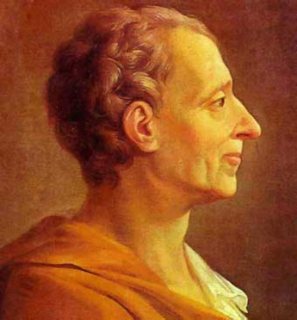
executive, legislative, judicial; classification of
government based on their principles
Influences: Aristotle, Cicero, Thomas Hobbes,
Polybius, René Descartes, Jean Bodin, Nicolas
Malebranche, John Locke, Adam Smith, 18th-
century English constitution
Influenced: Hume, Paine, Rousseau, Burke,
Hegel, Tocqueville, Durkheim, Arendt, Adam
Ferguson, Isaiah Berlin, Jefferson, Madison,
Hamilton, Robespierre, Keynes
From Wikipedia
Montesquieu was a French judge, man of letters, historian, and political philosopher. He is the principal source of the theory of separation of powers, which is implemented in many constitu- tions throughout the world. He is also known for doing more than any other author to secure the place of the word despotism in the political lexicon. His anonymously published The Spirit of Law, which was received well,... influenced the Founding Fathers of the United States in drafting the U.S. Constitution.
Introductory Comments
England after 1688 had a monarch who ruled with Parliament rather than around it, judges the king could not dismiss at pleasure, and subjects who could criticize the government in print. To a Frenchman living under Louis XV, this was remarkable. Montesquieu crossed the Channel in 1729 and stayed some 18 months, then 19 years later, in The Spirit of the Laws, he made the English constitution the centerpiece of his case for dividing the powers of government. 39 years after that, delegates gathered in Philadelphia and built a government on that division, with a generous helping of checks and balances. They cited him more often than any other secular authority. And so, in a nutshell: the Glorious Revolution gives England a government of limited and divided power; Montesquieu makes England his model; the Americans read Montesquieu and write his theory into a constitution. And somewhere in the middle, the two countries spend 8 years shooting at each other - the Americans rebelling against the very government they had most admired.
The ironies keep coming. The England Montesquieu described was already ceasing to exist as he described it: cabinet government would soon fuse the executive and legislative powers precisely where he saw them separated. And in America, over 250 years, the executive branch has steadily overpowered the legislative - or perhaps the legislative has steadily handed over the keys. Either way: goodbye, Montesquieu.
Some of Montesquieu's Key Positions
History is not a chain of accidents. Particular events are often unpredictable - a battle lost, a general assassinated - but the general course of a nation follows from its conditions, its laws, and the things its people prize. If a single defeat destroys a state, there was already a deeper cause at work that left the state destructible by a single defeat.
Rome is the case in point. Caesar's ambition did not bring down the Republic; it merely supplied the occasion. Had Caesar never been born, someone else would have played his part, because Rome's institutions, formed for a small city, could no longer govern an empire. The Republic fell to its own success.
The most powerful underlying factor here is the constitution of the state, whether written or not. To endure, a government must be built with human nature in view - above all the appetite for power, which grows by feeding. Every man entrusted with authority is tempted to press it as far as it will go, and stops only where he meets resistance. One power must be restrained by another power.
Hence liberty depends on distributing the executive, legislative, and judicial powers among distinct hands, and arranging matters so that each can check the others. Separation alone is not enough; each branch of government must be able resist, when necessary, the others.
Place in the History of Ideas
Montesquieu's Place in History of Ideas
Cassirer: One can say of Montesquieu that he is the first thinker to grasp and to express clearly the concept of "ideal types" in history…. Mon- tesquieu proposes to show that forms of gov- ernment which we call republic, aristocracy, monarchy, and despotism are not mere aggre- gates of accidentally acquired properties but that each of these forms is, as it were, pre-formed, the expression of a certain structure. This structure remains concealed from us as long as we merely observe political and social phenomena…. But this illusion vanishes as soon as we learn to go back from appearances to principles, from the diversity of empirical shapes to the forming forces.
James Madison: Montesquieu has resolved the great operative principles of government into fear, honor, and virtue, applying the first to pure despotisms, the second to regular monar- chies, and the third to republics. The portion of truth blended with the ingenuity of this system, sufficiently justifies the admiration bestowed on its author. Its accuracy however can never be defended against the criticisms which it has encountered. Montesquieu was in politics not a Newton or a Locke, who established immortal systems.... He was in his particular science what Bacon was in universal science: He lifted the veil from the venerable errors which enslaved opin- ion, and pointed the way to those luminous truths of which he had but a glimpse himself.
Random Thoughts on Montesquieu
Every form of government, Montesquieu argued, runs on a distinct fuel. Despotism runs on fear, monarchy on honor, republics on virtue. Let the fuel run out and the machine does not merely idle; it becomes something else. A republic whose citizens stop caring about virtue slides into despotism, whatever its constitution says on paper. To modern ears the word "virtue" rings faintly hollow. Isn't the whole point of dividing power that men are not virtuous? Madison put it memorably in Federalist 51: angels would need no government at all. But Montesquieu was not asking for angels. His virtue is political virtue, which he took pains to distinguish from the moral and Christian kind - it is love of country, devotion to honest civic discourse, a disposition to prefer the public good to one's own. Nearer to civic habit than to sainthood. And Madison, a few papers later in Federalist 55, conceded as much: a republic presupposes qualities in human nature that warrant "esteem and confidence."
When citizens stop caring in this civic sense, mores rot and laws become decoration - which is roughly Montesquieu's account of how the Roman Republic, having conquered everything, lost the one thing that had made it a republic. And a failed republic can keep its laws long after it has stopped meaning them, since the decorations are always the last thing to go. Montesquieu's warning then: A republic rarely dies because its constitution is forgotten; it dies because its civic virtues are.
Althusser (Material factors, such as climate, help shape society and politics.)
Comte (The study of society should be scientific, quantifiable, and objective.)
Condorcet (Enlightenment principles can lead us toward the perfect society.)
Hayek (Only free market capitalism is consistent with freedom & democracy.)
Herder (Climate & geography shape the temperaments & customs of countries.)
Madison (Government excesses can be avoided through checks and balances.)
Smith, Adam (Commercial societies tend to enjoy more tranquility & happiness.)
Thinkers with opposing positions:
Carlyle (The history of the world is but the biography of great men.)
Engels (All recorded history hitherto has been a history of class struggle.)
Goldman (Anarchism is the liberation from oppression of govt. & religion.)
Lukács (Our obsession with commodities have made social relations “thinglike.”)
Marcuse (Capitalism can lead to a dehumanizing objectification of ourselves.)
Nietzsche (Great men shape and direct history. The masses just follow along.)
Proudhon (As we seek justice in equality, so society seeks order in anarchy.)
Schiller (History is the story of how human passions play out on world stage.)
Stirner (The state should be replaced with a voluntary union of egotists.)
What others said about Montesquieu
Burke: He is often obscure, sometimes misled by system; but, on the whole, a learned, and ingenious writer, and sometimes a most profound thinker.
D. F. Pocock: [Montesquieu's "The Spirit of Law" was] the first consistent attempt to survey the varieties of human society, to classify and compare them and, within society, to study the inter-functioning of institutions.
Cassirer: In his masterpiece Montesquieu attempted to the describe the "spirit of the laws." But he found that this spirit is everywhere bound down to its physical conditions. The soil, the climate, the anthropological character of the various nations were declared to be among the fundamental conditions of their laws and institutions
Voltaire: Montesquieu was almost always in error with the learned, because he was not learned, but he was almost always right against the fanatics and the promoters of slavery.
Bentham: Locke - dry, cold, languid, wearisome, will live forever. Montesquieu - rapid, brilliant, glorious, enchanting, will not outlive his century.
Jefferson: Still, every man who reflects as he reads, has considered [his book] as a book of paradoxes; having... much of truth and sound principle, but abounding also with inconsistencies, apocryphal facts and false inferences.
Berlin: [Montesquieu's] most famous doctrine, that of the separation of powers, an enthusiastic but mistaken tribute to the system that he had so falsely imagined to prevail in England..., had proved impracticable in France during the great Revolution, and had been much too faithfully adopted in the United States, with results not altogether fortunate.
Keynes: [Montesquieu is] the real French equivalent of Adam Smith, the greatest of your economists, head and shoulders above the physiocrats in penetration, clear-headedness and good sense….
Main interests: Anthropology, Commerce, Democracy, Geography, Government, History of Ideas, Jurisprudence, Justice, Law, Political Philosophy, Political Theory, Public Administration, Religion, Virtue, War