mind, aesthetics, philosophy of history, political
philosophy, philosophy of religion
Influences: J. G. Hamann, Kant, Spinoza, Thomas
Abbt, Kalidasa, J. A. Ernesti, J. J. Winckelmann,
Shakespeare, A. Dürer, Thomas Blackwell, Vico
Influenced: Ľudovít Štúr, Hegel, Schleiermacher,
Dilthey, Nietzsche, Goethe, Schlegel, Humboldt,
Johann Christoph Adelung, J. S. Mill, Franz Boas,
I. Berlin, Schelling, Wilhelm Wundt
From Wikipedia
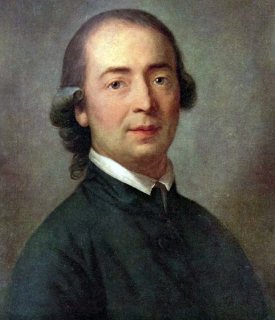
Herder was a Prussian philosopher, theologian, pastor, poet, and literary critic. He is associated with the Enlightenment, Sturm und Drang, and Weimar Classicism. He was a Romantic philoso- pher and poet who argued that true German culture was to be discovered among the common people (das Volk)…. He is credited with establish- ing or advancing a number of important disci- plines: hermeneutics, linguistics, anthropology, and a secular philosophy of history.
Introductory Comments
At seventeen Herder arrived at Königsberg and found his way into the lecture room of a young, unsalaried instructor named Immanuel Kant. This was the pre-critical Kant, the Critique of Pure Reason still twenty years off - a witty, wide-ranging lecturer on metaphysics and physical geography, fascinated by the creature called man. Herder took careful notes and remembered him warmly for decades. But where Kant probed how the mind organizes experience into knowledge, Herder turned his attention outward, to culture and the countless ways it enriches human life. If he took anything from Kant, it was a lasting suspicion of philosophical system-building.
Königsberg held a second teacher, and this one had no university post at all. Johann Georg Hamann - the "Magus of the North," a customs clerk of volcanic prose - tutored Herder privately in English, and the two read Shakespeare together. Man is not fundamentally a reasoning animal, Hamann insisted. Thinking is poetic before it is logical, and reason is the product of language rather than its source. To that attack on the Enlightenment Herder added a passion for culture - not the polished culture of courts, but the culture of the people: songs, tales, dialects, the entire fabric of ordinary life. And he quarreled with his mentor. Hamann held language to be a gift from God; Herder argued that human beings had made it themselves - plus everything else that distinguishes one group of people from all others.
Some of Herder's Key Positions
Great literature expresses the distinctive spirit of a people - and in expressing it, helps that spirit come into its own. Poetry does this best, because it wells up from a nation's own sources rather than from rules borrowed abroad.
Writers should therefore stop chasing foreign fashions - for example, French neoclassicism, imitated in courts where even the conversation is French. They should turn instead to their own people's past, which shaped how they think, what they love, and how they imagine.
Language matters most of all. A people's tongue is not a container for thoughts that exist before it; it is the medium in which that people learned to think at all. Writing in the vernacular is not a concession, then, but a homecoming. And the songs, tales, and proverbs of ordinary people - long dismissed as crude - turn out to be the truest record of a nation's mind.
A nation is thus more than a political unit, and a people more than a counting of heads. A people is a living culture: land, custom, language, folklore, art, music, dance, and much else besides, all animated by a single spirit.
And because each culture has its own center of gravity, none can be measured against another's yardstick. Each people has its own way of being human, and should be cherished on its own terms.
Place in the History of Ideas
Herder's Place in History of Ideas
Isaiah Berlin: Herder may not be its only begetter, but the idea that variety is preferable to uniformity, and not simply a form of human failure to arrive at the one true answer, and consequently a form of error or imperfection - the rejection of the traditional belief in the necessary harmony of values in a rational universe, whether as the reality beneath the appearances, or as the ideal presupposed by both reason and faith - this radical departure is altogether modern. The ancient world and the Middle Ages knew nothing of it.
Michael Neil Forster: [Herder's influence] has been immense both within philosophy and beyond it (much greater than is usually real- ized). For example, Hegel’s philosophy turns out to be largely a sort of elaborate systematic development of Herder’s ideas (especially concerning language, the mind, history, and God); so too does Schleiermacher’s (concerning language, interpretation, translation, the mind, art, and God); Nietzsche is deeply influenced by Herder as well (concerning language, the mind, history, and values); so too is Dilthey (especially concerning history); even John Stuart Mill has important debts to Herder (in political philos- ophy); and beyond philosophy, Goethe was transformed from being merely a clever but rather conventional poet into the great artist he eventually became largely through the early impact on him of Herder’s ideas.
Random Thoughts on Herder
Even the noblest insight can be seized by people with an agenda and twisted into something ignoble. Consider Herder's great discovery: that each nation has its own history, and each culture its own animating spirit. The key word is each. Against the dominant current of his century - which measured every people against the standard of contemporary Paris - Herder insisted there is no single yardstick. He wanted his readers to prize the songs, dances, tales, and language of their own people, and then to grant every other people exactly the same.
Call this pluralism rather than relativism. The distinction matters. A relativist cannot condemn anything, and Herder condemned plenty: slavery, conquest, the plunder of the Americas and Africa, the swallowing of small peoples by large empires. And while cultural pride is good and healthy, militant nationalism is anything but: "National glory is a deceiving seducer. When it reaches a certain height, it clasps the head with an iron band." And yet, by instilling a new pride in Germans for their history, language, and culture, Herder also inspired what was to become an absolutist and dangerous nationalism that in the 20th century would wreak havoc upon the world. Herder, of course, is not responsible for the terrible things people later did in his name. Nor is Nietzsche. Nor is Darwin. Nor is Jesus. Ideas are malleable things, and malleable things can be hammered completely out of shape.
Influences
Herder was influenced by: Abbt, Thomas, Blackwell, T., Durer, A., Ernesti, J.A., Hamann, Kalidasa, Kant, Shakespeare, Spinoza, Vico, Winckelmann
Berlin (Different cultures should not be measured against one another.)
Cousin (Both sensibility and reason are needed to make sense of the world.)
Goethe (The organic nature of the land molded the people and their customs.)
Hamann (Language does not spring from reason. Reason springs from language.)
Heidegger (Poetry, not philosophy, is best at unveiling the mysteries of Being)
Humboldt, W. (The structure of a language affects its speakers' worldview.)
Montesquieu (Climate & geography affect temperaments & cultures of states.)
Ortega (We are in no way free when we submerge our individuality in a group.)
Spivak (Western culture has either dismissed or marginalized those outside it.)
Vico (Human sciences require different methods from the natural sciences.)
Thinkers with opposing positions:
Fichte (Freedom springs from submerging individuality into a larger group.)
Jung (The "collective psyche [can be] more like the psyche of an animal.")
Locke (Social practices should spring from universally accepted principles.)
Plato (The highest form of understanding is through reason alone.)
Rousseau (Liberty is self-rule & self-rule is obedience to the "general will.")
Schlegel (There are no first principles that can guide us to the truth.)
What others said about Herder
Brian King: Herder’s view is a... relativist one in that he maintains that since each culture originates its values, it can only be judged on its own terms.
Michael Forster: [I]t was mainly Herder (not, as has often been claimed, Hamann) who established fundamental ideas concerning an intimate dependence of thought on language that underpin modern philosophy of language.
Brian King: Herder adapts Aristotle’s idea that man is a political animal, and takes it as a natural law that man is by destiny a creature of the herd, of society. And that, for Herder, is about it as regards any universal nature man has. The second basic view of Herder’s is that man’s values and sense of himself are passed on culturally, specifically by language.
Henry Fairfield Osborn: In a general way he upholds the doctrine of the transformation of the lower and higher forms of life, of a continuous transformation from lower to higher types, and of the law of Perfectibility.
Michael Forster: [H]is empirical approach to languages... inspired Friedrich Schlegel, Wilhelm von Humboldt, and others to found modern linguistics.
Brian King: ... Herder thought that peoples from different historical periods and cultures vary so much in their concepts and beliefs that human nature is radically different in different cultures.
Avi Lifschitz: [Herder argued] for the linguistic character of our cognition but also for the cognitive nature of human language. One could not think without language, as various Enlightenment thinkers argued, but at the same time one could not properly speak without perceiving the world in a uniquely human way....
Berlin: [Herder] disliked every form of violence, coercion and the swallowing of one culture by another, because he wants everything to be what it is as much as it possibly can.
Schools: Continental Philosophy, Counter-Enlightenment, Enlightenment, German Romanticism, Hermeneutics, Historicism, Nationalism, Romanticism, Sturm und Drang, Weimar Classicism
Main interests: Anthropology, Art and Aesthetics, Communication, History, Language, Mind, Philology, Poetry, Political Philosophy, Religion