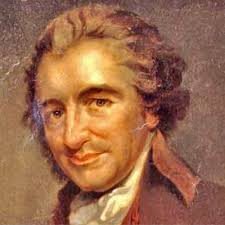
Paine was an English-born American Founding Father, French Revolutionary, inventor, and politi- cal philosopher. He authored Common Sense and The American Crisis, two of the most influential pamphlets at the start of the American Revolution, and he helped to inspire the colonial era patriots in 1776 to declare independence from Great Brit- ain. His ideas reflected Enlightenment-era ideals of human rights…. In The Age of Reason..., he advocated Deism, promoted reason and free- thought, and argued against religion....
Introductory Comments
Paine's life reads like a picaresque novel. Born in 1737 to a Norfolk staymaker, he is put to work making corsets. Grief comes early: his first wife dies within a year, apparently in childbirth, the infant with her. Then a decade of false starts - corsets, the excise office (which fires him twice), a school, a tobacco shop - and a second marriage ending in separation. At 37 he is bankrupt and finished. But in London he meets Ben Franklin, pockets a letter of introduction, and sails. A year later Common Sense appears, and a squabble over taxes becomes a case for independence. Fame does not settle him. Combative and indiscreet, he quarrels his way out of his post with the Congress and sails for Europe in 1787 - not fleeing enemies but chasing a patent for his iron bridge. The bridge stalls. A revolution turns up instead. Rights of Man answers Burke, earns him an indictment for seditious libel, and puts him out of England a step ahead of the constables. France elects him to its National Convention, though he speaks almost no French. He argues against executing the king. In the Terror, mercy is an offense, and the Luxembourg prison takes him in. The guillotine misses him, he says, on a technicality: his death mark is chalked on the cell door while it stands open, and vanishes when it swings shut. Robespierre falls, Paine walks free, and America withdraws its welcome. The Age of Reason did it. Readers who once honored him as a patriot, now condmen him as an athiest . He dies in 1809 in a rented Greenwich Village room, and six mourners follow him to the grave.
Some of Paine's Key Positions
Because all people possess inherent dignity and are born equally entitled to life and liberty, a government that tramples those rights forfeits the trust on which its authority depends. When a government breaks the social contract binding ruler and ruled, the people are entitled - even obliged - to overthrow it.
Hereditary monarchy is tyranny's favorite nursery. The whole arrangement offends our sense of equality: if all men are created equal, an accident of birth is a poor qualification for ruling people. Worse, kings raised on flattery and idleness tend to spend a nation's wealth on their own indulgence and its blood on wars fought for glory rather than necessity - wars people pay in taxes and in lives.
The best alternative is the republic: government answerable to the people rather than handed down through a bloodline. But answerability requires more than the name "republic." To be genuinely responsive, a government must not restrict voting or officeholding to men of property; Every citizen, propertied or not, deserves a voice and a seat.
Governments accountable in this way tend to be not just more peaceable but more humane. Freed from the expense of courts and vanity wars, they can turn their resources toward the poor and the elderly, and toward public schools for children - obligations no decent nation should shirk.
Place in the History of Ideas
Paine's Place in History of Ideas
Michael Foot: Thomas Paine was the most far-seeing Englishman of the eighteenth century.... [H]e remains the major prophet of democracy and representative government.... Almost a century before Lincoln he sought to write into the American Constitution a clause against slavery. Long before John Stuart Mill, he cham- pioned the rights of women. He was among the very first of English writers to espouse the cause of Indian freedom. Well ahead of my old friends, Dick Crossman or Barbara Castle, he had a good plan for old age pensions. And how men in all our modern parties might tremble at his proposals for land nationalization; he wanted new laws for marriage and divorce. International arbitration, family allowances, maternity benefits, free education, prison reform, full employment - yes much of what the future Labor Party has offered was previously on offer... from Thomas Paine.
Harvey J. Kaye: It was... Paine... who launched the social-democratic tradition in the 1790s. In his pamphlets, Rights of Man and Agrarian Justice, Paine outlined plans for combating poverty that would become what we today call Social Security. As Paine put it in the latter work, since God has provided the earth and the land upon it as a collective endowment for humanity, those who have come to possess the land as private property owe the dispossessed an annual rent for it.
Random Thoughts on Paine
Paine wielded a formidable pen. It helped turn a colonial rebellion into a revolution. It defended the French Revolution when respectable opinion had recoiled from it, and it produced The Age of Reason, which cost him most of his friends on a charge of atheism he never held (he was a deist). It also wrote Rights of Man, which alarmed the powers that be with proposals for pensions, child allowances, and public schooling, all of them scandalous then and unremarkable now. So what made Paine's pen so powerful?
Perhaps it was the thing Franklin appears to have recognized in him at once, having spent a lifetime perfecting it himself: the power of the speaking voice. Paine's prose sounds like a man talking. It is direct, personal, unhurried, and it treats the reader as an equal rather than a pupil. Where his contemporaries reached for Latin tags and classical authorities, Paine reached for the furniture of ordinary life. He promised "simple facts, plain arguments, and common sense," and delivered them - dispatching even the likes of William the Conqueror as just "a French bastard landing with an armed banditti."
The style was itself an argument. A writer who explains the English constitution in words a shopkeeper can follow has already conceded that the shopkeeper is entitled to an opinion about it. That concession turned out to be the most revolutionary thing on the page.
Aquinas (Certain rights are natural or inherent by virtue of our humanity.)
Carlyle (Democracy is just the way to choose the best representatives to rule.)
Cicero (Republics require that citizens place public good over private gain.)
Condorcet (Enlightenment principles can lead us toward the perfect society.)
Dewey (Democracy represents the ultimate ethical ideal of humanity.)
Diderot (Governments should guarantee freedom of religion & expression.)
Franklin (Though God is the Creator, He doesn't intrude on workings of nature.)
Goldman (Revolution is a violent process, but also at times a necessary one.)
Thinkers with opposing positions:
Bentham (Talk of natural rights is mere rhetoric - just "nonsense upon stilts.")
Burke (Radical changes in govt. are dangerous & undermine social stability.)
Croce (Freedom is not a birthright or natural right. It is an earned right.)
Edwards (Emotion plays an important part in religion, especially in conversion.)
Gentile (The state is the source of all authority and the object of all loyalty.)
King (Man is not sufficient unto himself. We need God’s living Word & guidance.)
Maistre (Authority in politics does not derive from reason, but from religion.)
Tillich (Humanism today has too much faith in man & all too little faith in God.)
What others said about Paine
Eric Foner: Through this new language he communicated a new vision - a utopian image of an egalitarian, republican society.
Jack P. Greene: It was not the British defeat at Yorktown, but Paine and the new American conception of political society he did so much to popularize in Europe that turned the world upside down.
E. P. Thompson: What he gave to the people was a new rhetoric of radical egalitarianism, which touched the deepest responses of the 'free-born Englishman' and which penetrated the sub-political attitude of the urban working people. ... [T]he Paine tradition runs strongly through the popular journalism of the nineteenth century.
Harvey J. Kaye: [Paine] imbued the nation they were founding with democratic impulse and... exceptional... purpose and promise. For 230 years Americans have drawn ideas, inspiration, and encouragement from Paine and his work.
Saul K. Padover: [Paine was] maker by trade, a journalist by profession, and a propagandist by inclination.
Thomas Edison: ... it was, indeed, a revelation to me to read that great thinker's views on political and theological subjects. Paine educated me, then, about many matters of which I had never before thought.
Robert G. Ingersoll: One by one most of his old friends and acquaintances had deserted him. Maligned on every side, execrated, shunned and abhorred - his virtues denounced as vices - his services forgotten - his character blackened, he preserved the poise and balance of his soul. He was a victim of the people, but his convictions remained unshaken.
Gary Kates: Paine's vision unified Philadelphia merchants, British artisans, French peasants, Dutch reformers, and radical intellectuals from Boston to Berlin in one great movement.
Main interests: Democracy, Equality, Ethics, Freedom, Freedom of the press, Government, Invention, Journalism, Justice, Law, Political Philosophy, Political Theory, Politics, Religion, Revolution, Technology, Welfare State