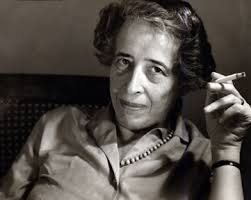
Arendt was a political philosopher, author, and Holocaust survivor. She is widely considered to be one of the most influential political theorists of the 20th century…. Her works cover a broad range of topics, but she is best known for those dealing with the nature of power and evil, as well as politics, direct democracy, authority, and totalitarianism. In the popular mind she is best remembered for the controversy surrounding the trial of Adolf Eichmann, her attempt to explain how ordinary people become actors in totalitarian systems….
Introductory Comments
Aristotle called man a zoon politikon - a political animal, not just a clever mammal keeping an eye on its property. From that remark grew a long tradition holding that republics live or die by how fully their citizens take part. Cicero defined the res publica as the res populi, the "people’s affair" - hardly a spectator sport. Machiavelli, ever the realist, warned that a people who left public life to others, and stopped bearing arms in their own defense, would not stay free for long. Jefferson dreamed of "ward republics," small enough for every citizen to have a say. And Tocqueville saw American civic associations as a bulwark against a new, gentler kind of despotism.
Arendt took up this tradition and turned it into a scathing indictment of the modern age. The old public realm, where people appeared before one another through speech and action, had steadily given way to two retreats. One led inward, into private introspection. The other led into the business of making a living, now swollen into an all-consuming obsession. No one chose this exile; it was the slow work of centuries. But the result was the same. When politics shrinks to administration and citizens to consumers, the public realm suffocates. With it goes the space where people can be seen and heard. The modern age, Arendt feared, might end in "the deadliest, most sterile passivity history has ever known." Put less grandly: a republic can die of boredom while its citizens are too busy earning and spending to notice.
Some of Arendt's Key Positions
Political life at its best is a shared public space where citizens act and speak together as equals. Voting for representatives is not enough. Freedom becomes real only when people take a direct part in public affairs. That participation is not a means to prosperity or efficient administration. It is valuable in itself, because acting with others is how human beings show who they are and begin something new.
Modern societies have largely lost this public realm. Citizens retreat into earning and consuming and leave public affairs to bureaucracies, which amount to "rule by Nobody," where no one can be held responsible.
Totalitarianism, as seen in Nazi Germany and Stalin's Soviet Union, is not merely extreme tyranny but a new form of government. Through ideology and terror, it seeks total domination, destroying not only rights but the human capacity for spontaneous action itself. Its defining institution is the concentration camp.
Citizens must therefore protect spaces of public freedom. When laws or officials go badly wrong, organized civil disobedience is legitimate. Above all, people must keep thinking. Great evil needs no monstrous motives. Adolf Eichmann helped send Europe's Jews to the death camps, yet at his trial he appeared not as a fanatic but as a thoughtless careerist. This is "the banality of evil."
Place in the History of Ideas
Arendt's Place in History of Ideas
A. P. D'Entreves: Arendt’s political thought cannot, in this sense, be identified either with the liberal tradition or with the claims ad- vanced by a number of its critics. Arendt did not conceive of politics as a means for the satis- faction of individual preferences, nor as a way to integrate individuals around a shared con- ception of the good. Her conception of politics is based instead on the idea of active citizen- ship, that is, on the value and importance of civic engagement and collective deliberation about all matters affecting the political commu- nity. If there is a tradition of thought with which Arendt can be identified, it is the classical tradition of civic republicanism originating in Aristotle and embodied in the writings of Machiavelli, Montesquieu, Jefferson, and Tocqueville. According to this tradition politics finds its authentic expression whenever citizens gather together in a public space to deliberate and decide about matters of collective concern.
Tony Judt: Arendt’s is, to coin a phrase, the republicanism of fear. In this way of thinking, the foundation for a modern, democratic politics must be our historical awareness of the consequences of not forging and preserving a modern, democratic polity. What matters, to put it bluntly, is that we understand as well as possible the risks of getting it wrong, rather than devoting ourselves over-enthusiastically to the business of getting it right.
Random Thoughts on Arendt
In 1924, an 18-year-old Hannah Arendt arrived at the University of Marburg and fell under the spell of Martin Heidegger. He was 35, married, and already famous among students as the most electrifying teacher in Germany. From him she learned to treat existence not as a bundle of abstract propositions but as a way of "being-in-the-world." She also became his lover.
Heidegger's Being and Time does make room for "being-with" others. But it treats the public world of "the They" (das Man) as a realm of chatter and conformity, from which the authentic self must reclaim itself. Arendt reversed that judgment. For her, the public realm was not where we lose ourselves but where we discover who we are, by speaking and acting among equals..
Then history supplied a bitter twist. In 1933, Heidegger joined the Nazi Party and became rector of the University of Freiburg. That same year Arendt, a Jew, was briefly arrested by the Gestapo and fled Germany. Eight years of statelessness followed, including internment in a French camp, before she reached New York in 1941. In The Origins of Totalitarianism, she argued that totalitarianism, unlike older despotisms, sets out to destroy plurality, spontaneity, and the human capacity to begin something new. Heidegger's philosophy had given her the language to describe a shared world. The regime he briefly served showed her what its destruction looked like.
Hegel (Political freedom is positive in that it's our participation in a state.)
Heidegger (Philosophy should start with the objects of conscious experience.)
Orwell (If government always lies, citizens can neither deliberate nor judge.)
Thinkers with opposing positions:
Burke (In representative democracy leaders should lead, not just represent.)
de Beauvoir (Politics includes household relationships between the sexes.)
Engels (The just distribution of goods is an inherently political responsibility.)
Godwin (The goods that benefit us must be regulated by justice alone, not laws.)
Jefferson (People are born with inalienable rights that must be respected.)
Mill (Political freedom is negative in that it's the absence of restraint.)
Plato (Truth is not found in this world, but in the eternal realm of Ideas.)
Rawls (It's useful to see govt. as a social contract conceived in a state of nature.)
Rousseau (The General or Collective Will must be acknowledged & enforced.)
What others said about Arendt
Zoe Williams: … perhaps Arendt’s most profound legacy is in establishing that one has to consider oneself political as part of the human condition.
A. P. D'Entreves: For Arendt modernity is characterized by… the restriction or elimination of the public sphere of action and speech in favor of the private world of introspection and the private pursuit of economic interests.
Majid Yar: The question with which Arendt engages most frequently is the nature of politics and the political life, as distinct from other domains of human activity. Arendt’s work, if it can be said to do any one thing, essentially undertakes a reconstruction of the nature of political existence. This pursuit takes shape as one that is decidedly phenomenological…..
Kathleen B. Jones: Over Arendt’s "report" hangs the shadow of her complicated judgment of the scope of horrors associated with the Holocaust, whose source she summarized in the phrase "the banality of evil."
Monisha Choudhary: Politics for Arendt is based on active citizenship - civic engagement and deliberation on issues affecting the political community.
Zoe Williams: There is also the matter of Martin Heidegger, the philosopher with whom she [a Jew] had a turbulent [romantic] relationship…, despite his links with the Nazi party….
A. P. D'Entreves: … she grappled with the most crucial political events of her time, trying to grasp their... historical import, and showing how they affected our categories of moral and political judgment. What was required, in her view, was a new framework that could enable us to come to terms with the twin horrors of the 20th century, Nazism and Stalinism.
Majid Yar: [Through phenomenological analysis,] Arendt in effect aims to make available the objective structures and characteristics of political being-in-the-world as a distinct mode of human experience.
Main interests: Alienation, Classics, Communication, Community, Death, Democracy, Desire, Equality, Free/Unfree Will, Freedom, Freedom of the press, Friendship, Game Theory, Government, History, History of Ideas, Human Will, Ideology, Industrialism, Journalism, Justice, Labor, Law, Literature, Memory, Personal Identity, Political Activism, Political Philosophy, Political Theory, Power, Public Administration, Punishment, Revolution, Rhetoric, Social Criticism, Social Philosophy, Technology, War, Welfare State, Will, Wisdom