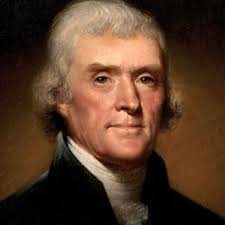
Born: April 13, 1743 in Shadwell, Virginia, British
America
Died: July 4, 1826 (aged 83) in Charlottesville,
Virginia, United States
Political party: Democratic-Republican
Alma mater: College of William and Mary
Main Interests: Politics, Political Philosophy,
Science, Agriculture, Music, History, Religion,
Architecture, Philosophy, Education,
Influences: Locke, Thomas Paine, Isaac Newton,
Montesquieu, Rousseau, Francis Bacon, Hume,
Epicurus, Joseph Priestley, Cicero, Marquis de
Condorcet, William Small, George Wythe
James Madison, George Mason, Denis Diderot
Influenced: Madison, Lafayette, Monroe, Ayn
Rand, Washington, Arendt, Emerson, John Dos
Passos, Humboldt, Albert Gallatin, John Taylor,
John Randolph, John C. Calhoun
From Wikipedia
Jefferson was an American Founding Father who served as the third president of the United States from 1801 to 1809. He was the primary author of the Declaration of Independence.... Jefferson was a leading proponent of democracy, republicanism, and natural rights, and he produced formative documents and decisions at the state, national, and international levels…. Presidential scholars and historians praise Jefferson's public achieve- ments, including his advocacy of religious freedom and tolerance .
Introductory Comments
America's "peculiar institution" was perhaps never more peculiar than in the household at Monticello, where the master's dead wife and his enslaved mistress shared a father. In 1772 a young, bookish, idealistic Jefferson married Martha Wayles Skelton, a talented widow of 23. Her father died the next year, and the couple inherited some 11 thousand acres, roughly 135 enslaved people, and a mountain of debt. Martha bore 6 children; 2 lived to adulthood. In 1782, at 33, she died. Jefferson was shattered - and then, in time, gathered himself and returned to public life.
Five years later, serving as Minister to France, he sent for his youngest surviving child, 8-year-old Polly. She crossed the Atlantic in the care of a fair-skinned girl of 14 from Monticello: Sally Hemings, daughter of Martha's father, John Wayles, and Betty Hemings, a woman Wayles owned. Sally was, in other words, the dead wife's half-sister. Sometime before Jefferson left Paris in 1789, Sally became pregnant by him. He was 46; she was 16; he owned her. She also held, for the only time in her life, a card worth playing: enslaved people on French soil could petition the courts for their freedom, and she knew it. By the account of her son Madison, she agreed to return to Virginia in exchange for "extraordinary privileges" and a promise that her children would go free at 21. Jefferson more or less kept it. He never freed Sally Hemings. Yet of the handful he did free, not one came from outside her family.
Some of Jefferson's Key Positions
All human beings are endowed with certain unalienable rights, among them life, liberty, and the pursuit of happiness. Governments exist to secure those rights and draw their just powers from the consent of the governed. When a government becomes destructive of that purpose, the people have a duty to alter or abolish it.
The government best suited to that task is a republic. Officials elected by the people are answerable to the people, and citizens who find them corrupt can vote them out at of office.
A republic, then, depends on its citizens, who must be virtuous, self-reliant, and well informed - hence the vital importance of public schooling. Hence, too, the essential role of the independent farmer, who owes his livelihood to no patron and can therefore vote his own judgment.
Large cities, on the contrary, pose a danger to a republic. As seen in Europe, they are too prone to widespread poverty and huge economic disparity. Political tyranny thrives under such conditions, but not a republic..
A healthy republic must also protect individual and minority rights against the power of the majority. Freedom of speech and the press are therefore indispensable, as is religious liberty. Government must not establish any religion, and a clear separation between church and state must exist.
Place in the History of Ideas
Jefferson's Place in History of Ideas
R.B. Bernstein: Whatever we think of Jefferson as a person or as a politician, we can never take away from him his remarkable gift as a writer or his ultimate claims to fame. He achieved his in- tention to express "the American mind" and became the leading spokesman for the revolu- tion of ideas that changed, and that continues to change, the face of America and the world.
James Madison: It may, on the whole, be truly said of him, that he was greatly eminent for the comprehensiveness and fertility of his genius, for the vast extent and rich variety of his ac- quirements, and particularly distinguished by the philosophic impress left on every subject which he touched. Nor was he less distin- guished for an early and uniform devotion to the cause of liberty, and systematic preference of a form of Government squared in the strict- est degree to the rights of man. In the social and domestic spheres, he was a model of the virtues and manners which most adorn them.
Abraham Lincoln: All honor to Jefferson, to the man, who, in the concrete pressure of a strug- gle for national independence by a single peo- ple, had the coolness, forecast, and capacity to introduce into [political discourse] an abstract truth, applicable to all men and all time, and so to embalm it there today and in all coming days it shall be a rebuke and a stumbling block to the very harbingers of reappearing tyranny....
Random Thoughts on Jefferson
Locke held that people have a natural right to life, liberty, and property. Jefferson, who read him closely, wrote instead of "life, liberty, and the pursuit of happiness." Why the substitution? The first thing to say is that it wasn't quite a substitution. Locke called the pursuit of happiness the foundation of liberty in his Essay Concerning Human Understanding. The word "happiness" also carried more weight than a modern ear hears. It meant something nearer to a life going well - publicly and privately - than to a good mood.
But perhaps we are looking at the wrong word. What captured Jefferson's imagination may have been the word "pursuit." It asks what one is doing with a life and a liberty, and it turns the sentence toward a future where nothing is settled yet. That openness Jefferson felt in his bones. He was future-minded by temperament and a frontiersman by imagination, forever looking past Monticello toward the western country - land he could call empty only by declining to notice who already lived on it. Which brings up the other thing. Jefferson's own pursuits - the books, the architecture, the wine, the long afternoons of thought - rested on people he owned. Property was not incidental to his happiness; it was the engine of it. Perhaps that was the reason the word sat uneasily with him. One thing is certain though: Jefferson wrote better than he lived, and left the country a sentence it would take a century and a war to make good on. Or begin to.
Jefferson influenced:Arendt, Calhoun, J.C., Dos Passos, Emerson, Gallatin, Humboldt, A., Lafayette, Madison, Monroe, Rand, Washington
Similar and opposing positions
Thinkers with similar positions:
Cicero (Republics require that citizens place public good over private gain.)
Comte (The ideal government should be made up of an intellectual elite.)
Gandhi (All religions should not only be tolerated, but also respected.)
Locke (Governments exist only to protect our rights & promote public good.)
Lucretius (True happiness springs from modest desires and simple pleasures.)
Nozick (Rights are best secured by minimal state limited to narrow functions.)
Paine (The only religion that's at all defensible is pure and simple deism.)
Thinkers with opposing positions:
Adorno (Rationality does not inevitably lead to progress in morality and justice.)
Arendt (Only rights granted by the state matter, not "inalienable human rights.")
Bentham (Talk of natural rights is mere rhetoric - just "nonsense upon stilts.")
Calvin (Church and State should collaborate to ensure a godly society.)
Croce (Freedom is not a birthright or natural right. It is an earned right.)
Dewey (Participation, not representation, is the essence of democracy.)
Evola (Liberal democracy represents an ignoble trend towards mediocrity.)
Gentile (The state is the source of all authority and the object of all loyalty.)
Maistre (Authority in politics does not derive from reason, but from religion.)
What others said about Jefferson
R. B. Bernstein: Only a republic could preserve liberty, Jefferson insisted, and only virtue among the people could preserve a republic.
J.F. Kennedy: I think this is the most extraordinary collection of talent, of human knowledge, that has ever been gathered together at the White House, with the possible exception of when Thomas Jefferson dined alone.
George Will: Jefferson expressed the American idea: political and social pluralism; government of limited, delegated and enumerated powers; the fecundity of freedom. He expressed it not only in stirring cadences, but also in the way he lived, as statesman, scientist, architect, educator. Jeffersonianism is what free men believe.
John Adams: Your administration will be quoted by philosophers as a model of profound wisdom; by politicians, as weak, superficial, and shortsighted. Mine, like Pope's woman, will have no character at all.
Chomsky: All the Founding Fathers hated Democracy - Thomas Jefferson was a partial exception, but only partial.
Frédéric de Liancourt: Mr. Jefferson displays a mild, easy and obliging temper, though he is somewhat cold and reserved. His conversation is the most agreeable kind.
Stephen E. Ambrose: Jefferson surely knew slavery was wrong, but he didn't have the courage to lead the way to emancipation. If you hate slavery and the terrible things it did to human beings, it is difficult to regard Jefferson as a great man, or a good man. He was a spendthrift, always deeply in debt. He never freed his slaves.... He could not rise above convenience.
Theodore Roosevelt: Thank Heaven, I have never hesitated to criticize Jefferson; he was infinitely below Hamilton. I think the worship of Jefferson a discredit to my country.