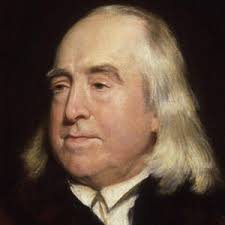
Owen, H. L. A. Hart, Burke, Isaiah Berlin, Francis
Y. Edgeworth, Iain King, John Bowring, Edwin
Chadwick, Hans Vaihinger
From Wikipedia
Bentham was an English philosopher, jurist, and social reformer regarded as the founder of modern utilitarianism. Bentham defined as the "fundamental axiom" of his philosophy the principle that "it is the greatest happiness of the greatest number that is the measure of right and wrong." He became a leading theorist in Anglo-American philosophy of law, and a political radical whose ideas influenced the development of welfarism. He advocated individual and economic freedoms, the separation of church and state….
Introductory Comments
Can a human life be scored - total pleasure points minus total pain points? That seems to be the implication of Bentham's hedonic calculus. If so, it seems only fair to make Bentham the guinea pig: He was born in 1748 to a prosperous London attorney, taught the violin as a small boy, sent to Westminster School, and packed off to Oxford at twelve. Call it 340 points for elite opportunity. Now subtract 710, because he disliked nearly all of it. Westminster found him small, timid, and unhappy. Oxford struck him as a place of idle teachers and antiquated subjects where the chief skill on offer was memorization.
Adulthood was better. There was work he loved, a wide circle of friends, and the small domestic pleasures of a confirmed eccentric: a walking stick named Dapple, a teapot named Dick, and a cat who rose through the ranks to become the Reverend Doctor John Langbourne. Against that, the ledger must record some 20 years poured into a model prison the government finally abandoned, and at least two marriage proposals - one at 57, renewed at 80 - that were both declined. Add it up and the pluses of the long adulthood roughly cancel the minuses of the short childhood, leaving Bentham a lifetime score of about zero. Which is roughly what the score tells us about the man. Bentham himself would no doubt have agreed: he left instructions that his body be preserved and put on permanent display, which is not the act of a man who thought he came out to zero.
Some of Bentham's Key Positions
Happiness is no mystery. It is pleasure maximized and pain minimized - and therefore, in principle, measurable. We should be able to measure or weigh pleasures and pains by their intensity, duration, certainty, nearness, and the number of people they touch. The arithmetic may be crude, but the attempt matters, above all for those who govern.
Every social and political decision should aim at the greatest happiness of the greatest number, for people always pursue their own happiness first, even when their motives look generous. The legislator's task, then, is not to preach altruism but to manufacture it - to arrange rewards and punishments so that private interest and public interest pull in the same direction.
The calculus here yields strikingly liberal results: free expression, the abolition of slavery, the decriminalizing of homosexual acts, greater equality for women, the right to divorce. Animals had a claim as well, since the decisive question "is not, Can they reason? nor, Can they talk? but, Can they suffer?"
These protections, however, are not natural rights. They are neither God-given nor lodged somehow inside the individual, waiting to be discovered. Rights are the children of law: society grants them, legislation enacts them, and without law there are none. Talk of natural rights is "nonsense upon stilts."
Place in the History of Ideas
Bentham's Place in History of Ideas
William Sweet: [Bentham] is primarily known today for his moral philosophy, especially his principle of utilitarianism, which evaluates actions based upon their consequences. The relevant consequences, in particular, are the overall happiness created for everyone affected by the action. Influenced by many enlighten- ment thinkers, especially empiricists such as John Locke and David Hume, Bentham devel- oped an ethical theory grounded in a largely empiricist account of human nature. He fa- mously held a hedonistic account of both motivation and value according to which what is fundamentally valuable and what ultimately motivates us is pleasure and pain. Happiness, according to Bentham, is thus a matter of experiencing pleasure and lack of pain.
William MacAskill: Many of Bentham’s views were considered radical in Georgian and Victorian Britain. His manuscripts on [decrimi- nalizing] homosexuality were so liberal that his editor hid them from the public after his death.... He was also an early advocate of animal welfare, famously stating that their capacity to feel suffering gives us reason to care for their wellbeing.... [In addition,] Bentham supported women’s rights (including the right to divorce), the abolition of slavery, the abolition of capital punishment, the abolition of corporal punishment, prison reform and economic liberalization.
Random Thoughts on Bentham
How does one weigh the greatest happiness of the greatest number against the rights of the individual? Bentham dreamed of a government that could calculate its way to good policy, weighing pleasures against pains the way a merchant weighs goods. Natural rights spoiled the arithmetic. They showed up as absolutes - non-negotiable, unquantifiable - and no legislator can subtract an absolute from anything. How is a government to compute the happiness a policy produces when some of the terms are declared beyond computation? Better to root rights in law and justify them by their consequences.
For rights, in Bentham's view, are not natural at all. They are creatures of legislation: A right exists precisely where the law lays a duty on somebody else. The right to one's property is the obligation of everyone else to leave it alone, and nothing more mysterious than that. Rights are given, then, but not the way a premise is given - they are not axioms. Nor do they hover about us like an aura or, worse, take up residence inside us like a dybbuk. Hence the famous verdict: Inalienable natural rights are "nonsense upon stilts." Yet notice what Bentham has done. He has not removed the stilts, only swapped them. Utility now holds up the whole structure - and utility, he admitted, is a principle that cannot itself be proved, since it is the thing by which everything else is proved. But at least Bentham's stilts are out where a person can see them.
F. Roosevelt (Govt. should play an assertive role in improving general welfare.)
Hart (There is no necessary connection between law and morals.)
Hobbes (Our ultimate motive is always to experience pleasure and avoid pain.)
Hutcheson (We should act in unselfish ways to increase happiness of others.)
Jefferson (Governments should guarantee freedom of religion & expression.)
Singer, Peter (Since subject to pain, animals deserve certain legal protections.)
Wollstonecraft (As rational beings, women must have same rights as men.)
Thinkers with opposing positions:
Abelard (Subjective intention or good will determines moral value of actions.)
Aquinas (God is both the source and the pinnacle of justice and natural law.)
Cicero (Natural laws are universal due to their rationality and moral worth.)
Hare (Moral decisions should consider both principles and consequences.)
Kant (Moral worth is not based on results, but on adherence to principles.)
Lukács (So-called eternal "laws" of economics are merely ideological illusions.)
Mill (Some forms of pleasure are higher and more valuable than other forms.)
Rothbard (Govt. should protect our freedom - not improve the general welfare.)
Socrates (The unexamined life is not worth living - even if full of pleasures.)
What others said about Bentham
Allen W. Wood: [Bentham] bases moral status not on the dignity of rational nature but rather solely on the capacity to feel pleasure and pain.
Hayek: [Bentham and the Utilitarians] introduced into Britain what had so far been entirely absent - the desire to remake the whole of the law and institutions on rational principles.
Mill: It is perhaps fortunate that Mr. Bentham devoted a much greater share of his time and labor to the subject of legislation, than that of morals; for the mode in which he understood and applied the principle of Utility, appears to me far more conducive to true and valuable results in the former, than in the latter of these two branches of inquiry.
Carlyle: Bentham is a denyer, he denies with a... convincing voice: his fault is that he can affirm nothing, except that money is pleasant in the purse and food in the stomach, and that by this simplest of all Beliefs he can reorganize Society.
William Hazlitt: ... in general habits and in all but his professional pursuits, he is a mere child.
A. V. Dicey: ... the teaching of Bentham exercised so potent an influence that to him is fairly ascribed that thorough-going though gradual amendment of the law of England which was one of the main results of the Reform Act.
William Sweet: According to Bentham..., the term "natural right" is a "perversion of language." It is "ambiguous," "sentimental" and "figurative" and it has anarchical consequences. At best, such a "right" may tell us what we ought to do; it cannot serve as a legal restriction on what we can or cannot do.... Properly speaking, there are no rights anterior to government.
Wilfrid Harrison: His primary concern was with neither psychology nor ethics, nor was it with "political theory", but with the reform of existing laws by means of a science of law.
Main interests: Abolition of slavery, Animal Rights, Commerce, Consequentialism, Desire, Economics, Equality, Ethics, Government, Happiness, International Law, Jurisprudence, Law, Political Philosophy, Politics, Punishment, Time, Virtue