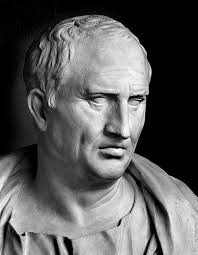
Cicero was a Roman statesman, lawyer, scholar, philosopher, writer and Academic skeptic, who tried to uphold optimate principles during the political crises that led to the establishment of the Roman Empire. His extensive writings include treatises on rhetoric, philosophy and politics. He is considered one of Rome's greatest orators and prose stylists.… Petrarch's rediscovery of Cicero's letters is often credited for initiating the 14th-century Renaissance in public affairs, humanism, and classical Roman culture.
Introductory Comments
Orator, lawyer, philosopher - Cicero was all three, but above all he was a politician. He took his highest duty to be active service in the Roman Republic - especially in defense against threats its survival. His priorities show in the fact that his greatest philosophical works were written after his political career had effectively come to an end, and he had time for more literary pursuits.
He was hardly the last to make philosophy a consolation for lost power - while also at times making pointed comments in political philosophy. Around 524, the Roman statesman Boethius, imprisoned by the Ostrogothic king Theodoric, wrote a book he aptly titled The Consolation of Philosophy. Centuries later, Machiavelli wrote The Prince during the enforced idleness that followed his exile from Florentine politics in 1512. Others followed a similar path: Seneca, More, Bacon, Hobbes, de Tocqueville, and Gramsci all produced significant work once political life had cast them aside or passed them by.
One needn't overstate the point to suspect a common motive. These men wrote, at least in part, for the delicious, literary, and very human satisfaction of getting the last word, and so winning over posterity, if only in imagination. The defeated, it turns out, leave behind a great many books. One could go so far as to say: history may be written by the victors, but political philosophy is largely the legacy of losers.
Some of Cicero's Key Positions
A measure of skepticism is healthy in all matters, however weighty. Certainty is beyond our reach, so no philosophy should be held to be absolutely true. As the Skeptics teach, we should suspend final judgment and weighed competing views.
Yet suspending certainty is not the same as throwing up one's hands. Some claims remain probable and worth provisional assent. The Stoics were largely right that virtue is the highest aim in life, and Socrates was right that rational beings ought to live by reason.
This is no argument for shunning pleasure. Pleasures may be pursued, but in moderation, and never at the expense of duty. Private appetites and ambitions must not crowd out our obligations to the republic.
A republic - a mixed constitution blending monarchy, aristocracy, and popular elements - is the soundest form of government, precisely because it tempers the excesses to which each pure form is prone. But it works only when citizens place the common good above private gain. Strip away that public spirit, and the republic falls apart.
In law, some statutes deserve to be called natural, even God-given: they accord with human nature and right reason, and they bind all peoples in all ages. Such natural law stands above mere human enactment and must be honored above all.
Place in the History of Ideas
Cicero's Place in History of Ideas
Johann Erdmann: A moderate skepticism was most consonant with Cicero's whole temper.... This... enables him to enter into isolated inquiries and to accept whatever seems most probable without committing himself to any system. Hence the method of... inquiring for the reasons for and against everything meets with his com- plete approval; it permits urging one point or another according to circumstances, a licence especially valuable to an orator. Finally..., it tends to modesty, and is a protection against the absurd exaggerations in which the other systems revel, because they pay no heed to common sense.... And in such a sense [Cicero] himself neither is a sage nor wishes to be one. Nor does he wish to describe all that the complete sage knows and is capable of, but only what is probable to a reasonable man, and how such a one has to bear himself.
Archibald Alexander: It was, however, in the sphere of Law and Jurisprudence that the independent contribution of Rome to the development of thought was mainly made, and consequently the influence of Cicero was felt most profoundly in his treatment of the legal aspects of morality. Stoicism, by its high conception of law, lent itself peculiarly to this form of thought, and it became the philosophic basis of that system of Jurisprudence which is Rome's gift to the world.
Random Thoughts on Cicero
Stoicism and Epicureanism shared a fair amount of common ground - high regard for reason, self-restraint, and friendship - yet Cicero (a skeptic by method, a Stoic by sympathy) leveled blistering attacks on the Epicureans. His two fairest and weightiest charges struck at their neglect of public virtues like courage and justice, and at their withdrawal from public life. His least fair charge was that they chased base pleasures without shame. In truth, the Epicureans prized simple, moderate pleasures and, more fundamentally, the absence of pain. They were not hedonists in the gluttonous sense the word now conjures.
But withdraw from public life they certainly did. The public arena was, to their eyes, a minefield - one wrong step and you were blown to pieces. Cicero's own career makes the point for them. He collected powerful enemies who worked hard to make his life miserable, and one of them, Mark Antony, went further still: he had Cicero executed in 43 BC. The Epicureans could have entered Cicero's life as Exhibit A in their case for staying out of politics.
Weigh that life on the Epicurean scale - pleasures minus pains - and the sum looks pitifully thin beside that of the average Epicurean tending his garden. Probably true. But the reckoning cuts both ways, because on that same scale the public virtues counted for nothing at all - and those were the very things Cicero lived and died for.
Boethius (Happiness is attained through sufficiency, virtue and wisdom.)
Cavell (Skepticism reflects the fundamental limits of human knowledge.)
Jefferson (There should be a wall of separation between Church and State.)
MacIntyre (God is both the source and the pinnacle of justice and natural law.)
Montaigne (When asking big questions, remain skeptical of all answers.)
Nussbaum (Life is fragile. Human goodness can't protect us from all peril.)
Philo (Serenity can be achieved thru self-discipline, temperance & stoicism.)
Pyrrho (Avoiding dogmatic beliefs frees us from mental disturbance.)
Seneca (Uncontrolled anger is damaging to everyone, especially he who is angry.)
Thinkers with opposing positions:
Bentham (Natural laws are nothing more than "nonsense on stilts.")
Descartes (Everything we perceive both clearly and distinctly must be true.)
Epicurus (Happiness comes from maximizing pleasure & minimizing pain.)
Holmes (Natural law does not exist. Morality has nothing to do with law.)
Pascal (Skepticism is a product of the devil and we must fight against it.)
Sade (Heed nothing but your desires; let them alone be your laws.)
Schopenhauer (Since desire leads to suffering, self-denial is our best path.)
What others said about Cicero
Tadeusz S. Zieliński: The Renaissance was above all things a revival of Cicero, and only after him and through him of the rest of Classical antiquity.
Dickens: If I could have known Cicero, and been his friend, and talked with him in his retirement at Tusculum (beau-ti-ful Tusculum l), I could have died contented.
Quintilian: It was not, therefore, without good reason that his own contemporaries spoke of his "sovereignty" at the bar, and that for posterity the name of Cicero has come to be regarded not as the name of a man, but as the name of eloquence itself. Let us, therefore, fix our eyes on him, take him as our pattern....
John Adams: As all the ages of the world have not produced a greater statesman and philosopher united than Cicero, his authority should have great weight.
Voltaire: [Cicero was] the greatest as well as the most elegant of Roman philosophers.
Alan Ryan: Cicero discusses justice as the second of the four cardinal virtues (wisdom, justice, courage, and temperance).... Justice is the virtue that holds society together and allows us to pursue the common good....
Montaigne: [Cicero's] way of writing... seems to me boring. If I have spent an hour in reading him, which is a lot for me, and I remember what juice and substance I have derived, most of the time I find nothing but wind; for he has not yet come to the arguments that serve his purpose and the reasons that properly touch on the crux, which I am looking for.
J. W. Mackail: Cicero's unique and imperishable glory is that he created the language of the civilized world, and used that language to create a style which 19 centuries have not replaced, and in some respects have hardly altered.
Schools: Humanism, Natural Law Theory, Republicanism, Skepticism, Stoicism, Virtue Ethics
Main interests: Agriculture, Fate, Free/Unfree Will, Friendship, Government, Happiness, History of Philosophy, Immortality, Jurisprudence, Just War, Justice, Law, Political Philosophy, Politics, Public Administration, Rhetoric, Virtue, War, Wisdom