Emma Goldman (1869 - 1940)
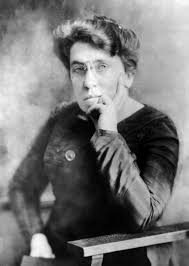
Open Goldman's interactive page (graphs of influences, similar and opposing positions, and quotes)
Background
Emma Goldman
Born: June 27, 1869 in Kovno, Russian Empire
Died: May 14, 1940 (aged 70) in Toronto,
Ontario, Canada
Schools: Anarchism, Anarcha-feminism,
Anarcho-communism, feminism
Main interests: Politics, political philosophy,
feminism
Influences: Friedrich Nietzsche, Johann Most,
Henry David Thoreau, Ralph Waldo Emerson,
Peter Kropotkin, Mikhail Bakunin, Karl Marx,
Mary Wollstonecraft, Nikolay Chernyshevsky,
Oscar Wilde, Max Stirner, Pierre-Joseph
Proudhon, Leo Tolstoy, Alexander Berkman,
Edward Bellamy
Influenced: Roger Nash Baldwin, Ba Jin, Noe Ito,
Margaret Sanger
From Wikipedia
Goldman was a Russian-born anarchist revolu- tionary, political activist, and writer. She played a pivotal role in the development of anarchist political philosophy in North America and Europe in the first half of the 20th century.... Her writing and lectures spanned a wide variety of issues, including prisons, atheism, freedom of speech, militarism, capitalism, marriage, free love, and homosexuality…. [She also] developed new ways of incorporating gender politics into anarchism.
Introductory Comments
Goldman spent half a century chasing a revolution that kept slipping out of her grasp. The dream never changed: a society in which order grows naturally from within instead of being imposed, despotically, from without. Her life, by contrast, was anything but orderly. In 1892 she helped plan Alexander Berkman’s attempt to assassinate Henry Clay Frick, chairman of Carnegie Steel, during the Homestead strike. Frick survived, and Berkman, her lover and lifelong comrade, spent 14 years in prison. The next year, with the country sunk in depression, she told a crowd of unemployed New Yorkers that if they were denied bread they should take it. The speech earned her a year in jail. In 1919, after a second prison term for opposing the draft, the United States deported her to Soviet Russia, the revolution she had cheered from afar. Within two years she left it, appalled. And in 1936 she found in the anarchist collectives of Republican Spain something close to her dream, just in time to watch it destroyed, by Franco's armies.
It would be easy to read all this as a parable of misplaced faith: a woman whom reality rejected again and again, and who refused, again and again, to take the hint. Goldman fought company guards and strikebreakers, laws forbidding talk of contraception, a draft that sent workers off to kill one another - the list is long. Nor was it all for naught. The society she dreamed of never arrived, but several of the freedoms she demanded did, and none of them arrived by asking politely.
Some of Goldman's Key Positions
Government is not the cure for injustice, violence, and corruption but their chief source, and the remedy is to abolish it. Anarchism does not mean chaos, but liberation: of the mind from religion, of the body from property, and of social life from government.
Capitalism and the state work together. Private property condemns workers to poverty and deadening labor. Production should be carried on by free associations of workers, with wealth held in common.
Anarchism is a way of living, not merely a political program, and it reaches into love, sex, marriage, art, and speech. Marriage is chiefly an economic arrangement that makes women dependent; love must be free. Women must have access to birth control, and speech must be free for everyone.
Women’s emancipation comes from within. The ballot will not free women any more than it has freed men. Liberation means casting off convention, public opinion, and dependence.
Patriotism is a superstition that turns workers into soldiers who kill one another for their rulers' benefit, so war and conscription must be resisted. Political violence is different: it is the predictable product of the violence society inflicts, the desperate act of people pushed past endurance. It must be understood before it is condemned.
Place in the History of Ideas
Goldman's Place in History of Ideas
Clyde E. Willis: Emma Goldman, a Russian-born anarchist, socialist, and feminist, was a thorn in the side of mainstream American society in the early part of the 20th century. She traveled constantly, delivering vitriolic speeches, lectur- ing, picketing, marching, and demonstrating for First Amendment rights. She advocated free speech, free love, birth control, women’s equal- ity, and the right of labor to organize. She fought against anti-syndicalism laws, the mili- tary draft, and American intervention in the Russian Revolution…. Finding much in the United States that disappointed her sense of justice for the disadvantaged, she began a life- time of revolutionary activities that frequently ended with her arrest…. Although most of Gold- man’s arrests, usually under state anti-syndical- ism laws, did not result in her being incarcer- ated, she spent considerable time in prison.
Gerald Sorin: The pages of the magazine Mother Earth that Emma Goldman edited from 1906 to 1917 are filled with Yiddish stories, tales from the Talmud, and translations of Morris Rosen- feld’s poetry. Moreover, her commitment to anarchism did not divert her from speaking and writing, openly and frequently, about the particular burdens Jews faced in a world in which antisemitism was a living enemy. Appar- ently, Emma Goldman’s faith in anarchism... did not result from and was not dependent on a casting off of Jewish identity
Random Thoughts on Goldman
Goldman began her political life breathing fire. At 23 she was convinced that injustice so deeply rooted could only be burned out, and that a well-aimed bullet might rouse America’s workers from their slumber. Berkman’s attack on Frick roused mostly the police. Over the following decades her faith in the dramatic deed cooled, and Russia finished the job. There she watched the Bolsheviks turn from liberators into jailers, and she drew the lesson that anchored her later thought: the methods a revolution uses to win become the habits it uses to govern. When freedom takes up the sword, it tends to end by cutting its own throat. Nobody, it seems, can shoot a path to anarchism based on voluntary cooperation.
On the question of joy, by contrast, Goldman did not waver. In her autobiography she recalls dancing at a party as a young agitator when a solemn comrade took her aside to say that such frivolity hurt the Cause. Her reply: a cause that promised freedom from convention had no business demanding that she give up life and joy. Decades later the story was boiled down to a slogan she never actually said ("If I can’t dance, I don’t want to be part of your revolution") and printed on T-shirts by the radicals of the 1970s. The words aren’t hers, but the sentiment is. And so, her two convictions converge: A revolution built on bloodshed produces a state that sheds blood; a revolution built on joy produces a joyful society. Either way, the means become the end.
Influences
Goldman was influenced by: Bakunin, Bellamy, E., Berkman, A., Chernyshevsky, Emerson, Kropotkin, Marx, Most, Johann, Nietzsche, Proudhon, Stirner, Thoreau, Tolstoy, Wilde, Wollstonecraft
Goldman influenced: Ba Jin, Baldwin, R.N., Noe Ito, Sanger, M.
Similar and opposing positions
Thinkers with similar positions:
- Bakunin (Law & the state are at times obstacles to freedom & human rights.)
- Condorcet (Patriarchal norms that oppress & marginalize women must end.)
- Engels (Marriage is a capitalist institution created to protect property.)
- Godwin (Government by its very nature counteracts creative & original thinking.)
- Kropotkin (A communist republic based on a strongly centralized state will fail.)
- Proudhon (As we seek justice in equality, so society seeks order in anarchy.)
- Singer, Peter (There's no evidence that God exists nor that belief in Him is good)
- Sorel (Violence is justified when done in general strike for rights of workers.)
Thinkers with opposing positions:
- Arendt (Only rights granted by the state matter, not "inalienable human rights.")
- Bentham (Natural laws are nothing more than "nonsense on stilts.")
- Burke (Radical changes in govt. are dangerous & undermine social stability.)
- Butler, Judith (Gender is constituted by action and speech. It is performative.)
- Cicero (Liberty is the power to do that which is permitted by law.)
- Dostoyevsky (Without religion, we will drown in our own irrational impulses.)
- Fichte (Active citizenship and civic freedom should be withheld from women.)
- Lukács (Commmunism should lead to the dictatorship of the proletariate.)
What others said about Goldman
- J. Edgar Hoover: [Emma Goldman is] the most dangerous woman in America.
- Jared Schroeder: Goldman, long known as an anarchist and feminist, deserves credit for her work as a free-press trailblazer, whose legal ordeals... were forerunners for critical First Amendment precedents.
- Kim Kelly: She is remembered as an earthy, bohemian woman who loved art, music, and sex, and saw no reason for a revolutionary to deprive themselves of beautiful things. This attitude gave rise to one of the most popular quotes attributed to her: “If I can’t dance, I don’t want to be in your revolution.”
- Alice Wexler: Revolutionary anarchism in America was largely an immigrant phenomenon. Goldman hoped to Americanize anarchism by appealing to English-speaking audiences, especially to intellectuals.
- Kim Kelly: She was proud of her Jewish identity but spurned religion as a tool of oppression.
- Jacob Applebaum: ... Emma Goldman is one of my great heroes and I really think that anarchism is a fantastic principle by which to fashion a utopian society even if we can't get there.
- Peggy Guggenheim: During that winter I met Emma Goldman and Alexander (Sasha) Berkman. They were glamorous revolutionary figures and one expected them to be quite different. They were frightfully human. Emma was very vain and it took me years to see through her. First I worshiped her and when later I was disillusioned she did not like it....
- Candace Falk: Her intention was to reach a varied audience through reason and emotion, always ending her talks with a rousing articulation of a vision of hope for a better world within reach.
Schools: Anarchism, Feminism, Social Liberalism, Socialism
Main interests: Civil Rights, Community, Democracy, Equality, Freedom, Freedom of the press, Government, Justice, Labor, Law, Love, Political Activism, Political Philosophy, Political Theory, Politics, Power, Revolution
Goldman's answers to philosophical questions
Economics
"The only demand that property recognizes is its own gluttonous appetite for greater wealth, because wealth means power."
Capitalism leads to physical suffering and dehumanizing working conditions. It must be replaced with free workers alliances.
Education
"No one [knows] the wealth of sympathy [hidden in] a child…. [E]very true education should [try] to unlock that treasure."
"Public school [is] where the human mind is drilled and manipulated into submission to various social and moral spooks...."
Ethics
"Love, the strongest and deepest element in all life, the harbinger of hope, of joy, of ecstasy... the defier of all laws...."
History
"The history of progress is written in the blood of men and women who have dared to espouse an unpopular cause...."
Law
"No great idea in its beginning can ever be within the law. How can it be within the law? The law is stationary. The law is fixed."
Nature
"I’d rather have roses on my table than diamonds on my neck."
Political Philosophy
Anarchism is "the liberation... from the dominion of property; liberation from the shackles and restraint of government."
All governments spring from violence and the desire to have power over the lives of others. Violence is inherent to goverment.
Democracy doesn't spring from voting for governmental leaders, but rather from doing away with government & its leaders.
Wars are never justified. Violence can only breed more violence. What is needed is a world-wide commitment to pacifism.
Governments are never justified in restricting the rights of its citizens. Human rights and freedoms are sacrosanct.
"Revolution is... a violent protest against man's inhumanity to man with all the thousand and one slaveries it involves."
Consenting adults should be allowed to pursue their sexual activities in whatever manner gives pleasure to their lives.
"The free expression of the hopes and aspirations of a people is the greatest and only safety in a sane society."
Religion and Theology
Religion springs in large part from the desire "to lash the people into obedience, meekness, and contentment."
Religion holds back moral and social progress by offering "poor people a false promise of a plentiful future in heaven."
"Whatever his mistakes, man has for thousands of years past been working to undo the botched job your God has made."
"The philosophy of Atheism expresses the expansion and growth of the human mind. The philosophy of theism... is static...."
Sex and Gender
Men and women should be free to choose as many sexual partners as they please, without any legal or marital restraints.
We must "do away with the... notion of the dualism of the sexes, or that man & woman represent two antagonistic worlds."
Marriage should be done away with. It's a confining & often cruel institution, & one that's particularly demeaning to women.
"I demand the independence of woman, her right to support herself; to live for herself; to love whomever she pleases...."