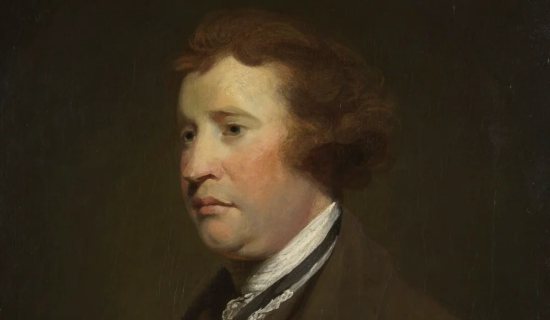
Burke was an Anglo-Irish statesman and philoso- pher.... Born in Dublin, Burke served as a member of Parliament between 1766 and 1794 in the House of Commons of Great Britain with the Whig Party…. In the 19th century, Burke was praised by both conservatives and liberals. Subsequently, in the 20th century, he became widely regarded, especially in the United States and the United Kingdom, as the philosophical founder of conservatism, along with his ultra-royalist and ultramontane counterpart Joseph de Maistre.
Introductory Comments
Burke denounced the French upheaval of 1789 with near-biblical fury, yet a decade earlier he had spoken in Parliament for the American colonists against his own government. Untangling the apparent contradiction leads straight into the center of his thought: Society, for Burke, is a cross-generational contract - "a partnership not only between those who are living, but between those who are living, those who are dead, and those who are to be born." The dead did the difficult work. Centuries of trial, error, and no small amount of blood produced the courts, charters, parishes, and customs that let the living get on with their business in relative peace. Each generation inherits an estate it did not build. The rent is stewardship: preserve what works, repair what doesn't, and pass the whole thing on in decent condition.
The French Revolution, as Burke saw it, burned this contract in order to start from scratch. They swept away not merely an incompetent monarchy but the accumulated machinery of a nation - its church, its law, its very currency - and did so on the authority of abstract rights deduced by men who had never governed anything. The dismal conditions they meant to remedy were real. Burke's charge though was that they had confused demolition with repair. In 1790 Burke warned: strip away inherited restraint and the vacuum will be filled by whoever proves most ruthless. Four years later the Reign of Terror began. (As to why he took the colonists' side, see Random Thoughts.)
Some of Burke's Key Positions
Radical reconstruction of a nation's government and society is both misguided and dangerous - the French Revolution being the great cautionary case. Political and social institutions are not blueprints drawn up on paper. They grow over generations, adapting by small steps and much trial and error to a people's circumstances, needs, and values.
Such institutions are "the general bank and capital of nations, and of ages." They hold more practical wisdom than any individual can spin out of his own small stock of reason. Accompanying these instituttions, is a set of inherited habits and settled feelings - a people's accumulated good sense, and a steadier guide than any abstract speculation of the "sophisters, economists, and calculators."
None of which means institutions should be frozen. Circumstances shift, and a state without the means of some change is without the means of its own preservation. Reform is the instrument of conservation, not its enemy. The test is whether a proposed change repairs and extends what already exists or scraps it for a scheme.
Two such needed changes: to further constrain the executive authority of the crown and to eliminate the patronage, pensions, and sinecures by which ministers bought a compliant Parliament. We must also lift legal disabilities from religious minorities, above all Irish Catholics, while defending the established church as part of the constitution.
Place in the History of Ideas
Burke's Place in History of Ideas
Roger Scruton: In Burke's eyes the self-righteous contempt for ancestors which characterized the Revolutionaries was also a disinheriting of the unborn. Rightly understood, he argued, society is a partnership among the dead, the living, and the unborn, and without what he called the “hereditary principle,” according to which rights could be inherited as well as acquired, both the dead and the unborn would be disenfranchized. Indeed, respect for the dead was, in Burke's view, the only real safeguard that the unborn could obtain, in a world that gave all its privileges to the living. His preferred vision of society was not as a contract, in fact, but as a trust, with the living members as trustees of an inheritance that they must strive to enhance and pass on.
Churchill: On the one hand [Burke] is revealed as a foremost apostle of Liberty, on the other as the redoubtable champion of Authority. But a charge of political inconsistency applied to this life appears a mean and petty thing.... His soul revolted against tyranny, whether it appeared in the aspect of a domineering Monarch [or in] the dictation of a brutal mob.... No one can read the Burke of Liberty and the Burke of Authority without feeling that here was the same man pursuing the same ends, seeking the same ideals of society and Government, and defending them from assaults, now from one extreme, now from the other.
Random Thoughts on Burke
Burke thought revolution a catastrophe and evolution a necessity. Fine. Then why did he stand up in Parliament, session after session, on the side of the American colonists? The short answer is that he did not see in America a revolution at all. The longer answer is more interesting, because it turns the usual picture inside out. In Burke's telling, the innovators in the American crisis were not in Boston. They were in Westminster. Consider what the colonists were actually demanding. Not the rights of man, not a new political science, not a constitution deduced from first principles - but the rights of Englishmen, which they believed they had carried across the Atlantic and never surrendered. Trial by jury. Charters. No taxation without their own consent. These were not novelties. Meanwhile Parliament asserted a sweeping new right to tax and legislate for the colonies "in all cases whatsoever." The British were the radicals.
Burke was not against change. He was against the belief that change can be designed on paper and imposed by force. The American colonies had been quietly changing for generations, and the sensible course was to recognize what they had become. Britain's error was insisting they remain what they had been. The French would soon commit the opposite error - insisting a nation become something it had never been. In brief: the British thought history had a reverse gear, the French thought history had a reset button; and Burke knew history had neither.
Arendt (Only rights granted by the state matter, not "inalienable human rights.")
Gadamer (We inevitably think and speak as part of cultural traditions.)
Herzen (Humans should never be sacrificed on an altar of glorious abstractions)
Jefferson (Governments should guarantee freedom of religion & expression.)
Locke (Adherence to the law is always the best guarantor of human rights.)
MacIntyre (Rationality is inevitably linked to cultural traditions.)
Montesquieu (Government excesses can be avoided thru' checks & balances.)
Oakeshott (Conservatives prefer the tried to untried, the actual to possible.)
Thinkers with opposing positions:
Arendt (Representatives should represent their constituents, not lead them.)
Fichte (Freedom springs from submerging individuality into a larger group.)
Godwin (The goods that benefit us must be regulated by justice alone, not laws.)
Hitchens (Religion is violent, irrational, intolerant & allied to racism & sexism.)
Paine (When governments trample on human rights, revolutions are justified.)
Rousseau (All government and all laws should be based on the Popular Will.)
Saint-Simon (Society and economy can be perfected thru science and reason.)
Wollstonecraft (Progress relies on reason & virtue - not tradition & custom.)
What others said about Burke
William Wordsworth: [Burke was] the most sagacious Politician of his age, [whose predictions] time has verified.
Novalis: Many counterrevolutionary books have been written in favor of the Revolution. But Burke has written a revolutionary book against the Revolution.
Roger Scruton: [Burke saw that the knowledge] we need in... unforeseeable circumstances [can't] be deduced a priori from universal laws. This knowledge is bequeathed to us by customs, institutions, and habits of thought that have shaped themselves over generations, through the trials and errors of people many of whom have perished in the course of acquiring it.
Gibbon: Burke's book is a most admirable medication against the French disease, which has made too much progress even in this happy country.... I approve his politics, I adore his chivalry, and I can even forgive his superstition.
Strauss: Burke... seeks the foundation of government "in a conformity to our duties" and not in "imaginary rights of man."
Smith, Adam: [Burke is] the only man I ever knew who thinks on economic subjects exactly as I do, without any previous communications having passed between us.
Christopher Hitchens: If modern conservatism can be held to derive from Burke, it is not just because he appealed to property owners in behalf of stability but also because he appealed to an everyday interest in the preservation of the ancestral and the immemorial.
Francis Hirst: [Burke was] always anxious to preserve and renovate rather than to innovate. In politics he resembled the modern architect who would restore an old house instead of pulling it down to construct a new one....
Schools: Classical Liberalism, Common Sense Realism, Conservatism, Counter-Enlightenment, Traditionalism
Main interests: Beauty, Communication, Desire, Government, Habits, Health, Ideology, Just War, Justice, Law, Political Philosophy, Political Theory, Politics, Republicanism, Revolution, Social Philosophy, Sublime Nature, Wisdom