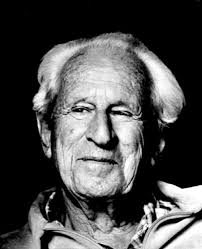
Marcuse was a German-American philosopher, sociologist, and political theorist…. He was a prominent figure in the Frankfurt-based Institute for Social Research - what later became known as the Frankfurt School…. In the 1960s and the 1970s he became known as the preeminent theorist of the New Left and the student movements of West Germany, France, and the United States; some consider him "the Father of the New Left". His best-known works are Eros and Civilization and One-Dimensional Man.
Introductory Comments
Every so often a thinker tries to marry two great systems, and the guests leave wondering whether bride and groom had ever been properly introduced. Marcuse attempted just such a match: a Marx freed from orthodox economics, wed to a Freud coaxed off his Victorian couch. The offspring was a utopia neither parent would likely have recognized. Start with Marx. Marcuse kept the dialectic - he was one of the most Hegelian of Marxists - but he injected Freud's "polymorphous perversity" into the theory of labor. The aim was to turn the stern analyst of alienated work into something like a prophet of joy. Toil, once freed from scarcity, was to become play: creative, expressive, and - the reader may need a moment here - erotic.
Freud received similar treatment. Marcuse kept the id and kept repression, but he discarded the gloom. Freud saw repression as the unavoidable price of civilization. Marcuse agreed that some was necessary but argued that modern industrial society exacts far more than order requires. This "surplus repression," he claimed, serves domination rather than survival - keeping people working, disciplined, and, most of all, compliant. Nor was the death instinct banished; a liberated Eros, Marcuse proposed, might simply tame it. The result was a Marx high on pleasure and a Freud dripping with optimism. It made a heady brew, and it turned a German philosopher pushing seventy into an improbable hero of the student New Left.
Some of Marcuse's Key Positions
Marx remains indispensable, but orthodox Marxism needs correcting. By treating human beings chiefly as economic actors, it neglected the psychological roots of both domination and freedom. Class exploitation is real and ongoing, yet human unfreedom reaches well beyond the struggle over material goods.
Marx wrote before Freud, and his theory lacks an account of the instincts. Freud supplies one, though his conclusions need revising. Civilization does require some repression of instinct, but modern society imposes far more than it needs. Genuine liberation requires freeing Eros: not sexuality in the narrow sense, but the whole life instinct of pleasure, play, and creativity, reshaping work and social life alike.
A culture saturated with sexual excitement is not that liberation but its counterfeit. Advanced industrial society permits a controlled, commercialized release of instinct through advertising, entertainment, and mass culture. This is "repressive desublimation."
The result is a "one-dimensional" society, one that has lost the capacity to imagine alternatives to itself. Satisfying "false needs," which the system implants and which serve it, absorbs the discontent that might otherwise fuel opposition. People comply less because they are coerced than because they are gratified.
Place in the History of Ideas
Marcuse's Place in History of Ideas
Peter Beilharz: The European critique of modernity was born as a critique of the mass - mass society, mass production, mass migration, the mass man, the image of life based on the factory, on its regimentation and yesmen, the conformism of following orders. This was also Marcuse’s anxiety into the 1960s - that the lucid or erotic components of being had been submerged into dull regimes of compliance, consumption, and getting on. Perhaps this was the moment when sociology began to shifts its focus from the realm of production to that of consumption. Gramsci had already anticipated the cultural turn in Marxian thirty years earlier. Marcuse was not the only high-profile critical theorist, though the fact that he remained in the USA after Horkheimer and Adorno returned to Germany placed him strategically to be more significantly influential into the 1960s.
Mark Kurlansky: By 1968 there was another in- tellectual it seemed everybody wanted to quote: Marxist-Hegelian revisionist revolution- ary Herbert Marcuse. His most appealing idea was what he called "the great refusal," the time to say "No, this is not acceptable" - another idea that was expressed in Savio's "odious ma- chine" speech.... The most talked about Mar- cuse book of the late sixties, One-Dimensional Man, was published in 1964. It denounced technological society as shallow and conform- ist....
Random Thoughts on Marcuse
Anyone who has spent time with a baby knows that its pursuit of pleasure is wonderfully indiscriminate. A toe, a thumb, a warm bath, a spoonful of mashed banana - all will do. Freud gave this condition a forbidding name, "polymorphous perversity," but he meant it as clinical description, not moral judgment. The infant’s sexual drive, he argued, is diffuse and unorganized. It draws pleasure from mouth, skin, and bowels alike, with no ranking among them. Genital primacy comes later. So do shame, disgust, and morality, which Freud likened to dams built against the flood. No fixation, no purpose, no embarrassment: the infant is, in a sense, a tiny anarchist of pleasure.
Marcuse, never one to waste a utopian possibility, looked at this portrait and saw not a stage to be outgrown but a promise to be redeemed. Some repression, he granted, is the price of any civilization. But much of what we endure is "surplus repression," imposed not for survival but to keep us docile and productively miserable. Lift it, and the old diffuse eroticism might reawaken, spreading beyond the genitals into play, art, social life, even work. Marcuse saw the obvious objection coming. This would not be a return to the nursery, he insisted, but a liberation guided by reason. Still, it's hard not to smile. For two and a half millennia, philosophers had labored to define the mature human being. Now one of 20th century's most sophisticated theorists seemed to suggest that the ideal had been gurgling in a crib all along.
Marcuse influenced: Acker, Kathy, Bey, Hakim, Black, Bob, Brown, N.O., Davis, Angela, Dutschke, R., Gorz, Andre, Habermas, Hoffman, A., Kellner, D., Young, R.M.
Similar and opposing positions
Thinkers with similar positions:
Bakunin (Law & the state are at times obstacles to freedom & human rights.)
Fourier (Transforming labor into pleasure is a humane and worthy goal.)
Freud (Human civilization developed thru' the suppression of human nature.)
Fromm (We need a socialist humanism that fights both injustice & alienation.)
Gramsci (Overthrowing unjust regimes requires overthrowing their worldviews)
Horkheimer (Popular culture encourages a passive & unquestioning worldview.)
Humboldt, W. (Mind and body form a vital unity as seen in man's sensuality.)
Lukács (Our obsession with commodities have made social relations "thinglike.")
Marcel (We too often define ourselves by what we own - not who we are.)
Ortega (Modern capitalism has demoralized humanity & weakened morality.)
Ruskin (Most importantly, govt. should promote economic and social justice.)
Thinkers with opposing positions:
Benjamin (At its best popular culture can help bring about social change.)
Burke (Laws of commerce are laws of Nature & therefore the laws of God.)
Hayek (Socialism requires central planning which in turns leads to oppression.)
Locke (The preservation of property is one of the most essential roles of govt.)
Montesquieu (Commerce tends to reduce prejudice and increase freedom.)
What others said about Marcuse
MacIntyre: Marcuse invokes the great names of freedom and reason while betraying their substance at every important point.
Mark Kurlansky: One of the first Marxists to lose faith in the Soviet system, Marcuse saw the West as also in a state of "unfreedom" and often suggested that revolution may be the only path to true freedom.
Herbert Gintis: I had lunch with Marcuse when he was lecturing in Cambridge, Ma.... I told him that he and his critical studies comrades were true totalitarians. They hoped for a workers' revolution, after which they would be appointed Cultural Commisars by the Great Leader of the working class, and they would teach people what to think.
Hayek: [Marcuse's writings represent] the kind of Marxism which I dislike the most. It’s a combination of Marxism and Freudianism. I am equally opposed to both of the sources, and in its combined form I find it particularly repulsive.
MacIntyre: ... Marcuse was not an orthodox Marxist. Like many of the Frankfurt School, Marcuse wrote of "critical theory" not of "Marxism."
Leszek Kołakowski: [Marcuse's ideal society] is to be ruled despotically by an enlightened group [who] have realized in themselves the unity of Logos and Eros, and thrown off the vexatious authority of logic [and science].
Mark Kurlansky: While [many praised technology], Marcuse warned that it would instead imprison people in unoriginal lives devoid of creative thinking. He warned that though technology appeared to help the dissenter, it would actually be used to muffle protest. People were being anesthetized into a complacency that was mistaken for happiness.
Herbert Gintis: I quite liked Marcuse because his was capable of changing his mind, and was mentally vigorous at an advanced age (most of my colleagues ceased thinking beyond tenure).
Main interests: Alienation, Communication, Cultural Criticism, Desire, Economics, Eroticism, Free/Unfree Will, Freedom, Ideology, Industrialism, Labor, Language, Mass Media, Mind, Political Activism, Political Philosophy, Political Theory, Politics, Popular Culture, Psychoanalysis, Psychology, Revolution, Sexuality, Social Criticism, Social Philosophy, Social Theory, Technology, Utopia