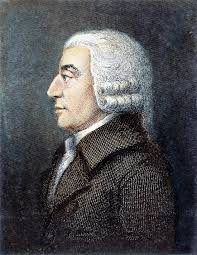
Smith was a Scottish economist and philosopher who was a pioneer in the thinking of political economy and key figure during the Scottish En- lightenment. Seen by some as "The Father of Economics"…, he wrote two classic works, The Theory of Moral Sentiments and The Wealth of Nations…. Smith refuses to explain the distribution of wealth and power in terms of God's will and instead appeals to natural, political, social, economic, legal, environmental and technological factors and the interactions among them.
Introductory Comments
Because of his reputation as a religious skeptic, Hume never got the university professorship he sought. His good friend Adam Smith, by contrast, was not only a professor, albeit a famously absent-minded one, but the esteemed Professor of Moral Philosophy at the University of Glasgow. The competition for such posts had been a minor story for centuries. It grew into a larger one in the 18th century, at least in Scotland, where the universities became genuine engines of Enlightenment thought. With the rise of the Scottish chairs came a sharper distinction between the man of letters, who made his living by his pen, and the professional academic, whose income and standing came with admission to the Hallowed Halls.
The distinction shaped intellectual life: how such men wrote, what they wrote about, where they published. Academics increasingly addressed fellow specialists and aimed to compel assent through evidence and argument. Men of letters addressed educated readers and aimed to win them through voice, wit, and pathos. The former were scholarly, the latter friendly. The former were esteemed, the latter loved. And Smith and Hume? Neither quite fit the above descriptions. And happily, friendship proved more powerful than professional geography. The professor and the man of letters remained devoted friends, intellectual companions, and admirers of each other's work - two rather different careers joined in one of the Enlightenment's great friendships.
Some of Adam Smith's Key Positions
Whatever moralists say, rational self-interest is a good thing in economic matters - especially when competition keeps it honest. The butcher and the baker do not feed the town out of benevolence; they feed it because it serves them, and in serving themselves they serve everyone else.
Such an economy is energetic and, to a remarkable degree, self-coordinating. Prices and profits shift as buyers and sellers respond to one another, steering labor and capital toward what people actually want. No government could direct the countless economic decisions of individuals as effectively as individuals pursuing their own interests within a framework honest competition.
However, government should establish and enforce the rules necessary for markets to function fairly - without price fixing - and regulate businesses when their activities threaten the public good, and provide essential services that private enterprise cannot adequately supply.
We must also remember that morality is not the same thing as economics. Empathy, not self-interest, governs morals - the imaginative effort of standing in another's situation. Conscience is that effort turned inward: the verdict of an impartial spectator installed in ourselves. So: self-interest is the engine that drives an economy, and government regulation, plus empathy, the brake that keeps it from running over people.
Place in the History of Ideas
Adam Smith's Place in History of Ideas
Robert Heilbroner: Adam Smith’s laws of the market are basically simple. They tell us that the outcome of a certain kind of behavior in a certain social framework will bring about perfectly definite and foreseeable results. Specifically they show us how the drive of individual self-interest in an environment of similarly mo- tivated individuals will result in competition; and they further demonstrate how competition will result in the provision of those goods that society wants, in the quantities that society desires, and at the prices society is prepared to pay.... But self-interest is only half the picture. It drives men to action. Something else must pre- vent the pushing of profit-hungry individuals from holding society up to exorbitant ransom: a community activated only by self-interest would be a community of ruthless profiteers. This regulator is competition, the conflict of the self-interested actors on the marketplace.
F. Hayek: Adam Smith was the first to perceive that we have stumbled upon methods of order- ing human economic cooperation that exceed the limits of our knowledge and perception. His "invisible hand" had perhaps better have been described as an invisible... pattern. We are led... to do things by circumstances of which we are largely unaware and which produce results that we do not intend. In our economic activities we do not know the needs which we satisfy nor the sources of the things which we get.
Random Thoughts on Adam Smith
Long before Smith described an invisible hand guiding the economy through the interplay of countless self-interests, Bernard Mandeville got there in a joke. The Fable of the Bees began in 1705 as a piece of doggerel about a thriving hive of thoroughly corrupt bees, and grew by 1714 into a book of poem-plus-commentary with a subtitle that says everything: Private Vices, Publick Benefits. Mandeville's bees are grasping, vain, and dishonest, and their hive hums. Then Jove grants their prayer for honesty. Virtue arrives, spending stops, and the economy collapses into a hollow tree. The moral is delivered with a grin: the vanity that buys the silk gown feeds the weaver, and the glutton's appetite employs the cook.
The differences with Smith are more than differences of tone, though the tonal gap is wide enough - Professor Smith earnest and systematic, Mandeville witty and flippant, the man of letters again writing to be enjoyed rather than examined. Smith read him closely and rejected him flatly, calling his conclusions wholly pernicious. Mandeville needs vice, because he defines virtue so strictly that any act done for pleasure or profit fails the test, which conveniently makes every human motive a vice and every benefit a paradox. Smith refuses the trick. The butcher's regard for his own interest is not greed dressed up; it is prudence, and prudence is a genuine virtue. The quarrel, then, boils down to alchemy. Where Mandeville uses lead to turn into gold, Smith uses silver.
Hayek (The common interest requires everyone seek economic self-interest.)
Hutcheson (Our motives are often neither self-interested nor materialistic.)
Keynes (Govt. interference in an economy is at times needed as a stimulus.)
Montesquieu (Commerce tends to reduce prejudice and increase freedom.)
Reid (Our sentiments are a natural, powerful and precious birthright.)
Ricardo (With industrial economies, international trade is always beneficial.)
Thinkers with opposing positions:
Bourdieu (We don't always act according to rational or economic criteria.)
Dostoyevsky (Humans are full of irrational cravings and contradictions.)
Holbach (The state should not try to regulate or interfere with the economy.)
Kropotkin (The best economy is a decentralized one based on mutual aid.)
Lukács (So-called eternal "laws" of economics are merely ideological illusions.)
Marcuse (Capitalism can lead to a dehumanizing objectification of ourselves.)
More (We must vigilantly guard against our craving for money and wealth.)
Nozick (No laws should limit people's consensual acts in economic matters.)
Saint-Simon (Society and economy can be perfected thru science and reason.)
Spencer (Govt. should not interfere in the economic survival of the fittest.)
What others said about Smith, Adam
P. J. O'Rourke: [Adam Smith was the] founder of free market economics.
Herbert Stein: He viewed government intervention in the market with great skepticism [yet] was prepared to accept... qualifications to that policy in the specific cases where he judged that their net effect would be beneficial....
Chomsky: Everybody reads the first paragraph of The Wealth of Nations where he talks about how wonderful the division of labor is. But not many people get to the point hundreds of pages later, where he says that division of labor will destroy human beings and turn people into creatures as stupid and ignorant as it is possible for a human being to be.
Hayek: The nineteenth-century enthusiast who claimed that the Wealth of Nations was in importance second only to the Bible has often been ridiculed; but he may not have exaggerated so much.
Joseph Stiglitz: The reason that the invisible hand often seems invisible is that it is often not there.
Alan Greenspan: It was left to Adam Smith to identify the more-general set of principles that brought conceptual clarity to the seeming chaos of market transactions.
Friedman: The key insight of Adam Smith's Wealth of Nations is misleadingly simple: if an exchange between two parties is voluntary, it will not take place unless both believe they will benefit from it. Most economic fallacies derive from the neglect of this simple insight, from the [assumption] that there is a fixed pie, that one party can gain only at the expense of another.
Heilbroner: Even today - in blithe disregard of his actual philosophy - Smith is generally regarded as a conservative economist, whereas in fact, he was more... hostile to the motives of businessmen than most New Deal economists.
Main interests: Abolition of slavery, Class Struggle, Commerce, Desire, Economics, Ethics, Friendship, Game Theory, Government, Happiness, History, Labor, Political Philosophy, Political Theory, Progress, Property, Social Theory, Virtue, Wealth