Thomas Carlyle (1795 - 1881)
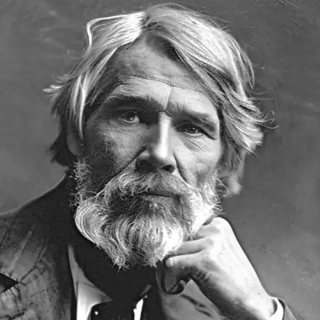
Open Carlyle's interactive page (graphs of influences, similar and opposing positions, and quotes)
Background
Thomas Carlyle
Born: 4 December 1795 in Ecclefechan,
Dumfriesshire, Scotland,
Died: 5 February 1881 (aged 85) in London,
England, United Kingdom
Literary movement: Victorian literature,
Romanticism
Notable works: Sartor Resartus, The French
Revolution: A History On Heroes, Hero-Worship,
and The Heroic in History, Frederick the Great
Main interests: Literature, history, mathematics,
heroes, social criticism, race
Influences: Shakespeare, Fichte, Goethe, Swift,
Saint-Simon, Schiller, Laurence Sterne,
Coleridge
Influenced: Emerson, Proust, Thoreau, Charles
Dickens, John Ruskin, Matthew Arnold, George
Fitzhugh, George Meredith, Thackeray, George
Eliot, Joseph Goebbels, Adolf Hitler
From Wikipedia
Carlyle was a Scottish essayist, historian, and philosopher. Known as the "sage of Chelsea," his writings strongly influenced the intellectual and artistic culture of the Victorian era…. He initially gained prominence in English-language literary circles for his extensive writing on German Romantic literature and philosophy…. His reputation... declined in the aftermaths of World War I and World War II, when his philosophy was seen as a precursor of both Prussianism and fascism.
Introductory Comments
Carlyle spent his career insisting that history is made by great men and that work and duty are sacred. He spent his home life demonstrating what that combination costs the people standing nearest to it. He married Jane Baillie Welsh in 1826. She was witty, well-read, and - she is now read as one of the finest letter writers of the century - and she had chosen him, against her mother's judgment, as a man destined for great things. He had chosen her for a brilliance he never stopped acknowledging. From 1834 their narrow house in Chelsea, became one of the addresses of Victorian intellectual life. Dickens, Mill, Emerson, Tennyson, Mazzini, Thackeray, and Darwin passed through it, drawn as much by Jane's charm as by Thomas's thunder. Her ear sharpened his prose; her salon supplied the connections his reputation ran on.
And underneath it, trouble. Carlyle was large, moody, and cantankerous, a man who demanded silence for his work and received sympathy, hospitality, and quiet from a wife who got little of any in return. Whether his gospel of heroism was self-portraiture is not a question the evidence can settle. What can be said is that the household ran on the doctrine he preached: the work was sacred, and everything else - Jane's health, her ambitions, her considerable talent - arranged itself around it. After Jane died in 1866 he read her letters and journals, understood at last what the arrangement had cost her, and passed his remaining years in a remorse he made no effort to conceal.
Some of Carlyle's Key Positions
Against the utilitarians and the self-styled practical men, the visible world is not the real one. Matter is the vesture of spirit: every fact, institution, and person is an emblem of a deeper reality that alone is ultimate. To read the world literally - as so much machinery - is to mistake the clothes for the man.
The soul that denies that reality pronounces the "Everlasting No," a defiant rejection of meaning that leaves the denier both miserable and blind. But the No is a stage, not a destination:
Passing through a "Centre of Indifference," the soul may come at last to the "Everlasting Yea" - an affirmation that gives religion a new form and a fresh vitality. Dogma falls away; what remains is faith in God joined to faith in the nobility latent in man. The divine is no longer only above us. It is potentially within us - in thought, in character, and above all in work, which should be held sacred.
Great achievements still require great men. Conditions and economic forces supply the raw material of history, but the material is inert until a hero - prophet, poet, king - gives it direction and kindles the spiritual energies of the rest.
None of this licenses contempt for the weak. Children in the mills and men worked like slaves in the factories are an indictment of the governing classes, who have let the "cash nexus" become the only remaining tie between master and man.
Place in the History of Ideas
Carlyle's Place in History of Ideas
G. K. Chesterton: His great and real work was the attack on Utilitarianism: which did real good, though there was much that was mud- dled and dangerous in the historical philosophy which he preached as an alternative. It is his real glory that he was the first to see clearly and say plainly the great truth of our time; that the wealth of the state is not the prosperity of the people. Macaulay and the Mills and all the regular run of the Early Victorians, took it for granted that if Manchester was getting richer, we had got hold of the key to comfort and progress. Carlyle pointed out (with stronger sagacity and humour than he showed on any other question) that it was just as true to say that Manchester was getting poorer as that it was getting richer....
John Morley: I always felt the force of [John Stuart Mill's] distrust of "thunderings" after an hour with Carlyle. You walked away from Chelsea stirred to the depths by a torrent of humour. But then it was splendid caricature: words and images infinitely picturesque and satiric, marvellous collocations and antitheses, impassioned railing against all the human and even superhuman elements in our blindly misguided universe. But of direction, of any sign-post or way out, not a trace was to be discovered, any more than a judicial page, or sense of any wisdom in the judicial, is to be found in his greatest pieces of history.
Random Thoughts on Carlyle
Carlyle discovered Germany in a room in Edinburgh, decades before he set foot in the place. Goethe, Novalis, Fichte arrived less as literature than as rescue: organic growth in place of mechanical order, Spirit (Geist) at work in history and in the self, mystery restored to a universe the previous century had been busy tidying up. To a young man who had lost his Calvinist faith and kept the Calvinist hunger, it was water in the desert. But he did not swallow the Geist whole. His supreme German was Goethe, who spent much of his life resisting the Romantics, and what Carlyle took from him was not play but discipline. Where Schlegel prized irony, Carlyle demanded earnestness: spiritual depth proved by labor, duty, obedience to one's calling. The theology went; the temperament stayed.
The hero he altered most. From Fichte he took the notion that the great man perceives the Divine Idea of the world and says it aloud. But was the hero a German idea at all, or, rather, the Calvinist elect, unpredestined and dressed for the 19th century? Either way, Carlyle felt a strong connection to Germany. He cheered Prussia in 1870 and spent six volumes on Frederick the Great - the book Goebbels read aloud in the bunker in 1945 while, Goebbels reports, tears stood in Hitler's eyes. Yet the road from his house in Chelsea to the bunker is not straight. Carlyle's hero answers to a moral order above him; the next century's leaders answered to nothing but themselves.
Influences
Carlyle was influenced by: Coleridge, Fichte, Goethe, Saint-Simon, Schiller, Shakespeare, Sterne, L., Swedenborg, Swift
Carlyle influenced: Arnold, Borges, Dickens, Eliot, George, Emerson, Fitzhugh, G., Goebbels, Green, Hitler, Meredith, G., Proust, Ruskin, Thackeray, Thoreau
Similar and opposing positions
Thinkers with similar positions:
- Fichte (Intuition gives our minds direct access to the ground & nature of reality.)
- Goethe (Christianity is the noblest worship, but it's the Worship of Sorrow.)
- Goethe (The true artist strives after a higher truth, not a mere naturalness.)
- Jaspers (Philosophical claims are expressions of our mental dispositions.)
- Kierkegaard (Belief in God cannot be based on reason. Faith requires a leap.)
- Nietzsche (Great men shape and direct history. The masses just follow along.)
- Paine (Democracy is just the way to choose the best representatives to rule.)
- Schiller (Utility is the great idol of the age, to which all demean themselves.)
Thinkers with opposing positions:
- Bakunin (To be free, every form of hierarchical authority must be rejected.)
- Bentham (Greatest happiness of greatest number is measure of right & wrong.)
- Boethius (The purely contemplative part of the Soul is its higher & eternal part.)
- Engels (All recorded history hitherto has been a history of class struggle.)
- Hegel (History follows the dictates of reason and the dialectics of ideas.)
- Holbach (The universe is simply matter in motion, bound by laws of nature.)
- Maistre (Authority in politics does not derive from reason, but from religion.)
- Montesquieu (Great underlying causes, not individual men, shape history.)
What others said about Carlyle
- Whitman: [Carlyle lit] up our Nineteenth Century with the light of a powerful, penetrating and perfectly honest intellect of the first-class.
- Emerson: As a literary artist he has great merits, beginning with the main one that he never wrote one dull line. How well-read, how adroit, what thousand arts in his one art of writing.
- E. M. Forster: [The Nazis] would put it to our young people that our best writers were Nazis at heart.... They have not got a bad case over Carlyle - he had something of the Nazi about him: he despised individualism and liberty and worshipped the dictator-hero.
- Mill: [Carlyle's earlier writings] seemed a haze of poetry and German metaphysics, in which almost the only clear thing was a strong animosity to most of the opinions which were the basis of my mode of thought....
- Samuel Butler: It was very good of God to let Carlyle and Mrs. Carlyle marry one another, and so make only two people miserable and not four.
- George Meredith: [Carlyle was] Titanic, not Olympian: a heaver of rocks, not a shaper. But if he did no perfect work, he had lightning's power to strike out marvelous pictures and reach to the inmost of men with a phrase.
- Chesterton: The two primary things in Thomas Carlyle were his early Scotch education and his later German culture. The first was in almost all respects his strength; the latter in some respects his weakness. As an ordinary lowland peasant, he inherited the really valuable historic property of the Scots, their independence, their fighting spirit, and their [realism].
- Mill: [Carlyle's book is the] history of the French Revolution, and the poetry of it, both in one; and on the whole no work of greater genius, either historical or poetical, has been produced in this country for many years.
Schools: Perennial Philosophy, Romanticism, Social Liberalism
Main interests: Habits, History, Human Will, Industrialism, Literature, Mathematics, Personal Identity, Semiotics, Social Criticism, Social Philosophy, Sublime Nature
Carlyle's answers to philosophical questions
Art and Aesthetics
The best art and literature springs from a commitment to truth: "The merit of originality is not novelty; it is sincerity."
"Music is well said to be the speech of angels; in fact, nothing among the utterances allowed to man is felt to be so divine."
Economics
Economists are forever saying supply & demand. "Teach a parrot the terms 'supply & demand' and you've got an economist."
We should all find work that challenges and fulfills us: "I've got a great ambition to die of exhaustion rather than boredom."
Education
"All that mankind has done, thought, gained, or been; it is lying as in magic preservation in the pages of books."
Book learning is essential, but it does not require an institution: "The greatest university of all is a collection of books.”
Ethics
We too often disguise self-interest: "A person usually has two reasons for doing something, a good reason & the real reason."
Happiness is not the aim of life: "The tragedy of life is not so much what men suffer, but rather what they miss."
Just do it: "Have a purpose in life, & having it, throw into your work such strength of mind & muscle as God has given you."
Conscience is spiritual: "Of all acts of man repentance is the most divine. The greatest of all faults is to be conscious of none."
"Love is not altogether a delirium, yet it has many points in common therewith."
History
History is a type of phoenix, where a civilization grows and dies in various stages, only to be reborn again and start all over.
"History is a mighty drama, enacted upon the theatre of times, with suns for lamps and eternity for a background."
The course of history is determined by great men. Indeed, "the history of the world is but the biography of great men."
"The great man always acts like a thunder. He storms the skies, while others are waiting to be stormed. "
Language
"Silence is as deep as eternity, speech as shallow as time."
Metaphysics
"Everywhere the human soul stands between... the confines of two everlasting hostile empires, - Necessity and Free Will."
Life is short and that much more precious for being so: "One life - a little gleam of Time between two Eternities."
Mind
"Intellect is the soul of man, the only immortal part of him."
Nature
"Man is a tool-using animal. Without tools he is nothing, with tools he is all."
Philosophy
Philosophy vs. activity: "Our main business is not to see what lies dimly at a distance, but to do what lies clearly at hand."
Political Philosophy
Government is "a machine: to the discontented a 'taxing machine,' to the contented a 'machine for securing propetry.'"
Democracy is absurd. We cannot arrive at truth by counting votes. Government should be in the hands of the most able.
"Democracy... means despair of finding any Heroes to govern you, and contented putting up with the want of them…."
"War is a quarrel between two thieves too cowardly to fight their own battle."
Governments must not allow terrible social injustice, such as child-labor and slave-like working conditions in our factories.
"'A fair day's wages for a fair day's work': it is as just a demand as governed men ever made of the governing."
Psychology
Human will is the force that keeps a man on his path: "To find this path, and walk in it, is the one thing needful for him."
Stop worrying so much: "Of all your troubles, great and small, the greatest are the ones that don't happen at all."
Religion and Theology
Whatever a man does that concerns "his vital relation to this mysterious Universe, and his duty... there," that is his religion.
"O Heaven, it is… awful to consider that we not only carry each a future Ghost within him; but are, in very deed, Ghosts! "
"If Jesus Christ were to come today, people would… ask him to dinner, and hear what he had to say, and make fun of it."
Society
"Culture is the process by which a person becomes all that they were created capable of being."
"The Great Man was always as lightning out of Heaven; the rest of men waited for him like fuel, & then they too would flame."