Martin Luther (1483 - 1546)
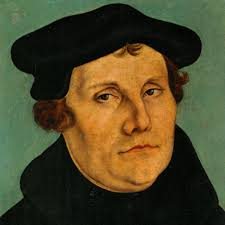
Open Luther's interactive page (graphs of influences, similar and opposing positions, and quotes)
Background
Martin Luther
Born: 10 November 1483 in Eisleben, Saxony,
Holy Roman Empire (now Germany)
Died: 18 February 1546 (aged 62) in Eisleben,
Saxony, Holy Roman Empire (now Germany)
Education: University of Erfurt
Notable works: Ninety-five Theses, Luther's
Large Catechism, Luther's Small Catechism,
On the Freedom of a Christian
Tradition or movement: Lutheranism
Main interests: theology, religion, politics
Influences: Jesus, St. Paul, Augustine, Cicero,
Erasmus, Jan Hus, John Wycliffe, Duns Scotus,
Aquinas, Ockham, Arisotle, Gabriel Biel
Influenced: Melanchthon, Calvin, Zwingli, John
Knox, Thomas Müntzer, Thomas Cranmer,
William Tyndale, John Wesley, Karl Barth,
Kierkegaard, Johann Sebastian Bach, Georg
Witzel, Martin Bucer, Heinrich Himmler
From Wikipedia
Luther was a German priest, theologian, author, hymnwriter, professor, and Augustinian friar. Luther was the seminal figure of the Protestant Reformation, and his theological beliefs form the basis of Lutheranism. He is widely regarded as one of the most influential figures in Western and Christian history…. Luther asserted that Christians receive... righteousness entirely from outside themselves; that righteousness not only comes from Christ, it actually is the righteousness of Christ, and remains outside of us….
Introductory Comments
The young Martin Luther was a troubled soul. He tormented himself with endless doubts: whether God had chosen him for salvation, whether his sins could ever be forgiven, whether Satan would ever leave him in peace. As to that last worry, you can still see the ink stain on the wall of Luther's room in Wartburg Castle, where he is said to have hurled an inkwell at the devil - perhaps in reply to some naughty suggestion the devil had made concerning a nun. If so, the devil's advice may not have been half bad. About four years later Martin married a former nun, Katherine of Bora, and, lo and behold, his self-torments began to fizzle out. The man was happy.
But as Martin's torment of himself waned, his tormenting of others waxed. Little by little the happily married reformer grew more irascible and dogmatic on the page, more strident and shrill in his attacks - especially on Jews, but also Muslims, Anabaptists, Scholastic theologians, Humanists, rival reformers, rebellious peasants, and, of course, the pope. What explains the turnabout, from monkish self-flagellation to merciless lashing out? A number of things, no doubt. But one of them may have been his marriage. As a single man, Luther aimed his aggression chiefly at Luther. Once wedded - too happy, too comfortable, and, let's be honest, too fat to go on beating himself up - he set that aggression free at last. And it landed on everyone else.
Some of Luther's Key Positions
Because of their numerous corruptions and abuses, particularly the indulgences, the pope and the entire Church authority have lost their legitimacy. They are no longer the earthly spokesmen of God, but are in fact undermining true Christianity.
Salvation and eternal life cannot be earned - neither through payments to the Church nor through good deeds. They come through faith in Jesus as Messiah. This faith is not a human achievement but a gift of God's grace, granted through the Holy Spirit.
Since faith is God's gift, no one earns or deserves salvation; it is received, not merited. Why God saves some and not others remains, an inscrutable mystery of divine will.
This is not to say, however, that a Christian should do nothing and just passively resign himself to his eternal fate. As individuals, we must repent for our sins. We must also study Scripture to better understand what has been divinely revealed about God and Christ.
And as communities, we must form Christian congregations, entirely independent from the Catholic Church. These congregations should instead look to Scripture for truth, with each member searching his or her conscience as to the meaning of Scripture.
Place in the History of Ideas
Luther's Place in History of Ideas
Hegel: ... the Reformation made its appearance, partly, no doubt, as a separation from the Catholic Church, but partly as a reformation from within. There is a mistaken idea that the Reformation only effected a separation from the Catholic Church; Luther just as truly reformed the Catholic Church, the corruption of which one learns from his writings....
Kirby Page: Freedom was the watchword of Martin Luther in his early days. His theology rested upon the foundation of the right of private judgment, and he boldly proclaimed the "universal priesthood of all Christians." His own conduct, however, often departed widely from his abstract teaching.... In practice he was often bitterly intolerant of his opponents.... He fa- vored banishment for Catholics who remained steadfast to their faith, and in 1530... justified the setting up of a regular system of coercion and the use of the death penalty for the most dangerous heretics or blasphemers.
Isaac Asimov: Why [did] Luther succeed, where- as [earlier] rebels against the medieval church - like John Hus - fail? Well, Luther was successful because printing had been developed by the time he advanced his cause. So his good earthy writings were put into pamphlets and spread so far and wide that the church officials couldn't have stopped the Protestant Reformation even if they had burned Luther at the stake.
Random Thoughts on Luther
The central antithesis around which much of Luther's theology orbits is this: the powerlessness of man set against the omnipotence of God. Nowhere is this clearer than in what Luther says about salvation. We are all incorrigible sinners and, as such, deserve damnation. Yet for reasons known only to himself, God has chosen to save some of us, through a grace as divine as it is inexplicable. True, Luther also insists, with Paul, that we are saved through faith alone - but faith, he says, is itself a gift of the Holy Spirit. And yes, Luther grants that the saved behave morally; but such good behavior is the fruit of faith, and thus, indirectly, of grace. So those who claim that salvation can be earned through good works confuse effect for cause.
Given Luther's insistence that our sinfulness leaves us powerless to secure the one thing that matters most - salvation - we seem forced to conclude that the will is not ours to command, and that our sense of free will is an illusion. Luther says as much himself: against Erasmus he argued at length for the bondage of the will. Push further still, into territory Luther never enters, and history begins to look like an illusion too - at least when it seems to pit good against evil. If free will is a mirage and God is all-powerful, then what looks like humanity's moral struggle may really be a script God wrote in advance, with all of us merely performing parts assigned from eternity. Which raises the faintly vertiginous question: performing them for whose benefit? Ours, or God's?
Influences
Luther was influenced by: Aquinas, Aristotle, Augustine, Cicero, Duns Scotus, Erasmus, Hus, Jesus, Ockham, Paul of Tarsus, Savonarola, Wycliffe
Luther influenced: Bach, J.S., Barth, Bucer, Martin, Calvin, Cranmer, T., Himmler, H., Kierkegaard, Knox, John, Melanchthon, Muntzer, T., Tyndale, W., Wesley, John, Witzel, Georg, Zwingli
Similar and opposing positions
Thinkers with similar positions:
- Augustine (Being overwhelmed by sinfulness, we aren't free to choose good.)
- Barth (God's perfection makes Him infinitely different from us.)
- Einstein (Free will isn't compatible with determinism. Our wills are determined.)
- Pascal (God is infinitely incomprehensible. We can't reason our way to God.)
- Paul of Tarsus (Our faith must focus on the centrality of Christ as Redeemer.)
- Skinner (Free will is not possible in our deterministic world.)
- Voltaire (The Catholic Church has often been guilty of oppression & corruption.)
Thinkers with opposing positions:
- Cousin (A spontaneity in us allows for free will, even after determination.)
- de Beauvoir (We can neither escape our personal freedom nor give it away.)
- Dennett (Free will and determinism become compatible through rationality.)
- Diderot (The universe is simply matter in motion, bound by laws of nature.)
- Eckhart (We must empty our sense of self & let God's presence fill within us.)
- Epicurus (The gods do not punish the bad and reward the good.)
- Erasmus (The Catholic Church should be reformed, not overthrown or destroyed.)
- Galileo (The Bible should be followed for its moral teaching, not cosmology.)
- Lucretius (An occasional spontaneity or swerve in the atoms allows for free will)
What others said about Luther
- Erasmus: [Luther is] a mighty trumpet of gospel truth.... It is clear that many of the reforms for which Luther calls are urgently needed.
- Windelband: The [premises] of the Reformation appeared as its ruin, and as Luther had once waged his warfare against the "sophistry" of the Scholastics, so now a movement of Mysticism [was being] directed… against his own creation.
- Hegel: ... to have one's own right to speak and think in one's own language really belongs to liberty. This is of infinite importance, and without this form of being-at-horne-with-self, subjective freedom could not have existed; Luther could not have accomplished his Reformation without translating the Bible into German.
- Kirby Page: By a strange inconsistency, Luther justified all wars of self-defense except those waged by subjects against tyrannical rulers. He unconditionally condemned rebellion and revolution. [This refers to the Peasants' Revolt.]
- Alec Ryrie: Luther’s fire caught because fuel had been quietly building up for some time. The principal fuel was desire for reform of the church.
- Robert Boyle: The wish of Luther, that all his books of devotion [be] burnt, raises him greatly in my opinion; because he discovered that the immoderate esteem and veneration attatched to them, caused the Scriptures to be neglected.
- H. L. Mencken: [Protestantism's] original purpose, at least in theory, was to remove the priestly veil separating man from the revealed Word of God. But that veil was restored almost instantly, and by the year 1522... Luther was damning the Anabaptists with all the ferocious certainty of a medieval Pope, and his followers were docily accepting his teaching.
- Copleston: Luther himself did not deny all human freedom; but he did not consider that the freedom left to man after the Fall is sufficient to enable him to achieve moral reform.
Schools: Augustinianism, Christian Theology, Fideism, Voluntarism
Main interests: Eschatology, Faith, Fate, Free/Unfree Will, Immortality, Music, Politics, Religion, Salvation, Spirituality, Theology, Will
Luther's answers to philosophical questions
Art and Aesthetics
Religious hymns can be spiritually uplifting and can offer religious guidance to all classes of society and to all ages.
"[M]usic is the art of the prophets that can calm the agitations of the soul;… it is one of God's most delightful presents to us."
Education
"I am afraid that the schools will prove the very gates of hell, unless they diligently labor in explaining the Holy Scriptures…."
Epistemology
Reason is adequate only in our understanding of the temporal and natural world, not in what is eternal and divine.
Ethics
"Even if I knew that tomorrow the world would go to pieces, I would still plant my apple tree."
History
"Blood alone moves the wheels of history."
Metaphysics
Given God's absolute sovereignty and our own terrible sinfulness, there can be no free will.
Mind
"Human reason is like a drunken man on horseback; set it up on one side, and it topples over on the other."
Nature
We humans have little inherent worth. "God doesn’t love us because of our worth, we are of worth because God loves us."
Political Philosophy
"Government is a sign of the divine grace, of the mercy of God, who has no pleasure in murdering, killing, and strangling."
"War is the greatest plague..., it destroys religion, it destroys states, it destroys families. Any scourge is preferable to it."
People should submit their grievances to secular government. Violent revolt against the social order is a terrible sin.
Religion and Theology
"The whole being of any Christian is faith and love. Faith brings the person to God, love brings the person to people."
We learn of God only through divine revelation, not reason. Reading Scripture is therefore essential for all Christians.
"[R]eason is the greatest enemy that faith has; it never comes to the aid of spiritual things...."
"Be a sinner and sin boldly, but believe and rejoice in Christ even more boldly."
"God created the world out of nothing, and so long as we are nothing, He can make something out of us."
"God writes the gospel not in the Bible alone, but on trees and flowers and clouds and stars."
As St. Paul has taught, our redemption is not achieved through our free will, but through God's grace alone.
The soul sleeps in sweet peace after death. It is not threatened by the supposed torments of a so-called purgatory.
"The cross is the way to the kingdom, but not just the cross as a piece of wood. Rather, it is the cross in its power and grace."
Salvation is a free gift of God. No one deserves salvation, but for some mysterious reason God bestows it upon some.
"Lord Jesus, You are my righteousness, I am your sin…. You became what you were not, that I might become what I was not."
"… as long as I have God's Word, I know that I am walking in His way and that I shall not fall into any error or delusion."
Sex and Gender
"Woman was created for the benefit of man, that is, for the prudent and sensible training of children."
"... to avoid unchasteness, God has commanded marriage so that everyone may have his moderate portion" of fleshly joy.
"Let the wife make her husband glad to come home and let him make her sorry to see him leave."
Society
"God does not need your good works, but your neighbor does."