Bonaventure (1221 - 1274)
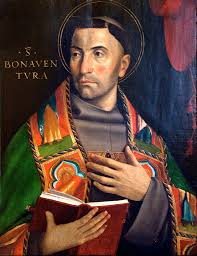
Open Bonaventure's interactive page (graphs of influences, similar and opposing positions, and quotes)
Background
Bonaventure
Born: 1221 in Bagnoregio, Province of Viterbo,
Latium, Papal States
Died: 15 July 1274 in Lyon, Lyonnais, Kingdom of
Arles
Alma mater: University of Paris
Era: Medieval philosophy
Region: Western philosophy
Schools: Scholasticism, Medieval realism,
Mysticism
Main interests: Theology, religion, epistemology
Influences: Jesus, Alexander of Hales, Aristotle,
Augustine, Pseudo-Dionysius, Anselm of
Canterbury, Avicebron, St. Francis of Assisi,
Cicero, Plato, Plotinus
Influenced: Nicholas of Cusa, Eckhart,
Mirandola
From Wikipedia
In philosophy Bonaventure presents a marked contrast to his contemporaries, Roger Bacon, Albert the Great, and Thomas Aquinas. While these may be taken as representing, respectively, physical science yet in its infancy, and Aristotelian scholasticism in its most perfect form, Bonaven- ture presents the mystical and Platonizing mode of speculation.... To him, the purely intellectual element, though never absent, is of inferior interest when compared with the living power of the affections or the heart.
Introductory Comments
As near contemporaries at the University of Paris, both pursuing advanced degrees, Bonaventure and Aquinas may have known each other. They likely knew many of the same teachers, read many of the same books, and argued their way through many of the same debates. Both were also steeped in the Scholasticism for which Paris was famous - a rigorous, if now often ridiculed, blend of medieval logic and Church doctrine. Yet from this common soil grew two strikingly different thinkers.
Aquinas became, in a sense, Scholasticism perfected. He understood Aristotle more deeply than perhaps any philosopher of his era, and he brought to that understanding a logical rigor that would have impressed any age. Yes, his conclusions were often bent to fit Church doctrine - but even so, few matched his skill in explaining and systematizing that doctrine into a coherent whole.
Bonaventure took a different path. Though perfectly capable of rigorous argument, at crucial moments he set logic aside altogether in favor of mystical intuition - an intuition reminiscent of Plotinus. The world, he held, flows out of the overflowing love of God, and the soul's journey ends when, through love, it returns to God and merges with Him once more. For Aquinas, reason was a ladder for climbing to great heights. Bonaventure climbed that ladder too, but then kicked it away so that he might climb higher still.
Some of Bonaventure's Key Positions
Faith and reason can and should be integrated, yet both are ultimately surpassed by a mystical union with God. Accepting Christ as savior begins in faith, deepens through understanding, and is perfected in a felt oneness with God.
Rational inquiry into religious matters therefore matters, but it must always be placed in its proper context: an ardent awareness of God's presence in the world and within the soul. Reason is a path toward God, not the destination.
This perspective should shape our response to Aristotle himself. Aristotle can teach us a great deal, but on certain questions his reason went astray. The Aristotelian doctrine of the eternity of the world, for instance, cannot be reconciled with God as Creator; because God created the world, the world cannot be eternal.
So too with Aristotle's claim that forms exist only in existing things. This slights God's infinite power and presence, since forms must first exist in the divine mind as archetypes, or "exemplars," before they take shape in created things.
Reason, then, is not the summit of the spiritual life but its guide. At a certain point it must yield to prayer, meditation, and the cultivation of the virtues, through which the soul is made receptive to the divine illumination that culminates in mystical union with God.
Place in the History of Ideas
Bonaventure's Place in History of Ideas
Ralph McInerny: In form and intent the work of St. Bonaventure is always the work of a theologian; he writes as one for whom the only angle of vision and the proximate criterion of truth is the Christian faith. This fact influences his importance for the history of philosophy; when coupled with his style, it makes Bonaven- ture perhaps the least accessible of the major figures of the thirteenth century. This is true, not because he is a theologian, but because philosophy interests him largely as... a foreshad- ow of or deviation from what God has revealed. We find in his writings something like a charter for philosophy, but not for anything like a fully autonomous philosophy.
Paschal Robinson: ... in attempting to make a comparison between Bonaventure and St. Thomas [Aquinas], we should remember that the two saints were of a different bent of mind; each had qualities in which he excelled; one was in a sense the complement of the other; one supplied what the other lacked. Thus Thomas was the teacher of the schools, Bonaventure of practical life; Thomas enlightened the mind, Bonaventure inflamed the heart; Thomas extended the Kingdom of God by the love of theology, Bonaventure by the theology of love. Even those who hold that Bonaventure does not reach the level of St. Thomas in the sphere of Scholastic speculation concede that as a mystic he far surpasses the Angelic Doctor.
Random Thoughts on Bonaventure
Insofar as medieval Scholasticism leaned too heavily on Authority (Aristotle and the Church Fathers above all) and on Scholastic reasoning (with its arcane terminology and sometimes dubious logic), some have welcomed Bonaventure's mysticism as a refreshing alternative. Bonaventure held that reason and logic could be useful tools for explaining Christian belief, but that at a certain point these tools became impediments. The most precious parts of Christianity, he thought, had always lain beyond the reach of reason - above all, the emanation of the world through God's overflowing love and the soul's return into God through its own abounding love. These are mysteries to be intuited, never unraveled.
Short of these ultimate mysteries, though, Bonaventure found Christian belief entirely explicable. Like any good medieval Scholastic, he treated theology as an intellectual pursuit, resting on a selective use of Aristotle and a meticulous application of logic. As both Scholastic and mystic, then, Bonaventure was something of a walking paradox: a logician who relished his power to lay bare the hidden logic of doctrine, and a mystic who rejoiced in his inability to find any logic in religion's most divine truths. More surprising still, he saw mysticism not as a challenge to Scholasticism but as its fulfillment - the irrational flowering of an overly rational discipline. Or, if you prefer, the rung one step above the ladder.
Influences
Bonaventure was influenced by: Alex. of Hales, Anselm, Aristotle, Augustine, Avicebron, Cicero, Jesus, Paul of Tarsus, Plato, Plotinus, Pseudo-Denys, St. Francis
Bonaventure influenced: Eckhart, Nicholas of C., Pico
Similar and opposing positions
Thinkers with similar positions:
- Al-Kindi (The purely contemplative part of the Soul is its higher & eternal part.)
- Anselm (God's existence is inferable from the mere idea of a Perfect Being.)
- Augustine (Primary universals are the creative archetypes of the divine mind.)
- Eckhart (We must empty our sense of self & let God's presence fill within us.)
- Luther (Soul and body are distinct substances & soul is superior to body.)
- Nicholas of C. (All the sciences are but the handmaids of theology.)
- Plato (Universals or metaphysical Forms are more real than individual things.)
- Porphyry (Being perfect & eternal, the One is stable, uniform & unchanging.)
Thinkers with opposing positions:
- Aquinas (Philosophy can be pursued successfully independent of theology.)
- Aristotle (The world was not created, but must have existed for all eternity.)
- Barth (There is an infinite qualitative distinction between God & mankind.)
- Bultmann (We must demythologize Scripture to make God relevant today.)
- Holbach (Religion is an impediment to the moral advancement of humanity.)
- Ockham (Universals are just concepts. Only concrete individual things are real.)
- Russell (No empricial evidence nor rational argument proves God's existence.)
- Tillich (God isn't personal. God is a pure absolute devoid of consciousness & life.)
What others said about Bonaventure
- William Turner: All knowledge, [Bonaventure] teaches,takes place by means of illumination.
- Étienne Gilson: With St. Bonaventure the mystical synthesis of mediaeval Augustinianism was fully formed, just as that of Christian Aristotelianism was fully formed with St. Thomas.
- Pope Sixtus IV: Bonaventure was great in learning, but no less great in humility and holiness. His innocence and dove-like simplicity were such that Alexander of Hales, the renowned doctor whose disciple Saint Bonaventure became, used to say of him that it seemed as though Adam had never sinned in him.
- Russell: [Bonaventure] saw in the new Aristotelianism a fundamental opposition to Christianity. He believed in Platonic ideas, which, however, only God knows perfectly.
- J. Hirschberger: [Bonaventure] held most dear that... intuitive knowledge of God which he derived from the self-consciousness of the soul and its acts.
- Pope Leo XIII: Having scaled the difficult heights of speculation in a most notable manner, he treated of mystical theology with such perfection that in the common opinion of the learned he is "facile princeps" in that field.
- Étienne Gilson: In St. Bonaventure’s Christian universe there is, in reality, no place for Aristotelian accident; his thought shrinks from supposing a series of causes accidentally ordered, that is to say, without order, without law and with its terms following one another at random.
- Pope Sixtus V: For there was in St. Bonaventure something preeminent and unique, so that he stood out not only in subtlety of arguing, in facility of teaching..., but he excelled in a... divine strength of thoroughly stirring up souls.
Schools: Augustinianism, Christian Theology, Divine Illumination, Medieval Realism, Mysticism, Scholasticism
Main interests: Epistemology, Faith, Religion, Spirituality, Theology
Bonaventure's answers to philosophical questions
Epistemology
Concerning both philosophical and spiritual matters, the innate light within us is the ultimate source of truth.
Ethics
Though we are all prone to self-interest, our true interest is in transcending self so that we may be one with God.
Our desire for perfect happiness is profound, but it leads to personal transcendence and mystical union with God.
"[H]umility is the foundation of all virtue. Learn to be really humble and not, as the hypocrite, humble merely in appearance."
Metaphysics
Universals are ideal and eternal forms in the mind of God that serve as archetypes for the temporal world of things.
Time, as we know and experience it, began with the creation of the world. But God is eternal and, thus, transcends time.
Mind
Our sense of self must be transcended if we are to achieve mystical union with God.
Religion and Theology
Spirituality begins in faith, develops through reason and meditation, but is perfected by a mystical union with God.
Since God is being itself, God must be. That is, God must exist, because existence is God's defining feature.
Faith springs from divine illumination. It always precedes true understanding.
The beatific vision reveals to us the perfect joy of an eternal life where one's soul is forever in the presence of God.
Jesus taught that highest forms of love are the love of God and the love of man for God's sake.