Niccolò Machiavelli (1469 - 1527)
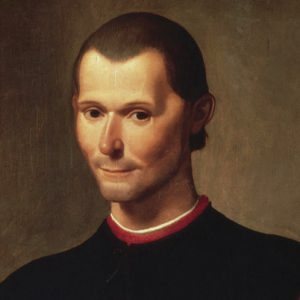
Open Machiavelli's interactive page (graphs of influences, similar and opposing positions, and quotes)
Background
Niccolò Machiavelli
Born: 3 May 1469 in Florence, Republic of
Florence
Died: 21 June 1527 (aged 58) in Florence,
Republic of Florence
Schools: Renaissance humanism, political
realism, classical republicanism
Main interests: Politics and political philosophy,
military theory, history
Influences: Plato, Aristotle, Socrates, St.
Augustine, St. Thomas Aquinas, Dante Alighieri,
Xenophon, Plutarch, Tacitus, Polybius, Cicero,
Sallust, Livy, Thucydides
Influenced: Bacon, Hobbes, Harrington, Vico,
Rousseau, Edward Gibbon, David Hume, John
Adams, Vincenzo Cuoco, Nietzsche, Pareto,
Gramsci, Althusser, T. Schelling, Negri, Waltz,
Baruch de Spinoza, Denis Diderot, Carl Schmitt,
Giulio Andreotti, Philip Pettit, Strauss
From Wikipedia
Machiavelli was a Florentine diplomat, author, philosopher, and historian who lived during the Italian Renaissance. He is best known for his political treatise The Prince, written around 1513.…. While less well known than The Prince, the Discourses on Livy has been said to have paved the way for modern republicanism. His works were a major influence on Enlightenment authors who revived interest in classical republi- canism, such as Jean-Jacques Rousseau and James Harrington.
Introductory Comments
Few names resonate with the force of Machiavelli's. To be Machiavellian is, for most of us, to be a villain - as if the "-vellian" were just "villain" misspelled. Leo Strauss captured the popular verdict when he described Machiavelli's politics as "guided exclusively by considerations of expediency, which uses all means, fair or foul, ... for achieving its ends." Yet Strauss also credited him with hoping for the "rebirth of republicanism," which, in theory, best represents the people's interests. And to complicate matters further, Strauss accused Machiavelli of "sometimes blurring the distinction between tyrannies, principalities, and republics."
So who is confused - Leo or Niccolò? Or neither? It is true that Machiavelli's two most important works view politics from distinct vantage points. The Prince is concerned with (you guessed it) princes and what they must do to survive; the Discourses on Livy is a long meditation on how republics can be preserved. But how can one thinker justify so dramatic a shift? Many have tried to explain it - as two stages in the development of government, two poles on a single spectrum, two chapters in one unified theory. Another possibility: perhaps Machiavelli was simply the sort of guy who relished seeing a subject from several angles - a pleasure familiar to many students of the history of ideas. Seen this way, the gap between the two books is not a contradiction to be explained away but a range of vision to be admired.
Some of Machiavelli's Key Positions
Private and public moralities are two very different things. For the prince, conventional moral principles are luxuries he can indulge only when circumstances permit; otherwise they must yield to hard necessity. Nothing is worse than the disorder that follows from weak leadership.
So when it is safe, the prince should act morally and win his people's goodwill. But when necessity demands, he must set morality aside and resort to deception, cruelty, even violence, to hold onto power. Since men are fickle, it is safer to be feared than loved - though never hated. (This is the hard counsel of The Prince.)
Yet, having said this, a well-oordered republic remains the best form of government - the one that offers a guarantee of liberty and lasting stability that no principality can match. The catch is that republics are fragile: internal corruption or external threats can plunge them into disorder. When this happens, a strong leader may need to seize the reins and set the state back on its feet, even by extraordinary means. (This is the softer counsel of the Discourses on Livy.)
As for religion, it can both strengthen and weaken the social order. When it makes people more cooperative or obedient, the prince (or republic) should encourage it; when it challenges authority, it must be resisted. Religion is valuable less for its truth than for its usefulness.
Place in the History of Ideas
Machiavelli's Place in History of Ideas
Isaiah Berlin: ... Machiavelli also sets side by side with this the notion of Christian virtues - humil- ity, acceptance of suffering, unworldliness, the hope of salvation in an afterlife - and he re- marks that if, as he plainly himself favors, a State of a Roman type is to be established, these qualities will not promote it: those who live by the precepts of Christian morality are bound to be trampled on by the ruthless pur- suit of power on the part of men who alone can re-create and dominate the republic which he wants to see. He does not condemn Christian virtues. He merely points out that the two mo- ralities are incompatible, and he does not rec- ognise an overarching criterion whereby we are enabled to decide the right life for men.
Edward Skidelsky: Machiavelli's notorious in- strumentalism - his assessment of all acts, virtu- ous or vicious, in terms of their political effica- cy - is a consequence of this severing of politics from any broader ethical context. Statecraft be- comes an exercise of pure technique, compara- ble to a game of chess.
Joshua Kaplan: [Machiavelli] emancipated poli- tics from theology and moral philosophy. He undertook to describe simply what rulers actu- ally did and thus anticipated what was later called the scientific spirit in which questions of good and bad are ignored, and the observer attempts to discover only what really happens.
Random Thoughts on Machiavelli
Recent studies have shown that tit for tat is not only the simplest of all game-theory strategies but also one of the most successful. When you face an unknown player in some sort of game - economic, professional, political, whatever - cooperate on your first move. After that, do whatever she does. If she cooperates, keep cooperating. The moment she defects, hit back hard. If she learns her lesson and cooperates again, then cooperate again yourself. End of strategy. When the political scientist Robert Axelrod pitted rival strategies against one another in his now-famous computer tournaments, the plain little tit-for-tat program almost always came out on top.
Machiavelli never explicitly endorses anything we would now call tit for tat, but he hints at it - as when he writes that "men should be either treated generously or destroyed, because they take revenge for slight injuries; for heavy ones they cannot." And I - to drop my third-person mask for a moment - cannot help thinking that Machiavelli, brought back to life, would be fascinated by Donald Trump's transparent use of this simplest of strategies. Fascinated, but also a little aghast at the threat it poses to republics, and a little disgusted to see how far the art of politics had fallen since the days of Lorenzo de' Medici. For subtle Lorenzo hid his hand, while Donald shows his to the entire world. Thus, others feared what Lorenzo might do; everyone knows what Donald will do. Behold the awesome and vulgar power of tit for tat.
Influences
Machiavelli was influenced by: Aquinas, Aristotle, Augustine, Cicero, Dante, Livy, Plato, Plutarch, Polybius, Tacitus, Thucydides
Machiavelli influenced: Adams, John, Althusser, Bacon, Francis, Burke, Diderot, Gibbon, Gramsci, Hobbes, Hume, Nietzsche, Rousseau, Schmitt, Spinoza, Strauss, Vico
Similar and opposing positions
Thinkers with similar positions:
- Benjamin (Though conceptually distinct, power & violence are often connected.)
- Boccaccio (We should try to overcome fate - when overcoming fate is possible.)
- Bourdieu (Language is not merely a means of expression, but also of power.)
- Comte (The study of society should be empirical - based on facts, not fictions.)
- Gramsci (A society can be manipulated by controlling popular ideas of morality.)
- Locke (Knowledge is empirical and springs from observing the actual world.)
- Petrarch (Despite its pagan beliefs, we can learn much from classical antiquity.)
Thinkers with opposing positions:
- Bakunin (To be free, every form of hierarchical authority must be rejected.)
- Buber (People must never be seen as mere means to our personal ends.)
- Einstein (The most important human endeavor is the pursuing of moral aims.)
- Erasmus (A good ruler is not feared. Rather, he's loved because he rules well)
- Paine (When governments trample on human rights, revolutions are justified.)
- Socrates (Politics should be guided by morality. Might does not make right.)
- Spinoza (As natural creatures, we must base morality on the laws of nature.)
- Strauss (A just and virtuous society needs a reliable set of moral beliefs.)
- Tolstoy (There has never been nor will ever be a just war. All war is evil.)
What others said about Machiavelli
- Rousseau: While pretending to give lessons to kings, he gave great ones to peoples. "The Prince" of Machiavelli is the book for republicans.
- Spinoza: If [Machiavelli] did have some good purpose in mind..., it must have been to show how foolish are the attempts so often made to get rid of a tyrant while yet the causes that have made the prince a tyrant cannot be removed....
- Bacon, Francis: We are much beholden to Machiavelli and others, that write what men do, and not what they ought to do. For it is not possible to join serpentine wisdom with the columbine innocency, except men know exactly all the conditions of the serpent; his baseness and going upon his belly...; that is, all forms and natures of evil.
- Cassirer: For Machiavelli, Fortune rules over half of all human actions. But she gives herself to him who acts, to him who quickly and boldly grasps her, and not to the passive observer.
- Merleau-Ponty: Machiavelli is the complete contrary of a machiavellian, since he describes the tricks of power and "gives the whole show away."
- Anthony Kenny: Some have been shocked by the book's immorality; others have found its lack of humbug refreshing. Few, however, have been persuaded to admire the models held up by Machiavelli, such as… Cesare Borgia.
- Strauss: Machiavelli is the only political thinker whose name has come into common use for designating a kind of... politics guided exclusively by considerations of expediency, which uses all means, fair or foul, iron or poison, for achieving its ends - its end being the aggrandizement of one's country or fatherland - but also… self-aggrandizement of the politician….
- Nietzsche: ... my cure for all things Platonic has always been Thucydides. Thucydides, and perhaps Machiavelli's "Principe" are most closely related to me in terms of their unconditional will not to be fooled [by so-called "morality."]
Schools: Humanism
Main interests: Classics, Democracy, Government, History, Human Will, Just War, Political Philosophy, Political Theory, Politics, Power, Public Administration, Punishment, Revolution, War
Machiavelli's answers to philosophical questions
Ethics
"Wisdom consists of knowing how to distinguish the nature of trouble, and in choosing the lesser evil."
A moral principle is a luxury that can be indulged in, but it must give way, when necessary, to practical considerations.
Those who act according to their professed high principles are soon brought to ruin by those act without principle.
"[A] man who wants to act virtuous in every way necessarily comes to grief among so many who are not virtuous."
History
Though history reveals a ciruclar aspect to the alternating forms of government, the sequence here is not an exact one.
History is driven by the pride and ambition of leaders. Successful leaders also need to be disciplined and prudent.
We need a strong leader to end the violence & plundering, the swindling & corruption, that is ravaging much of Italy.
For those who lead, history is full of useful lessons. The idealist relies on philosophy; the pragmatist relies on history.
Law
"As there can't be good laws where the state isn't well armed, it follows that where they are well armed they have good laws."
Metaphysics
"Majesty King Chance does three-quarters of the business of this miserable universe."
Nature
We're driven by selfish passions as much as are other animals. Reason is just a tool we use to pursue our brutish ends.
Political Philosophy
A republic is the best form of government, but when corruption or chaos looms large, a dictator is needed.
All governments are founded on force, but once in power the prince should, when possible, seek the love of his people.
Rulers must master warcraft, for "when princes have thought more of ease than of arms, they have lost their states."
To be an effective leader and remain in power, the prince should, if necessary, deprive people of their rights & liberties.
Founders of a stable republic must presuppose that all men can act badly and then structure the republic accordingly.
The sovereign Italian nation must be free of Church domination in politics. A sovereign has no master.
Psychology
Humans are motivated by greed, ambition & the desire for revenge, mixed with a good amount of fear & cowardliness.
Politically speaking, love and fear are the most powerful emotions. Ideally, the leader should be both loved and feared.
"Make mistakes of ambition and not mistakes of sloth. Develop the strength to do bold things, not the strength to suffer."
Religion and Theology
Religion gives moral order & discipline to the state. Indeed, "strict religious worship is the cause why states rise to eminence."
"God is not willing to do everything, and thus take away our free will and that share of glory which belongs to us."
Sex and Gender
"He who shuns women avoids the trouble, but also the benefits. He who puts up with them gains the benefits & the trouble."