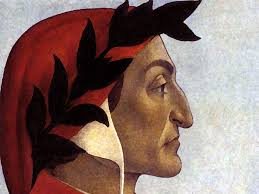
Dante was a Florentine poet, writer, and philoso- pher. His Divine Comedy... is widely considered one of the most important poems of the Middle Ages and the greatest literary work in the Italian language…. Dante was instrumental in establish- ing the literature of Italy, and is considered to be among the country's national poets and the Western world's greatest literary icons. His depic- tions of Hell, Purgatory, and Heaven provided inspiration for the larger body of Western art and literature.
Introductory Comments
Art imitates life - and rarely more grandly than in Dante's The Divine Comedy. But let's start with the life: As a young man, Dante got swept up in a power struggle within his beloved Florence: the long feud between the Guelphs, who broadly backed the Papacy, and the Ghibellines, who backed the Holy Roman Emperor. The Guelphs then split and turned on each other. The Black Guelphs favored strong papal influence; the White Guelphs, Dante among them, sought a middle path between Pope and Emperor. When the Blacks seized the upper hand in Florence, Dante was driven into a bitter exile that lasted the final two decades of his life.
Now the art. In The Divine Comedy, Dante casts himself not as an exile wandering from court to court, as he really did, but as a pilgrim on a hair-raising, stomach-turning, mind-blowing tour of Hell, Purgatory, and Heaven. His guide through Hell and Purgatory is his favorite poet, Virgil, and later, through Paradise, his long-lost love, Beatrice. Along the way his enemies - Pope Boniface VIII among them - are damned or soon will be, while his friends and heroes are enthroned in Heaven or bound for it. Friends, foes, heroes, Guelphs, Ghibellines: all of them crowd into the poem, illustrating virtues and vices even as they give vent to Dante's very personal longings and grudges. So, as much a of settling of scores as it is a theological vision, Dante's poem does indeed imitate life - but in cosmic proportions.
Some of Dante's Key Positions
Though the mystical vision of Paradise reveals truths far greater than speech can capture, poetic imagination lets us at least approach the ineffable, using earthly images and metaphors to suggest heavenly realities.
This is possible because the human world, though often sinful, is not entirely cut off from the divine. The beauty around us hints at a beauty that is transcendent, and the good things of earth point toward better things to come.
Courtly love offers one example of this bond between the earthly and the divine. Such love idealizes its object and worships from a reverent distance rather than seeking consummation, and so it can rise into spiritual inspiration. Because the human world is at its best animated by the divine, human love at its best carries something divine within it and reaches toward all things divine.
Beatrice is the great instance: a beloved woman who is not the endpoint of desire but a guide leading the lover through her beauty to God..
This love of both worldly and heavenly beauty suggests, too, that the City of Man and the City of God stand closer together than Augustine allowed. And if the two cities are not so cleanly divided, then allusions to Scripture and to classical literature may be woven together, each enriching our understanding of the other.
Place in the History of Ideas
Dante's Place in History of Ideas
Edmund Gardner: The essence of Dante's philos- ophy is that all virtues and all vices proceed from love. The "Purgatorio" shows how love is to be set in order, the "Paradiso" shows how it is rendered perfect in successive stages of illu- mination, until it attains to union with the Di- vine Love. The whole structure and spiritual ar- rangement of Dante's paradise, in which groups of saints make a temporary appearance in the lower spheres in token of the "many mansions," is closely dependent upon the teachings of the Pseudo-Dionysius and St. Bernard concerning the different offices of the nine orders of angels.... His theology is mainly that of St. Thomas Aquinas, though he occasionally (as when treating of primal matter and of the nature of the celestial intelligences) departs from the teaching of the Angelical Doctor.
Roger Theodore Laferty: Dante gave poetic expression to the standard philosophy of his time, and this philosophy is thus the substance of his whole work. As a philosopher, however, Dante was not himself an original creative thinker, but the poet of the philosophy which had been making for centuries. His mission was not to make, but to express. He brought together all the previous philosophies and welded them... into one great system. It is the poetic expression and the poetic, rather than intellectual, value of the philosophical content that is so great.
Random Thoughts on Dante
Virgil, playing tour guide and moral theorist both, explains that Dante's Hell is organized not by whim but by a deliberate hierarchy of sin. At the top sit sins of incontinence - lust, gluttony, avarice, wrath - passions left unchecked. These are degrading because they are animal-like: they don't destroy reason so much as let it go slack, reducing us to the level of beasts. Below incontinence comes a middle tier of violence - murder, suicide, blasphemy - worse because it actively harms rather than merely indulges, though animals, too, can be violent in their way. At the very bottom, reserved for the worst offenders, are sins of fraud: theft, deception, treachery, the betrayal of trust itself. These are the gravest sins of all, not because they strip away reason but because they weaponize it. They take God's most precious gift and bend it into an instrument of evil.
But is the distinction persuasive? Should sins really be ranked by whether reason played a part? In its favor, one might note how neatly it fits Aristotle's - and indeed all of Western philosophy's - reverence for rationality. Against this distinction, one might question - as many now do - just how rational human beings really are. (Think of the shelves groaning under books that delight to tell us exactly how irrational we are, books by the likes of Kahneman, Ariely, Thaler, and Gladwell.) So, if modern psychology is right, Dante's map of Hell may reveal less about sin than about an unusually optimistic theory of the human mind.
Boethius (Happiness is attained through sufficiency, virtue and wisdom.)
Cicero (If you have a garden and a library, you have everything you need.)
Herder (Language helps shape the unique thinking & feelings of a people.)
John of Damas. (God, being perfect and eternal, is stable, uniform and flawless.)
Ockham (There should be a complete separation between Church and State.)
Plotinus (The highest form of love transforms the erotic into the ideal & pure.)
Thinkers with opposing positions:
Bakunin (If God really existed, it would be necessary to abolish Him.)
Boccaccio (Virtue may at times be compromised for the sake of expediency.)
Diderot (The universe is simply matter in motion, bound by laws of nature.)
Lucretius (Philosophy aims at liberating man from the fear of death & the gods.)
Maimonides (Poetry is of little value, since it was founded on pure invention.)
More (The state should support religioius faith and punish heretics.)
Plato (Being a copy of a copy of a Form, art removes us even further from truth.)
Sade (To be free means to be unrestrained by any chains of morality.)
Schopenhauer (Love is a sexual obsession that invariably leads to anguish.)
Stirner (All "sacred truths" in law, morality & religion are artificial concepts.)
What others said about Dante
James Joyce: I love Dante almost as much as the Bible. He is my spiritual food, the rest is ballast.
T. S. Eliot: Dante is, beyond all other poets..., the most European. He is the least provincial - and yet that statement must be immediately protected by saying that he did not become the "least provincial" by ceasing to be local.
Carlyle: Dante does not come before us as a large catholic mind; rather as a narrow, and even sectarian mind.... He is world-great not because he is world-wide, but because he is world-deep. Through all objects he pierces as it were down into the heart of Being. I know nothing so intense as Dante.
Napolean: Dante has not deigned to take his inspiration from any other. He has wished to be himself, himself alone; in a word, to create. He has occupied a vast space, and has filled it with the superiority of a sublime mind.
Nietzsche: [Dante was an] hyena that wrote poetry on tombs.
Pope Francis: Dante is...a prophet of hope, a herald of humanity's possible redemption and liberation, of profound change in every man and woman, of all of humanity.
Christian Moevs: When the human mind is fully informed by philosophy, it would appear, it becomes virtually one of the "intelligenze," who know both what is above them and what is below, God as cause and the created universe as effect. Thus Dante can speak of our rational nature as, simultaneously our “truly human” and “our angelic nature.”
Voltaire: He enjoys an immortal reputation because he is seldom read. Everyone knows by heart some twenty quotations from his writings, and that relieves them of the necessity of examining the remainder.