Desiderius Erasmus (c. 1466 - 1536)
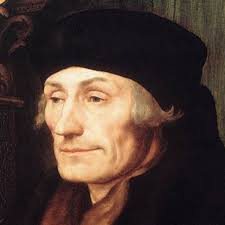
Open Erasmus's interactive page (graphs of influences, similar and opposing positions, and quotes)
Background
Desiderius Erasmus
Born: c. 28 October 1466 in Rotterdam or
Gouda, Burgundian Netherlands
Died: 12 July 1536 (aged 69) in Basel, Old Swiss
Confederacy
Alma mater: Queens' College, Cambridge,
Collège de Montaigu, Paris, University of Turin
Era: Renaissance philosophy
Region: Western philosophy
Main interests: Christian philosophy,
Renaissance humanism, Religion, Literature
Notable ideas: Erasmian pronunciation
Influences: Epicureanism, Cicero, Giovanni Pico
della Mirandola, John Colet, Alexander Hegius,
Jan Standonck, Lucian, Plato, Aristotle
Augsutine, Aquinas, St. Jerome, Lorenzo Valla
Influenced: Thomas More, Damião de Góis,
Martin Luther, William Tyndale, Jacob Milich,
Wolfgang Capito
From Wikipedia
Erasmus was a Dutch Christian humanist, Catho- lic theologian, educationalist, satirist, and phi- losopher. Through his vast number of transla- tions, books, essays, prayers and letters, he is considered one of the most influential thinkers of the Northern Renaissance and one of the major figures of Dutch and Western culture…. Erasmus lived against the backdrop of the grow- ing European religious Reformation. He developed a biblical humanistic theology in which he advocated tolerance, concord and free thinking.
Introductory Comments
Within just a few years, Erasmus went from praising Luther as a bold and powerful critic of the Church to condemning him as a divisive and dangerous threat to it. It is a story told many times in the history of ideas: the established elder enthusiastically anoints the up-and-coming younger man, only to revoke the blessing later. Freud and Jung, Sartre and Camus, Russell and Wittgenstein - the pattern recurs so often it begins to look like the Oedipus complex run backward. Instead of the son striking down the father, the loving father embraces the son, thinks better of it, and clobbers him on the head.
In the case of Erasmus and Luther, the son reversed course too, moving from praising Erasmus as a great scholar to dismissing him, a few years on, as an ineffectual moralist. Why the plunge from mutual admiration to mutual disdain? Part of it was strategy. Erasmus wanted to repair the Catholic Church from within; Luther wanted to abandon ship and, if he could manage it, sink it. But other things were in play, chief among them their quarrel over free will - an emphatic humanistic thumbs-up from Erasmus, a stern predestinarian thumbs-down from Luther.
Which raises a nice puzzle. Why should the man who denied free will become the far greater activist - the one who actually changed the course of history - while the champion of free will watched history pass him by?
Some of Erasmus's Key Positions
Luxury, lust, and avarice have corrupted parts of the Catholic Church. Abuses of papal authority have produced inexcusable practices - above all the sale of indulgences and the squandering of Church wealth at the people's expense.
Yet these abuses, however real, can be reformed gradually from within. Luther's assault on papal authority and his insistence on faith alone are both misguided and dangerous. - a remedy worse than the ailment.
Let every believer interpret Scripture as he pleased and the result would be not enlightenment but babel - a chaos of competing readings. Strip away the Church's solemn rites, and most people, left to their own devices, would simply stop praying altogether. Ecclesiastical discipline, however imperfect, at least kept sin in check; remove it, and human waywardness would fill the vacuum.
Worse still, a war on Church authority would end in an actual war. Such a course would "drive the princes into using force to restrain good men and bad alike" - an indiscriminate crackdown sparing neither reformer nor rogue.
Luther errs, too, in denying free will. Because the question cannot be settled by reason alone, it is safest to defer to consensus of Church authority, which holds that free will exists, and that sin does not bar us from freely turning toward God.
Place in the History of Ideas
Erasmus's Place in History of Ideas
John Herman Randall, Jr.: Master of irony and innuendo, [Erasmus] flashed his rapier against all the enemies of he humanistic ideal, and in defense of a tolerant, humane, and cosmopoli- tan culture.... It was indeed tragic that he and his civilized Humanists had to give way before Luther and Calvin and Loyola, that they could not build gradually withn the old Church a new culture and a new religion.... But in truth Eras- mus was one of those liberals whose energies are exhausted in being liberal, without ever coming to grips with what has to be done. He looked backward rather toward the new age; his program was that of a witty, charming, and mediating conservative.
Russell: There are, throughout [Erasmus's "In Praise of Folly"], two kinds of Folly, one praised ironically, the other seriously; the kind praised seriously is that which is displayed in Christian simplicity. This praise is of a piece with Eras- mus's dislike of scholastic philosophy.... But it has also a deeper aspect. It is the first appear- ance in literature, so far as I know, of the view set forth in Rousseau's "Savoyard Vicar," ac- cording to which true religion comes from the heart, not the head, and all elaborate theology is superfluous. This point of view has become increasingly common, and is now pretty gener- ally accepted among Protestants. It is, essen- tially, a rejection of Hellenic intellectualism by the sentimentalism of the North.
Random Thoughts on Erasmus
Back to the Future is not just a movie; it's a recurring theme in the history of ideas. To move forward, we must first look back - modeling the future on a past we imagine to have been more perfect than the present. What makes Erasmus a little unusual is not that he was a back-to-the-future thinker, but that he was one in two distinct ways. First, like Petrarch, he held that the classical civilizations of Greece and Rome were the best foundation on which to rebuild the culture of his own day. And second, he believed the early Christian Church was the best model for a renewed and revitalized Catholicism - the finest example of simple, humble piety.
But Erasmus's doubled back-to-the-future (or is it his back-to-the-future doubled?) raises a problem. How can one argue at once for a return to the brilliance of Greece and Rome and for a return to the humble simplicity of the early Church? The two worldviews don't seem to mix. To his credit, though, Erasmus had a strategy for splitting the difference: he treated pagan learning not as a rival to faith but as a preparation for it, insisting that the eloquence and ethics of a Socrates or a Cicero could be pressed into Christian service. At the same time, humanist's tools - careful reading and a nose for corrupted texts - became the very means of recovering the pure faith of the early Church. The result was what he called the philosophia Christi: a stripped-down faith that owed its polish to Athens even as it bent the knee in Jerusalem.
Influences
Erasmus was influenced by: Aquinas, Aristotle, Augustine, Cicero, Colet, John, Epicurus, Hegius, Jerome, Lucian, Pico, Plato, Standonck, Valla
Erasmus influenced: Bruno, Calvin, Capito, W., Gois, Damiao, Grotius, Luther, Milich, Jacob, More, Tyndale, W.
Similar and opposing positions
Thinkers with similar positions:
- Albertus Mag. (Reason cannot replace faith, but can work together with faith.)
- Cicero (Truth is furthered by harmonious discussion, not angry fighting.)
- Epicurus (Contentment is gained thru moderation and living a measured life.)
- Montaigne (Honest speech is not only a virture, but also the basis of society.)
- More (The Catholic Church should be reformed, not overthrown or destroyed.)
- Ockham (Faith, not reason, provides the foundation for Christian beliefs.)
- Tolstoy (Our greatest hope is in following Christ's original & radical teachings.)
- Voltaire (The Catholic Church has often been guilty of oppression & corruption.)
Thinkers with opposing positions:
- Augustine (Being overwhelmed by sinfulness, we aren't free to choose good.)
- Dante (There should be a complete separation between Church and State.)
- Kropotkin (All hierarchical associations, like church and state, are oppressive.)
- Luther (Given God's sovereignty & our own sinfulness, there is no free will.)
- Machiavelli (It is safer for the prince to be feared than to be loved.)
- Pascal (Skepticism is a product of the devil and we must fight against it.)
- Rousseau (Progress in the sciences and arts has led to decay and immorality.)
- Suarez (In metaphysics the individual remains the fundamental reality.)
What others said about Erasmus
- Luther: [Erasmus is a ] viper [and] the very mouth and t of Satan.
- Russell: Erasmus was interested in the world, but could not digest it in the raw: it had to be dished up in Latin or Greek before he could assimilate it. Travellers' tales were discounted, but any marvel in Pliny was believed.
- Cassirer: Erasmus is convinced that the restoration of the pure text of the Bible would also mean the restitution of pure Christian doctrine. If we succeed in purifying this text of all later additions and arbitrary falsifications, then the image of pure Christianity in its sublime simplicity and in its original moral meaning will shine forth.
- Hieronymus Aleander: The poison of Erasmus has a much more dangerous effect than that of Luther, who by his notorious satirical and insulting letters has injured his own teaching.
- Gary Remer: Like Cicero, Erasmus concludes that truth is furthered by a more harmonious relationship between interlocutors.
- Kenan Malik: ... Erasmus, like all humanists, proclaimed the dignity of Man, and from it drew his faith; Luther saw humans as wretched beings possessed of no dignity, whose very wretchedness revealed the need for faith.
- Terrence M. Reynolds: Aleander was mistaken when he called Erasmus a Lutheran; but there is no doubt that, in his reforms and later attempts at peaceful settlement, Erasmus was, in a significant way, responsible for the course of Lutheran history. If properly understood, then, the charge that Erasmus laid the egg and Luther hatched it was a substantially accurate one.
- Jacques Barzun: Erasmus was a courageous, independent fighter, as easily aroused to anger - if anger is a revolutioinary virtue - as Luther himself. He was impetuous in pushing his cause well before Luther thought of having one.
Schools: Christian Humanism, Christian Theology, Humanism, Skepticism
Main interests: Classics, Happiness, Health, History of Philosophy, Immortality, Just War, Literature, Psychology, Religion, Rhetoric, War
Erasmus's answers to philosophical questions
Education
"The main hope of a nation lies in the proper education of its youth."
Epistemology
"It is beyond dispute that a man not instructed through reason... and sound learning is a creature lower than a brute...."
Truth is an ideal to aim for, but that is all. "Man's mind is so formed that it is far more susceptible to falsehood than to truth."
Ethics
"For anyone who loves intensely lives not in himself but in the object of his love, & the further he [does so], the happier he is."
Christ taught that to avoid a tormented conscience & achieve tranquility one should live a compassionate & moral life.
"Now what else is the whole life of mortals, but a sort of comedy in which the various actors… walk on and play [their parts]. "
Friendship has a serious aspect, but is also playful. And "one thing is certain, no party is any fun unless seasoned with folly."
History
We must admit our debt to the past. "It is an unscrupulous intellect that does not pay to antiquity its due reverence."
Language
Valla is right: To better understand the written word, we need to study the nature & development of human language.
Besides being the defining feature of humanity, language mediates our relationship with God & brings us closer to God.
Since society is built on trust and trust relies on honesty, dishonest language represents the greatest danger to society.
Metaphysics
Though we can't prove the existence of free will, we should accept its existence, since it is the basis of all morality.
Mind
"Reflection is a flower of the mind, giving out wholesome fragrance; but revelry is the same flower, when rank...."
Nature
"[A]ll other creatures are content with those bounds that nature set them, only man endeavors to exceed them."
Philosophy
Unlike Scholasticism, Jesus's teachings are truly philosophical in that they are about moral values and a way of living.
"[History shows] that no state has been so plagued… as when power has fallen into the hands of some dabbler in philosophy."
Political Philosophy
The prince should always act for the welfare of the people. He should seek and earn the people's love, not their fear.
The prince's power should be tempered be principles of honor & by the knowledge that he is the servant of the people.
Wars are never just. All rulers need to recognize how honorable peace is and how disastrous are wars.
Psychology
Fortunately, we are not simply rational creatures, for "the highest form of bliss is living with a certain degree of folly."
"Jupiter, not wanting man’s life to be wholly gloomy and grim, has bestowed far more passion than reason…."
Insanity is relative: "I doubt if a single individual could be found from the whole of mankind free from some form of insanity."
Habits should improve one's life. If they don't, replace them: "A nail is driven out by another nail; habit is overcome by habit."
"The summit of happiness is reached when a person is ready to be what he is."
Religion and Theology
Rites and other external forms of religion can be useful aids, but spirituality itself is an inner relationship with God.
God surpasses understanding. Therefore, it is better to believe in God than to try to understand him through reason.
God's omnipotence does not interfere with man's freedom, because God's and man's wills both desire the same ends.
Though rites and sacraments have valid roles to play, what matters most is the believer's direct relationship with God.
Reading scripture, particularly the story and teachings of Jesus, can transform us and motivate us toward love.
"It's the generally accepted privilege of theologians to stretch the heavens, that is the Scriptures, like tanners with a hide."
Science
"Human affairs are so obscure and various that nothing can be clearly known."
"By identifying the new learning with heresy, you make orthodoxy synonymous with ignorance."
Sex and Gender
Human sexuality is not sinful. God ordained marriage, whose function cannot be fulfilled without sexual arousal.
"It must borne in mind that in the apetites of the body there is very little difference between man and other living creatures."
Society
"The main hope of a nation lies in the proper education of its youth."
"Nothing is as peevish and pedantic as men’s judgments of one another."
"[Some people] live in a dream world, [and some] face reality; and then there are those who turn one into the other."