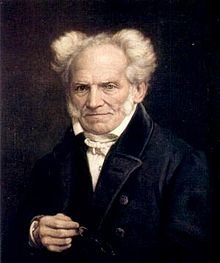
Schopenhauerwas a German philosopher. He is known for his 1818 work The World as Will and Representation, which characterizes the phe- nomenal world as the manifestation of a blind and irrational noumenal will. Building on the transcendental idealism of Immanuel Kant, Scho- penhauer developed an atheistic metaphysical and ethical system that rejected the contemporane- ous ideas of German idealism.... His work has been described as an exemplary manifestation of philosophical pessimism.
Introductory Comments
Every philosopher gets a caricature, and Schopenhauer's is a memorable one: the sour bachelor who wrote a biting essay called "On Women" and thought better of his poodle than of the human race. Much of it is true. And the story begins, as Freud would have insisted, with his mother. Johanna Schopenhauer was among the first German women to live by her pen - novels, travel books, a Weimar salon with Goethe on the sofa. She was also self-absorbed and unbothered by the gloomy young man glowering in the corner. He judged her; she found him insufferable." The rupture came in 1814, when she read a letter in which Arthur blamed her for his father's death. She lived another 24 years. They never met again.
With other women he did no better, though not for want of trying. At 43 he offered a bunch of white grapes to 17-year-old Flora Weiss during a boating party; she let them slip into the water behind her, confiding to her diary that she was revolted that old Schopenhauer had touched them. Then there was Caroline Marquet, a seamstress chattering outside his door in 1821. He shoved her out; she claimed lasting injury; the courts agreed. Six years of litigation left him paying her 60 thalers a year for life.
And as to sex? Schopenhauer argued that it is just another one of mother nature's "tricks" on us - the triumph of the species' need to propagate over the individual's need for peace and quiet.
Some of Schopenhauer's Key Positions
Kant was right about a great deal, Schopenhauer thought, but wrong to seal off the thing-in-itself as forever unknowable. There is one door, and Kant walked past it. Each of us knows his own body twice: from outside, as one object among others, and from within, as striving, effort, appetite. That inner acquaintance gives the fundamental reality its name - Will.
The stone falling, the sap climbing a vine, the spider spinning a web no one taught it, the ambitious man climbing over his rivals: one blind, aimless force objectifying itself at every grade of nature. We feel it, too, in the way objects and other beings press themselves upon us, even as each of us presses back.
Hence the Will is also the curse of humanity. Desire is born of lack, and lack is pain. Satisfaction is merely negative - a want briefly silenced - and it yields at once to a new want, or, worse, to boredom. Life swings between the two like a pendulum. The Will tosses us on a stormy sea with no harbor in sight.
The best we can do is quiet the Will within us. That means seeing through individuality, which is illusion: the barrier between self and other is a trick of appearance, and compassion is what happens when it thins. Our allies here can be found in the Upanishads and in Buddhism, as well as in aesthetic contemplation, especially music.
Place in the History of Ideas
Schopenhauer's Place in History of Ideas
Robert Wicks: Arthur Schopenhauer was among the first 19th century philosophers to contend that at its core, the universe is not a rational place. Inspired by Plato and Kant, both of whom regarded the world as being more amenable to reason, Schopenhauer developed their philoso- phies into an instinct-recognizing and ultimately ascetic outlook, emphasizing that in the face of a world filled with endless strife, we ought to minimize our natural desires for the sake of achieving a more tranquil frame of mind and a disposition towards universal beneficence. Often considered to be a thor- oughgoing pessimist, Schopenhauer in fact advocated ways - via artistic, moral and ascetic forms of awareness - to overcome a frustration-filled and fundamentally painful human cond- ition. Since his death in 1860, his philosophy has had a special attraction for those who wonder about life’s meaning, along with those engaged in music, literature, and the visual arts.
Carl Jung: He was the first to speak of the suffering of the world, which visibly and glaringly surrounds us, and of confusion, passion, evil - all those things which the [other philosophers] hardly seemed to notice and always tried to resolve into all-embracing harmony and comprehensiblility. Here at last was a philosopher who had the courage to see that all was not for the best in the fundaments of the universe.
Random Thoughts on Schopenhauer
Call the Will what Schopenhauer's readers have always privately called it: a Cosmic Bully. Though the term flatters it. A bully at least notices you. Schopenhauer's Will is blind, aimless, and entirely indifferent - an insatiable striving that pulls roots underground, sap up a vine, and human beings into one another's arms, with no more interest in anyone's happiness than gravity has.
It would be easy to file all this under the strange dreams of a strange man. But few strange dreams have had such a career. Nietzsche read Schopenhauer at 21 and never quite got over him; his will to power is the Will turned inside out - no longer a force to be quieted but one to be affirmed and mastered. Wittgenstein, who came The World as Will and Representation in his youth, left its traces on several pages of the Tractatus - the ones about the limits of the world and the will that cannot alter the facts. And Freud, chasing the death instinct through Beyond the Pleasure Principle, conceded that "we have unwittingly steered our course into the harbor of Schopenhauer's philosophy." That last move is the pattern. Schopenhauer's heirs keep arriving in his harbor by accident. Today's evolutionary psychology, explaining that desire serves the species (or, according to Dawkins, the genes at work within the species), rather than the person doing the desiring, is consistent with the spirit of Schopenhauer. For the Will is itself at the mercy of something it doesn't understand.
Albertus Mag. (Music can nourish perfection through contemplation.)
Boethius (Music is a natural and essential part of human nature.)
Cousin (The will is who we are. It's the "me" at the center of each of us.)
Croce (More than even science or metaphysics, art edifies and enriches us.)
Heraclitus (The fairest universe is but a heap of rubbish piled up at random.)
Kant (Judgments based on experience also rely on innate categories of mind.)
Porphyry (Philosophy can liberate the soul from subjection to bodily passions.)
Seneca (We should be free of unruly emotions, as they disturb judgment.)
Thinkers with opposing positions:
Bourdieu (Art is never free of the societal forces at work in its creation.)
Camus (We value life in spite of our mortality and the universe's silence.)
Chesterton (You can't condemn will in general: its essence is in the particular.)
Dante (Pursuit of love is a transcendental experience and a test of virtue.)
Epicurus (Happiness comes from maximizing pleasure and minimizing pain.)
Fromm (Love is based on care, responsibility, respect, and knowledge.)
Jung (The differentiation of the self is the main task of human development.)
Marcuse (The realization of man's erotic nature is liberation for humanity.)
What others said about Schopenhauer
Eric F. J. Payne: We are struck by the psychological force and even fierceness with which he reveals the deepest recesses of the human heart.
Tolstoy: At present I am convinced that Schopenhauer is the greatest genius among men.... [His writing] is the whole world in an incomparably beautiful and clear reflection.
Berlin: [Schopenhauer] sees man as being tossed in a kind of frail bark upon a vast ocean of the will, which has no purpose, no end, no direction, which man can resist only at his own peril, with which man can come to terms only if he manages to rid himself of this unnecessary desire to order… to create a cozy home for himself in this wild and unpredictable element.
Will Durant: Part of the cause of pessimism, in Schopenhauer and his contemporaries, lay in their romantic attitudes and expectations. Youth expects too much of the world; pessimism is the morning after optimism....
Daniel Albright: Schopenhauer thought that music was the only art that did not merely copy ideas, but actually embodied the will itself.
Helen Keller: One who believes that the pain in the world outweighs the joy, and expresses that unhappy conviction, only adds to the pain. Schopenhauer is an enemy to the race.
Einstein: Schopenhauer's saying, that "a man can do as he will, but not will as he will," has been an inspiration to me since my youth up, and a continual consolation and unfailing well-spring of patience in the face of the hardships of life, my own and others'. This feeling... prevents us from taking ourselves and other people too seriously....
Bryan Magee: He speaks to me as no other philosopher does, direct and in his own human voice, a fellow spirit, a penetratingly perceptive friend, with a hand on my elbow and a twinkle in his eye.