Chrysippus (c. 279 BC - c. 206 BC)
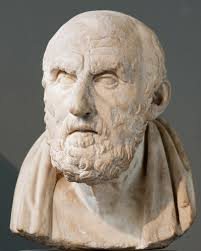
Open Chrysippus's interactive page (graphs of influences, similar and opposing positions, and quotes)
Background
Chrysippus
Born: c. 279 BC in Soli, Cilicia (now Turkey)
Died: c. 206 BC (aged 73) in Athens, Greece
Era: Ancient philosophy
Region: Western philosophy
School: Stoicism
Main interests: Logic, physics, ethics, science,
psychology, epistemology, religion, theology,
mathematics, metaphysics, cosmology
Notable ideas: Systemization of Stoicism,
Pneuma
Influences: Zeno of Citium, Cleanthes, Diodorus
Cronus, Philo of Megara, Aristotle, Plato
Influenced: Stoic school, Epictetus, Marcus
Aurelius, Cicero, Seneca, Zeno of Tarsus,
Diogenes of Babylon, Antipater of Tarsus
From Wikipedia
Chrysippus was a Greco-Phoenician Stoic philoso- pher…. Chrysippus excelled in logic, the theory of knowledge, ethics, and physics. He adhered to a deterministic view of fate, but nevertheless sought a role for personal freedom in thought and action. Ethics, he thought, depended on understanding the nature of the universe, and he taught a therapy of extirpating the unruly passions which depress and crush the soul. He initiated the success of Stoicism as one of the most influential philosophical movements for centuries….
Introductory Comments
Legend has it that Chrysippus died of laughter at one of his own jokes. Spotting an ass eating figs from a basket, he called out to an old woman to pour the poor beast some wine to wash them down. (That's it. That's the joke.) It is not, by any measure, a knee-slapper, but it was enough to kill Chrysippus. The story was almost certainly invented, and invented as a tribute: a sign of the philosopher's wisdom. Just as the Laughing Buddha's grin is taken across much of Asia to signal enlightenment and inner peace, so the West has long treated humor as a mark of wisdom. Voltaire, Franklin, Twain, Wilde, and Russell were all admired for marrying insight to wit. Wittgenstein put the connection at its starkest, claiming that "a serious and good philosophical work could be written consisting entirely of jokes."
But not just any joke will do. To pass as a sign of wisdom, it must meet certain conditions. First, it can't be cruel, since cruelty is the opposite of the serene goodwill we expect of the wise. (Chrysippus is safe here: asses rarely take offense.) Second, it can't be obscene, since dirty jokes flatter our lower animal nature. (No trouble there either - and besides, the ass was an animal already.) Finally, it mustn't be too funny, since uproarious laughter sits poorly with the calm reserve of the sage. (On this last count Chrysippus's joke succeeds magnificently. If only Chrysippus himself had thought likewise.)
Some of Chrysippus's Key Positions
Fate determines everything, threading cause to effect in an unbroken chain that no event - and no person - can escape. The world is one vast web of causation, and we are caught in its strands along with everything else in it.
Yet, though everything is determined, a kind of personal freedom remains possible. Freedom does not consist in escaping fate, but in understanding and embracing it. We become free when we willingly assent to what necessity requires and, in a sense, make it our own.
The key, then, is not to fight the causal order but to live in harmony with it. If we do so, our will comes into accord with the rational structure of the world. We no longer feel chained to events beyond our control. Nor are we tossed about by unruly passions and desires. To make peace with fate is also to find peace within oneself.
Such accord rests on hard mental work. The receipt of impressions is passive, but the soul's task is active: it compares each new impression against those already stored in memory, sorting and classifying until stable concepts take shape, and causal connections become evident. Through this disciplined engagement we become rational beings - and it is precisely as rational beings, capable of giving or withholding assent, that we are free: A free rational being stuck in the web of a completely determined universe.
Place in the History of Ideas
Chrysippus's Place in History of Ideas
Johannes Hirschberger: [Chrysippus] believed he could resolve the conflict [between determin- ism and free will] by changing the meaning of freedom. In reality, for him freedom is synonymous with necessity. Only the fool wishes for something other than that which must be. The wise man, on the contrary, recognizes in the lawful character of events something peculiar to them, a lawfulness typically their own. He looks for nothing else and consequently assents to his own fate. Any other will-act on his part would be sheer caprice and as such only a manifestation of the affections of passion and of disorderliness.
Anthony Flew: Chrysippus was also the principal author of the Stoic ethical system, which is based on the principle of submission to Nature. Nothing can escape Nature's laws, but despite the determinism of fate human beings are free and responsible. If the will obeys reason it will live in accordance with Nature. It is this voluntary acceptance of Nature's laws that consti- tutes virtue, and virtue is both necessary and sufficient for happiness.... But Chrysippus had a number of ethical and political views that marked him out from other Stoics.... Chrysippus differed from some of his fellows in insisting that a philosopher need not devote himself to scholarship: for a Stoic it was acceptable, indeed praiseworthy, to take part in public life.
Random Thoughts on Chrysippus
Chrysippus was arguably the first philosopher to defend compatibilism - the view that free will and universal determinism can coexist. (Epicurus doesn't quite count as a rival here: his idea of atoms randomly "swerving" to make room for freedom only works by denying that determinism is universal in the first place.) On its face, compatibilism looks like a contradiction in terms. If everything is determined, doesn't that include our choices - and doesn't that leave no room for freedom or moral responsibility at all?
Chrysippus's answer is yes to determinism, no to the contradiction, because he locates freedom inside causality rather than outside it. We are free insofar as our will runs in sync with the causal order rather than against it. Hence his famous image: a dog is tied to a moving cart. If the dog trots along willingly, its motion is at once spontaneous and necessary - it goes where it was going to go anyway, but freely. If it digs in its heels, its unfreedom is there for all to see. Either way the cart wins; the only question is whether the dog comes along with dignity.
An existential dog, though, might bark back: Perhaps it is precisely the fighting - the refusal to be towed - that makes us free, however undignified the dragging looks to onlookers. Chrysippus would call that a category mistake. The existentialist would call it the whole point. And there, more or less, the argument still sits.
Influences
Chrysippus was influenced by: Aristotle, Cleanthes, Diodorus, Philo of M., Plato, Zeno of Citium
Chrysippus influenced: Antipater of T., Aurelius, Cicero, Diogenes of B., Epictetus, Seneca, Zeno of Tarsus
Similar and opposing positions
Thinkers with similar positions:
- Al-Ghazali (Though evil exists, God created the best of all possible worlds.)
- Boethius (Happiness is attained through sufficiency, virtue and wisdom.)
- Descartes (Everything we perceive both clearly and distinctly must be true.)
- Eriugena (God has created the world out of his own being.)
- James (Free will is pragmatically true because it better fits our moral nature.)
- Locke (Knowledge is empirical and springs from observing the actual world.)
- Lotze (Universal mechanical laws suggests the work of a universal mind.)
- Philo (Serenity can be achieved thru self-discipline, temperance & stoicism.)
- Spinoza (Liberty comes not from casting off determinism, but understanding it.)
Thinkers with opposing positions:
- Einstein (Free will isn't compatible with determinism. Our wills are determined.)
- Epicurus (There's an irreducible element of uncaused chance in the universe.)
- Hobbes (Since the will is causally determined, it is not free in its choices.)
- Luther (Given God's sovereignty & our own sinfulness, there is no free will.)
- Machiavelli (Living virtuously & wisely does not necessarily lead to happiness.)
- Sade (Heed nothing but your desires; let them alone be your laws.)
- Skinner (Free will is not possible in our deterministic world.)
What others said about Chrysippus
- Diogenes Laërtius: [Chrysippus taught that] living virtuously is equal to living in accordance with one's experience of the actual course of nature.
- Anthony Gottlieb: [Chrysippus thought] what we are going to think or do is already fixed by earlier causes.... But some of those causes have to do with our own characters, and in that sense our thoughts and actions are indeed our own.
- Nietzsche: According to nature you want to live? O you noble Stoics, what deceptive words these are.… And supposing your imperative, "live according to nature," meant at bottom as much as "living according to life" - how could you not do that? Why make a principle out of what you yourselves are and must be?
- Seneca: [Chrysippus taught that] wise people are in want of nothing, and yet need many things. On the other hand, nothing is needed by fools, for they do not understand how to use anything, but are in want of everything.
- Nassim N. Taleb: A Stoic is someone who transforms fear into prudence, pain into transformation, mistakes into initiation, and desire into undertaking.
- Russell: Chrysippus... had an elaborate theory of knowledge, in the main empirical and based on perception, though [he] allowed certain ideas and principles, which were held to be established by... the agreement of mankind.
- Diogenes Laërtius: There are, as usual, several accounts of [Chrysippus's] death. [For example, Diogenes says] that his death was caused by a violent fit of laughter; for after an ass had eaten up his figs, he cried out to the old woman, "Now give the ass a drink of pure wine to wash down the figs." And thereupon he laughed so heartily that he died.
- Cicero: [Chrysippus] maintained that aether is that which people call Zeus, and that the air which permeates the seas is Poseidon, and that the earth is what is known by the name of Demeter, and [likewise with] other gods.
Schools: Stoicism
Main interests: Cosmology, Epistemology, Ethics, Fate, Free/Unfree Will, Logic, Mathematics, Metaphysics, Physics, Psychology, Religion, Science, Theology
Chrysippus's answers to philosophical questions
Epistemology
We learn about the world by comparing and contrasting the current reports of our senses with previous ones.
Ethics
Happiness consists of nothing other than virtue, for, as all agree, vice inevitably leads to guilt, shame & overall unhappiness.
"I myself think that the wise man meddles little or not at all in affairs and does his own things."
Though all our actions are causally determined, if we accept and go along with this causality, these actions become our own.
Metaphysics
Free will is consistent with universal causality: Free will springs from accepting what is determined & "making it one's own."
Philosophy
Philosophy requires the mastery of logic - including the logic of conditional propositions and hypothetical syllogisms.
Psychology
Until we learn to control our passions, we will never be completely sane nor as productive as we should.
The key to a happy life is learning to control our unruly passions. We should see things calmly and in their proper proportion.
Religion and Theology
"The universe itself is God and the universal outpouring of its soul."