Heraclitus (c. 535 BC - c. 475 BC)
Open Heraclitus's interactive page (graphs of influences, similar and opposing positions, and quotes)
Background
Heraclitus of Ephesus
Born: c. 535 BC in Ephesus (near modern
Kuşadası, Turkey)
Died: c. 475 BC (aged around 60)
Schools: Ionian, Pre-Socratic philosophy
Main interests: Metaphysics, Epistemology,
Ethics, Politics, Cosmology, Ontology
Notable ideas: Logos, "everything flows", fire is
the arche, idios kosmos
Influences: Anaximander, Pythagoras, Bias of
Priene, Xenophanes
Influenced: Parmenides, Cratylus, Empedocles,
Democritus, Plato, Aristotle, Hegel, Engels,
Nietzsche, Heidegger, Whitehead, Spengler,
Popper, Terence McKenna, Walter Pater,
Montaigne, Socrates
From Wikipedia
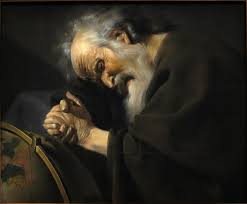
Little is known of Heraclitus's life. He wrote a single work, only fragments of which have survived…. His paradoxical philosophy and appreciation for wordplay and cryptic, oracular utterances has earned him the epithet "the obscure" since antiquity. He was considered arrogant and depressed, a misanthrope who was subject to melancholia. Consequently, he became known as "the weeping philosopher" in contrast to the ancient philosopher Democritus, who was known as "the laughing philosopher."
Introductory Comments
One of the few things we can say with confidence about Heraclitus the man is that he loved a paradox - making him the first in a long line of philosophers who tried to turn contradiction into revelation. Consider the evidence: "You cannot step into the same river twice"; "Good and ill are one"; "War is the father of all things"; "I am as I am not" Only Oscar Wilde more thoroughly relished waxing paradoxical.
But unlike Wilde, who used paradoxes to humorously point out the hypocricies of humanity and the unique importance of art, Heraclitus used them to reveal the paradoxical nature of reality itself. In that sense they were more like Nietzsche's paradoxes: serious attempts to turn the world upside down - or to crack it open for all to see. This can perhaps be felt most powerfully in the underlying principle Heraclitus calls Fire. It is not merely a physical element; it is something closer to ultimate reality - the ground of all becoming. Like the world itself, Fire is the most evanescent of things (a flame is always dying, always consuming itself) and, at the same time, the most persistent (the combustion seems to go on forever, cycling through form after form). In fire, destruction and generation are the same act. The world, for Heraclitus, is neither created nor destroyed - it simply burns, endlessly transforming, endlessly the same.
Some of Heraclitus's Key Positions
Everything flows. Nothing in the world settles into simple, stable being; everything is caught up in ceaseless change, driven by the tension between opposites. Light battles dark, love battles strife, birth gives way to death, which gives way to birth again. Yet this restless, combative flux is not mere chaos. Look closely, and a hidden pattern emerges: a dynamic equilibrium, taut and energetic, that warring opposites continually produce between them.
The famous image of the river makes the point precisely: no man steps into the same river twice, because neither the water nor the man is the same from one moment to the next. And yet the river persists. Change, paradoxically, is its own kind of constant - not a peaceful one, but agitated, crackling, never-quite-resolved.
The underlying principle of this flux is called Fire. It is not merely a physical element; it is something closer to ultimate reality - the ground of all becoming. Fire captures the paradox of the world with peculiar force: it is the most evanescent of things (a flame is always dying, always consuming itself) and, at the same time, the most persistent (the combustion goes on forever, cycling through form after form). In fire, destruction and generation are the same act. The world, is neither created nor destroyed - it simply burns, endlessly transforming, endlessly the same.
Place in the History of Ideas
Heraclitus's Place in History of Ideas
J. E. Erdmann: In opposition to the Eleatics, who attributed truth only to Being and denied Non-Being, Heraclitus maintains that every thing, and even one and the same thing, both is and is not. Thus he substitutes for the Eleatic Being, its combination with Non-Being, i.e. Becoming; and the idea that everything is in process and nothing at rest, and the idea that everything is undergoing continual change, objects as well as the subject that contemplates them...
Cassirer: At first glance the doctrine of Heraclitus still appears to stand wholly on the ground of Ionian natural philosophy. Heraclitus also sees the world as a totality of materials which reciprocally metamorphose into one another. But this appears to him only as the surface of events, beneath which there is a depth which he seeks to make visible, and which till now has not been disclosed to thought. The Ionians, too, are not to be satisfied with mere knowledge of the "what"; they also ask for the "how" and the "why." But this question is posed by Heraclitus with a new and precise meaning. And in giving the statement of the problem this new form, he is aware that perception, which is the sphere in which speculative natural philosophy has moved till now, is no longer capable of supplying the answer. Only thought can give us the answer: for in it, and it alone, is man freed of the limitations of his individuality.
Random Thoughts on Heraclitus
Why do we assume that the idea of a world in flux depressed Heraclitus - as those who labeled him "the weeping philosopher" must have assumed? What is so terrible about rapid change? People pay good money to watch sports like Formula One racing and ice hockey. They spend countless hours participating in fast-moving activities such as skiing and tennis. And consider the thrill of a roller coaster. Yet for most of us the phrase "constant flux" still carries an unpleasant ring. Perhaps we hear in it a reminder of our inability to hold onto life's passing moments. As Emily asks the Stage Manager in Our Town: "Do any human beings ever realize life while they live it? - every, every minute?"
The phrase "constant flux" does indeed awaken such concerns. Yet some philosophers say that complete immersion in the present can itself reveal something eternal. Kierkegaard and Santayana, for example, each suggested in different ways that a fully inhabited moment transcends ordinary time. Heraclitus arrives at a similar insight by a different route. Instead of seeking a refuge from change, he asks us to contemplate it. If we cease resisting the flux and recognize that everything is always becoming something else, we may glimpse what never changes: the fact of change itself. The river flows, the flame flickers, the world transforms - yet transformation endures. In that paradoxical sense, the eternal and the ephemeral are one in the same.
Influences
Heraclitus was influenced by: Anaximander, Bias of Priene, Pythagoras, Xenophanes
Heraclitus influenced: Aristotle, Cratylus, Democritus, Empedocles, Engels, Hegel, Heidegger, McKenna, T., Montaigne, Nietzsche, Parmenides, Pater, Plato, Popper, Socrates, Spengler, Whitehead
Similar and opposing positions
Thinkers with similar positions:
- Bergson (Duration is a continuous flow, immeasurable and unquantifiable.)
- Deleuze (There is no one substance, only an always-differentiating process.)
- Goethe (Science & philosophy need to ponder the dynamic character of nature.)
- Hegel (Reality is not a static set of facts. It is an ongoing process, a becoming.)
- Hegel (There's a certain unity of opposites at work in the history of our world.)
- James (Metaphyscial monism, in whatever guise it takes, is pure nonsense.)
- Malthus (The struggle for survival is an immense force at work in our world.)
- Montaigne (Nothing is certain in life: We change as much as do our judgments)
- Shakespeare (Nature may guide us, but towards no rational purpose or end.)
- Whitehead (The world is a process and can't be reduced to mere matter.)
Thinkers with opposing positions:
- Parmenides (Reality is one and changeless. Existence is timeless and uniform.)
- Petrarch (Exploring nature outdoors is both a pleasure and an inspiration.)
- Plotinus (The One, being perfect & eternal, is stable, uniform and unchanging.)
- Royce (Our ideas ultimately refer to a universal whole in which they belong.)
- Spinoza (Everything that exists is a modification or mode of one substance.)
- Zeno (Belief in movement and change leads to paradox and contradiction.)
What others said about Heraclitus
- Diogenes Laërtius: [Heraclitus believed] all things come into being by conflict of opposites, and the sum of things flows like a stream.
- Russell: The metaphysics of Heraclitus, like that of Anaximander, is dominated by a conception of cosmic justice, which prevents the strife of opposites from ever issuing in the complete victory of either.
- Schwegler: When... Heraclitus names the world an ever-living fire that... extinguishes itself and again kindles itself, when... all is exchanged for fire and fire for all... he can only understand by this that fire, this restless, all-consuming, all-transmuting, and equally (in heat) all-vivifying element, represents the constant force of this eternal alteration and transformation….
- Juvenal: The first of prayers, best known at all the temples, is mostly for riches... Seeing this then do you not commend the one sage Democritus for laughing... and the master of the other school Heraclitus for his tears?
- Santayana: Heraclitus remains the honest prophet of immediacy: a mystic without raptures or bad rhetoric….
- Nietzsche: [Heraclitus taught that] as the child and the artist plays, so too plays the ever living fire; it builds up and tears down, in innocence - such is the game eternity plays with itself.
- Hegel: Heraclitus is the one who first declared the nature of the infinite and first grasped nature as in itself infinite, that is, its essence as process. The origin of philosophy is to be dated from Heraclitus. His is the persistent Idea that is the same in all philosophers up to the present day, as it was [for] Plato and Aristotle.
- Simplicius: [Heraclitus saw] that all corporeal things are coming to be and departing and never really are... [and] that all things are always in flux and that you could not step twice in the same river.
Schools: Ionian School, Pre-Socratic Philosophy, Process Philosophy, Skepticism
Main interests: Beauty, Cosmology, Epistemology, Ethics, Metaphysics, Politics, War
Heraclitus's answers to philosophical questions
Education
Emphasize depth: "Learning many things doesn't teach understanding. Else it would have taught Hesiod & Pythagoras…."
"I am what libraries and librarians have made me, with little assistance from a professor of Greek and poets."
Epistemology
Organs of perceptions do not always truly perceive: "Eyes & ears are poor witnesses to people if they have uncultured souls."
"Many do not understand such things as they encounter, nor do they learn by their experience, but they think they do."
The Logos (Reason) is the universal principle that keeps all things in balance. Likewise, reason should be our guide in life.
"The Lord whose oracle is at Delphi neither reveals nor conceals, but gives a sign." From these signs, we discover the truth.
Ethics
Children have much to teach us about happiness and life: "Time is a game played beautifully by children."
"To be even-minded is the greatest virtue. Wisdom is to speak the truth and act in keeping with its nature."
History
"History is a child building a sand-castle by the sea, and that child is the whole majesty of man’s power in the world."
"The best people renounce all for one goal, the eternal fame of mortals; but most people stuff themselves like cattle."
Metaphysics
"The world, an entity out of everything, was created by neither gods nor men, but was, is and will be eternally living fire…."
Everything changes: "[W]ar is common, strife is justice, and all things happen according to strife and necessity."
Time is a powerful river that continually moves on - continually rearranging, changing and destroying all that it carries.
"Everything flows & nothing abides; everything gives way & nothing stays fixed." Time itself involves an ever-changing now.
"Everything gives way and nothing stays fixed." Yet the Fire exists forever through these very transformations.
"The content of your character is your choice. Day by day, what you... think and what you do is who you become."
All is one, but this oneness (the abiding Fire) entails a constant & balanced play of opposites - hot & cold, birth & death, etc.
Political Philosophy
Democracy is based on the false premise that all men are capable of self-rule. Few people can think for themselves.
Psychology
Will as desire: "It is hard to contend against one’s heart’s desire; for whatever it wishes to have it buys at the cost of soul."
"Man is most nearly himself when he achieves the seriousness of a child at play."
Good character takes time: "It is created little by little, day by day. Protracted... effort is needed to develop good character."
We have "a great desire to live & a great dissatisfaction with living." But if we live in harmony with the Logos, we'll be content.
Religion and Theology
"Religion is a disease, but it is a noble disease."
"To God all things are fair, good & just, but men suppose some things are unjust, some just." We lack God's all-seeing vision.