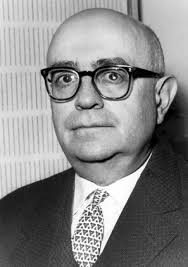
Adorno was a German philosopher, sociologist, [and] psychologist... known for his critical theory of society. He was a leading member of the Frankfurt School of critical theory, whose work has come to be associated with thinkers such as Ernst Bloch, Walter Benjamin, Max Horkheimer, Erich Fromm, and Herbert Marcuse, for whom the works of Freud, Marx, and Hegel were essential to a critique of modern society…. As a writer of polemics..., Adorno delivered scathing critiques of contemporary Western culture.
Introductory Comments
The Frankfurt School was born in Weimar Germany in the 1920s. A decade later its leading lights, among them Horkheimer, Marcuse, and Adorno, were running for their lives. Most were Jewish or, like Adorno, of partly Jewish descent. All were Marxists. In the Third Reich, either fact alone was enough to get a man killed. By the end of the 1930s, many of them had found refuge in the U.S. One might have expected a little gratitude toward their rescuer. Gratitude, however, was never the Frankfurt School's strong suit. Adorno took one look at Hollywood, Tin Pan Alley, radio, and advertising and saw not freedom but a softer cousin of the regime he had fled. Mass culture, he concluded, was hardly culture at all. It was a "culture industry," a machine for manufacturing consent and smothering genuine thought under an avalanche of cheerful, standardized nonsense.
What made the critique so formidable, and so maddening, was that it drew on three heavyweight traditions at once. From Hegel came the dialectic, which turned against Hegel's own optimism: reason, which had promised to free humanity from myth, had become a new myth and a new instrument of domination. From Marx came commodity fetishism, the illusion that a thing's market value belongs to the thing itself. Adorno extended it from goods to songs and films. And from Freud came the insight that a social order can harness desire to bind people emotionally to the very system that confines them.
Some of Adorno's Key Positions
Freud, Marx, and Hegel each show a different side of modern society. Freud exposes the irrational drives beneath social life. Marx shows how commodities and exchange shape thought, taste, and relationships as well as economies. Hegel supplies dialectics, a method for tracing how ideas and institutions breed their own contradictions. But his idealism must be turned against itself. No concept fully captures its object.
Reason itself has a dark side. The Enlightenment promised freedom from myth and fear. Yet reason, shrunk to a tool for calculation and control, has become a new myth and a new instrument of domination. The catastrophes of the 20th century are one of its outcomes, not merely its betrayal.
Fascism needs further analysis. The authoritarian personality is submissive toward superiors and aggressive toward inferiors and outsiders. It often grows out of a harsh, rigidly conventional upbringing, but democracies breed it too. Fascist leaders gain power by offering an idealized figure to identify with and a scapegoat to blame.
But cultural criticism need not be restricted to extreme cases such as Nazi Germany. In modern mass society, America above all, a "culture industry" turns out films and songs the way factories turn out cars. Amusement becomes an extension of work, breeding passive conformity and dulling critical thought.
Place in the History of Ideas
Adorno's Place in History of Ideas
Lambert Zuidervaart: Although less well known among anglophone philosophers than his con- temporary Hans-Georg Gadamer, Adorno had even greater influence on scholars and intellec- tuals in postwar Germany. In the 1960s he was the most prominent challenger to both Sir Karl Popper's philosophy of science and Martin Heidegger's philosophy of existence. Jürgen Habermas, Germany's foremost social philoso- pher after 1970, was Adorno's student and assistant. The scope of Adorno's influence stems from the interdisciplinary character of his re- search and of the Frankfurt School to which he belonged. It also stems from the thoroughness with which he examined Western philosophical traditions, especially from Kant onward, and the radicalness to his critique of contemporary Western society. He was a seminal social philosopher and a leading member of the first generation of Critical Theory.
Georg Lukács: A considerable part of the leading German intelligentsia, including Adorno, have taken up residence in the "Grand Hotel Abyss" which I described in connection with my critique of Schopenhauer as "a beautiful hotel, equipped with every comfort, on the edge of an abyss, of nothingness, of absurdity. And the daily contemplation of the abyss between excellent meals or artistic entertainments, can only heighten the enjoyment of the subtle comforts offered."
Random Thoughts on Adorno
Adorno’s critique of American culture won eager disciples among radical critics. They showed how consumerism consumes the consumers and how mass entertainment leaves little room to entertain thoughts of one's own. Others were less impressed. American sociologists and Birmingham's cultural-studies scholars charged him with highbrow despair. In their view, he couldn't see the irony and quiet subversion with which ordinary people use popular culture, and he had mistaken the roar of the crowd for the silence of the grave. Jazz was their favorite exhibit. To Adorno, it was no feat of improvisational genius but an assembly line with a syncopated beat. His critics noted that he mostly heard commercial dance bands, not Harlem clubs.
Then came Silicon Valley, staffed by optimists in hoodies who sincerely believed they were connecting the world. The social web followed, with algorithms that prize attention above truth and responsibility. They cater to our worst impulses, trade thought for dopamine hits, and baptize it all as "community" and "authenticity." Adorno, who wrote a whole book skewering the "jargon of authenticity," would have recognized the vocabulary. This is not a refutation of the culture-industry thesis but its apotheosis. The critics were right that Adorno couldn't hear what was happening in a jazz club. Yet he seems to have sensed a dystopia slouching toward Menlo Park decades before it arrived. You could hardly script a more Adornian punch line.
Freud (Human civilization developed thru' the suppression of human nature.)
Fromm (We must take responsibility for our individual actions and thoughts.)
Gramsci (The bourgeoisie spreads its politics more thru culture than violence)
Heidegger (Modern rationality tries too much to dominate the natural world.)
Horkheimer (Popular culture encourages a passive & unquestioning worldview.)
Kierkegaard (Philosophy must embrace subjectivity as an essential resource.)
Lukács (Our obsession with commodities have made social relations "thinglike.")
Nietzsche (Autonomy is spontaneous, creative human action, not rule-bound.)
Zizek (Idealogies spring from symbolic depictions of reality, not from reality.)
Thinkers with opposing positions:
Comte (The study of society should be scientific, quantifiable, and objective.)
Condorcet (Civilization inevitably leads to progress in morality and justice.)
Habermas (Reason plays a constructive role in moral, political & social systems.)
Kant (Morality should be based on formal procedural rules or maxims.)
Marx (Economic, rather than cultural, forces drive history and shape society.)
Popper (The search for truth should be completely fact-based and objective.)
Spencer (History shows that, like reason & science, societies progress over time.)
What others said about Adorno
Andrew Fagan: For Adorno, reality is grounded in suffering and the domination of nature.
Alex Ross: Adorno and Horkheimer... viewed pop culture as an instrument of economic and political control, enforcing conformity behind a permissive screen.
Fredric Jameson: Anyone surprised by the characterization of Adorno as a Marxist has not read much of his admittedly difficult writing.... Most available secondary discussions tend to leave the Marxism out, as though it were some curious set of period mannerisms which a postcontemporary discussion no longer needs to take into consideration.
Lambert Zuidervaart: Long before postmodernism" became fashionable, Adorno and Horkheimer wrote one of the most searching critiques of modernity to have emerged among progressive European intellectuals.
Alex Ross: Notoriously, Adorno compares jitterbugging to "St. Vitus’ dance or the reflexes of mutilated animals."
Andrew Fagan: Although he wrote on a wide range of subjects, his fundamental concern was human suffering - especially modern societies’ effects upon the human condition.
Volker Weiss: Adorno's philosophy was not only a critique of capitalism, it also offered an inventory of modernity as a whole…. His thinking was based on the [fact that] knowledge [was] being put to the service of rulers rather than liberation. He saw how Enlightenment, having... reached the highest level of technological progress, turned into a new barbarism.
Lambert Zuidervaart: Horkheimer and Adorno believe that society and culture form a historical totality, such that the pursuit of freedom in society is inseparable from the pursuit of enlightenment in culture.
Main interests: Alienation, Art and Aesthetics, Cultural Criticism, Cultural Studies, Desire, Epistemology, History, History of Ideas, Language, Literature, Mass Media, Music, Political Philosophy, Popular Culture, Psychoanalysis, Social Criticism, Social Philosophy, Social Theory, Tragedy