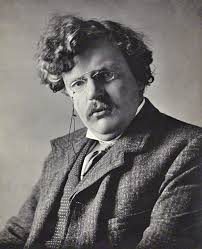
Chesterton was an English author, philosopher, Christian apologist, poet, journalist and magazine editor, and literary and art critic. Chesterton's wit, paradoxical style, and defence of tradition made him a dominant figure in early 20th-century literature…. Raised in a loosely Unitarian family, he became agnostic in his early adulthood, but later spent much of his life as a member of the Church of England.... He converted to Catholicism in 1922 largely under the influence of his longtime partnership with Hilaire Belloc….
Introductory Comments
Most thinkers treat a paradox the way a homeowner treats a leak: something to find, fix, and forget. Chesterton treated it more like a skylight. A genuine paradox, he believed, was not a mistake in reasoning but a glimpse of a reality too large for our categories. The distinction mattered. A contradiction is simply nonsense, like a square circle. A true paradox sets two truths side by side that seem to cancel each other out yet stubbornly refuse to leave. Tidy up the tension, and you buy consistency at the price of truth. A creed built that way may be easier for the mind to grasp, but it will be harder for the soul to embrace.
Chesterton carried the argument straight into the heart of Christianity. In Orthodoxy (1908), he noticed that critics attacked the faith for opposite faults: it was too gloomy and too cheerful, too meek and too warlike. Christianity's genius, he decided, lay not in steering a moderate course between rival virtues but in keeping both at full strength. It offered not the pale pink of compromise but red and white side by side. Courage, for instance, is a desire to live that takes the form of a readiness to die. Hence the gospel saying that whoever loses his life will save it. The doctrines share the same strange shape: God three and one, Christ fully divine and fully human. For Chesterton, a religion invented merely to satisfy human reason would presumably be more logically convenient, but also less faithful to the strange and stubborn facts of existence.
Some of Chesterton's Key Positions
Happiness does not come from savoring every pleasure life offers, as aesthetes such as Oscar Wilde suppose. The creed of "seize the day" belongs not to happy people but to unhappy ones, and a ravenous appetite for the passing moment betrays desperation rather than delight.
Real joy does not gather rosebuds while it may; its eyes are "fixed on the immortal rose which Dante saw." Lasting gladness rests on what is eternal, above all the God who became man in Christ, not on what fades.
Worshipping the new simply because it is new is a modern superstition. "Progress" means nothing unless we know what we are progressing toward, and without a fixed ideal, change is mere drift. Reason cut loose from faith and common sense does not produce sanity.
The Catholic Church, with its long memory and its settled teaching, offers the surest footing and best ideal of all, because it alone frees a person from being merely a child of his own age.
Social injustice demands remedy, but neither big business nor the big state supplies it. Property should be widely held, in many small farms, shops, and homes, rather than concentrated in the hands of capitalists or officials. Even so, no political arrangement, however just, can supply ultimate meaning.
Place in the History of Ideas
Chesterton's Place in History of Ideas
James Parker: In his vastness and mobility, Chesterton continues to elude definition: He was a Catholic convert and an oracular man of letters, a pneumatic cultural presence, an aphorist with the production rate of a pulp novelist.... Chesterton was a journalist; he was a metaphysician. He was a reactionary; he was a radical. He was a modernist, acutely alive to the rupture in consciousness that produced Eliot’s “The Hollow Men”; he was an anti-modernist... a parochial Englishman and a post-Victorian gasbag; he was a mystic wedded to eternity. All of these cheerfully contradictory things are true.... [However, his basic] message, a steady illumination beaming and clanging through every lens and facet of his creativity, was really very straightforward: get on your knees, modern man, and praise God.
T. S. Eliot: He was importantly and consistently on the side of the angels. Behind the Johnson- ian fancy-dress, so reassuring to the British public, he concealed the most serious and revolutionary designs - concealing them by exposure.... Chesterton's social and economic ideas... were fundamentally Christian and Catholic. He did more, I think, than any man of his time - and was able to do more than anyone else, because of his particular background, development and abilities as a public perform- er - to maintain the existence of the important minority in the modern world.
Random Thoughts on Chesterton
The word "heresy" comes from the Greek for "choice," and for Chesterton the etymology says it all. A heretic, as he saw it, is rarely short of faith. More often he is someone who insists on choosing. Faced with two truths pulling in opposite directions, the heretic does what logic seems to demand: he keeps one and throws the other overboard. God must be one or three, not both. He must stand above the world or dwell within it, not both. Christ must be divine or human, not both. Orthodoxy declines the bargain and keeps every ball in the air at once.
On this view, the great heresies are tidy-minded simplifications. Arianism demoted Christ to an exalted creature. Gnosticism scorned the material world as a prison. Pelagianism trusted human effort so fully that grace became almost optional. Unitarianism trimmed the Trinity down to a single, more manageable God. Each removed a scandal, and with it, Chesterton thought, a truth. To live inside the paradox instead is a lesson in humility: you cannot master it, only wonder at it. Hence his warning about logic run amok: "The poet only asks to get his head into the heavens. It is the logician who seeks to get the heavens into his head. And it is his head that splits."
Perhaps. But the logician has a reply. If any contradiction at the heart of a cherished belief can be promoted to a "paradox," what would ever count as a genuine error?
Influences
Chesterton was influenced by:Aquinas, Belloc, H., Browning, R., Burke, Cobbett, W., Dickens, McDonald, G., More, Newman, Stevenson, R.L.
Chesterton influenced: Auden, W.H., Borges, Burgess, A., Gandhi, Gardner, M., Gilson, Hitchcock, A., Lewis, C.S., McLuhan, M., Shaw, Sheen, F.J., Tolkein, Watts, Alan, Welles, Orson, Wills, Garry, Zizek
Similar and opposing positions
Thinkers with similar positions:
Aquinas (Human reason & will remained free to choose good even after the Fall.)
Bradley (Maximizing pleasures should not be the end moral agents aim for.)
Hutcheson (We should act in unselfish ways to increase happiness of others.)
Jesus (Love means to love that which is unlovable, else it is no virtue at all.)
MacIntyre (God is both the source and the pinnacle of justice and natural law.)
Mill (Some forms of pleasure are higher and more valuable than other forms.)
Vico (Society relies on narratives that give coherence and meaning to life.)
Zeno (The more we understand the world, the more paradoxical it becomes.)
Thinkers with opposing positions:
Carlyle (The history of the world is but the biography of great men.)
Derrida (There is nothing outside context. All meaning relies on context.)
Epicurus (Happiness comes from maximizing pleasure & minimizing pain.)
Goethe (One can be inwardly Christian w/o belonging to any Christian church.)
Hitchens (Religion is violent, irrational, intolerant & allied to racism & sexism.)
Hobbes (Our ultimate motive is always to experience pleasure and avoid pain.)
Nietzsche (Great men shape and direct history. The masses just follow along.)
Shaw (Progress requires unreasonable men to adapt the world to themselves.)
What others said about Chesterton
Rhonda Bodle: The [very] best popular defence of the full Christian position I know is G. K. Chesterton's "The Everlasting Man."
Neil Gaiman: I was always aware, reading Chesterton, that there was someone writing this who rejoiced in words, who deployed them on the page as an artist deploys his paints upon his palette.
Quentin Lauer: [Chesterton rejected] pessimism in any and all of its forms. This is not to say that he was unaware that there is evil - a great deal of it - in this world. His life was one continuous campaign against the evils he perceived, one of the chief of which was the denial that there is good in the world, the denial that life is basically good.
Hilaire Belloc: Everything he wrote upon any one of the great English literary names was of the first quality. He summed up any one pen...in exact sentences..., after a fashion which no one else has approached.
James Parker: His prose...[is] supremely entertaining.... He fulminates wittily; he cracks jokes like thunder.
Rebecca West: ... I believe his view of life to be based on a misconception. To put it in a theological way, he denies that God made the brain as well as the heart. He despises wisdom.... Like all sentimentalists he is cruel.
Étienne Gilson: [Chesterton's work is] the best book ever written on Saint Thomas.... [T]he few readers who have spent twenty or thirty years in studying St. Thomas Aquinas, and who, perhaps, have themselves published two or three volumes on the subject, cannot fail to perceive that the so-called "wit" of Chesterton has put their scholarship to shame.
T. S. Eliot: Some of his essays can be read again and again; though of his essay-writing as a whole, one can only say that it is remarkable to have maintained such a high average with so large an output.
Schools: Augustinianism, Christian Humanism, Christian Theology, Common Sense Realism, Conservatism, Personalism, Thomism, Traditionalism
Main interests: Art and Aesthetics, Autobiography, Childhood, Economics, Faith, Family, Friendship, Habits, History, Journalism, Literature, Poetry, Politics, Religion, Salvation