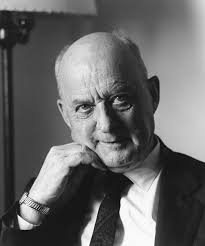
Influences: Karl Barth, Paul Tillich, Alfred North
Whitehead, Karl Marx, William James, Samuel
D. Press, Martin Buber, Augustine, Kierkegaard
Influenced: Martin Luther King Jr., George F.
Kennan, Hans Morgenthau, Kenneth Waltz,
Samuel P. Huntington, Richard Hofstadter,
Arthur M. Schlesinger Jr., Christopher Lasch,
Barack Obama, Jimmy Carter, Thomas Edison,
Hillary Clinton, Hubert Humphrey, Dean
Acheson, Madeleine Albright, John McCain,
D. Bonhoeffer, David Brooks, James B. Comey
From Wikipedia
Niebuhr was an American Reformed theologian, ethicist, commentator on politics and public af- fairs, and professor at Union Theological Seminary for more than 30 years. Niebuhr was one of Amer- ica's leading public intellectuals for several dec- ades of the 20th century…. A public theologian, he wrote and spoke frequently about the intersection of religion, politics, and public policy…. Starting as a minister with working-class sympathies in the 1920s..., his thinking evolved during the 1930s to neo-orthodox realist theology.....
Introductory Comments
Few theologians have changed their minds so publicly, or so usefully, as Reinhold Niebuhr. In 1915 he arrived as a young pastor in Detroit, a city being remade by Henry Ford's assembly lines. He came as a liberal of the Social Gospel stamp, confident that education, moral persuasion, and organized reform could build something like the Kingdom of God on earth. Detroit cured him of much of that. Watching workers ground down by the factories, he came to doubt that goodwill could prevail against organized economic power. His diary from those years, published as Leaves from the Notebook of a Tamed Cynic (1929), records the slow erosion of a hopeful creed.
The 1930s completed his education. From his new post at Union Theological Seminary in New York, he turned first to Marxism, which at least took power seriously. Moral Man and Immoral Society (1932) scandalized liberal colleagues by arguing that groups yield to pressure, not sermons. But as the Depression deepened and fascism spread, he found a still deeper diagnosis in older Christian sources, Augustine above all. He read the doctrine of original sin not as literal history but as a truthful myth: we humans persistently put ourselves at the center of things, and even our noblest acts are tinged with pride. That diagnosis undid utopian hopes of the Marxists, and in time it undid his own pacifism. The man who had hoped to build heaven in Detroit had not become a cynic. He had become something much rarer: a realist who still believed.
Some of Niebuhr's Key Positions
Individuals can sometimes rise above self-interest; groups almost never do. Nations, classes, and races pool the egoism of their members while escaping the conscience that restrains individuals. Relations between groups are therefore governed less by moral persuasion than by power, and justice among them requires that power be balanced and checked.
The root of the trouble is pride. Finite yet free, human beings grow anxious and try to secure themselves by grasping at power, knowledge, or virtue beyond their measure. The most dangerous form is moral pride, which blinds individuals and nations alike to their own corruption. Such sin flourishes most in utopian movements that promise to abolish evil. History's irony is that virtues trusted too completely become vices.
Biblical faith punctures this pretension. The cross reveals both the depth of human sin and a divine love, agape, that judges and forgives it. That love is an "impossible possibility": never fully realized in history, yet the standard against which every achievement falls short. Grace makes people not sinless but contrite, humble, and forgiving.
The political result is realism without cynicism. Perfect justice is unattainable; proximate justice is possible and obligatory. The human capacity for justice makes democracy possible, and the inclination to injustice makes it necessary.
Place in the History of Ideas
Niebuhr's Place in History of Ideas
Schlesinger: [Niehbur] persuaded me and many of my contemporaries that original sin provides a far stronger foundation for freedom and self-government than illusions about human perfectibility. Niebuhr's analysis was grounded in the Christianity of Augustine and Calvin, but he had, nonetheless, a special affinity with secular circles. His warnings against utopianism, messianism and perfectionism strike a chord today.... We cannot play the role of God to history, and we must strive as best we can to attain decency, clarity and proximate justice in an ambiguous world.
Robert H. Bonthius: Kierkegaard... taught that a "synthesis" was needed, by which he meant a vital relationship of man with God by which man may resolve his inner conflicts and live at peace with himself. Influenced by these thoughts of Kierkegaard, Reinhold Niebuhr has developed the thesis that man is a creature of two dimensions: "He stands at the juncture of nature and spirit." As finite, man is a part of nature, subject to its laws and its vicissitudes; but as self-conscious, man transcends himself, being capable of viewing himself as object, and thus is a creature of spirit. As part of nature he is determined; as spirit he is above nature and free. It is natural to man, therefore, to be in tension between the two; that tension is his anxiety, which is not sin but tempts to sin.
Random Thoughts on Niebuhr
Few distrusted tales of moral progress more than Niebuhr. Still, it's tempting to see his own life through that lens. The youthful idealist, who became the middle-aged realist, who then in 1952, at age 60, at the height the Cold War and the year a stroke began to slow him, published The Irony of American History. Its warning was that America's gravest danger lay less in its enemies than in its virtues. A nation sure of its innocence, and confident it could manage history, might through pride come to resemble the foe it opposed. Irony in Niebuhr's sense was the moment when strength becomes weakness and virtue becomes vice through a flaw the virtuous refuse to see. Over the next 15 years he turned that lens more and more on his own side. By the later 1960s he had come out against the war in Vietnam, dissenting from a consensus he had helped to build.
But the familiar arc of young optimist, middle-aged realist, and old ironist does not quite apply to Niebuhr. The ironist was there all along, waiting for history to supply the evidence. Yet his arc tells a truth of another kind. Idealism that survives contact with the world learns to walk with a limp - slower perhaps, but with humility. Perhaps this arc also explains why the words most often linked to Niebuhr's name are not a treatise but a short prayer. It asks for serenity to accept what cannot be changed, courage to change what can, and wisdom to know the difference. The young radical would have asked only for the courage.
Barth (God's perfection makes Him infinitely different from us.)
Buber (People must never be seen as mere means to our personal ends.)
Dewey (Democracy represents the ultimate ethical ideal of humanity.)
Jesus (Whatever is done for the least of my brethren is also done unto me.)
King (Social injustice is an inherently religious problem for Christians.)
Tolstoy (Our greatest hope is in following Christ's original & radical teachings.)
Thinkers with opposing positions:
Condorcet (Civilization inevitably leads to progress in morality and justice.)
Diderot (Enlightenment and the creation of a better world lie within our power.)
Einstein (The most important human endeavor is the pursuing of moral aims.)
Evola (Liberal democracy represents an ignoble trend towards mediocrity.)
Evola (The Ego is absolute. To deny this is to be both deluded and enfeebled.)
Hayek (Only free market capitalism is consistent with freedom & democracy.)
More (Utopianism has an important place even in our very imperfect world.)
Philo (We can gain a mystic unity with God through intellectual intuition.)
Pythagoras (Humans exist to observe the heavens and the workings of nature.)
Saint-Simon (Society and economy can be perfected thru science and reason.)
What others said about Niebuhr
Arthur Schlesinger: [Niebuhr is] the most influential American theologian of the 20th century.
Mike Wallace: Dr. Niebuhr would seem to be saying that if a nation would survive and remain free, its citizens must use religion as a source of self-criticism, not as a source of self-righteousness.
Schlesinger: Traditionally, the idea of the frailty of man led to the demand for obedience to ordained authority. But Niebuhr rejected that ancient conservative argument. Ordained authority, he showed, is all the more subject to the temptations of self-interest, self-deception and self-righteousness. Power must be balanced by power.
King: Individuals may see the moral light and voluntarily give up their unjust posture; but, as Reinhold Niebuhr has reminded us, groups tend to be more immoral than individuals.
Andrew Bacevich: [Niebuhr's book "The Irony of American History" is] the most important book ever written on U.S. foreign policy.
James I. Loeb: Most so-called liberals are idealists. They let their hearts run away with their heads. Niebuhr never does. For example, he has always been the leading liberal opponent of pacifism.... He is also an opponent of Marxism.
Chomsky: But to explain his status as "official establishment theologian" we must also attend to the lessons drawn from his exhortations.... The inescapable "taint of sin on all historical achievements," the necessity to make "conscious choices of evil for the sake of good" - these are soothing doctrines for those preparing... to set forth on a life of crime....
Schlesinger: He persuaded me and many of my contemporaries that original sin provides a far stronger foundation for freedom and self-government than illusions about human perfectibility.
Schools: Augustinianism, Christian Humanism, Christian Theology, Liberalism, Pragmatism
Main interests: Democracy, Eschatology, Ethics, Faith, Fate, History, Just War, Political Activism, Politics, Religion, Social Criticism, Sublime Nature, Theology, Tragedy, War