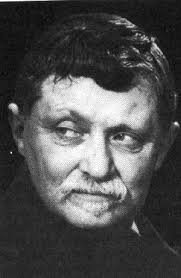
Gabriel Marcel (1889 - 1973)
Open Marcel's interactive page (graphs of influences, similar and opposing positions, and quotes)
Background
Gabriel Marcel
Born: 7 December 1889 in Paris, France
Died: 8 October 1973 (aged 83) in Paris, France
Alma mater: University of Paris
Region: Western Philosophy
Schools: Existentialism, Existential
phenomenology
Main interests: Ontology, Subjectivity, Ethics,
Religion, Theatre, Music, Freedom
Notable ideas: "The Other" (autrui), concrete
philosophy (philosophie concrète)
Influences: Henri Bergson, Martin Buber, Martin
Heidegger, Soren Kierkegaard, Edmund Husserl,
Josiah Royce, François Mauriac, Nikolai
Berdyaev, William Ernest Hocking
Influenced: Pierre Boutang, Emmanuel Levinas,
Walker Percy, Jean Wahl, Paul Ricoeur, Milan
Komar, Daniel-Rops, Jean-Paul Sartre
From Wikipedia
Marcel was a French philosopher, playwright, music critic and leading Christian existentialist. The author of over a dozen books and at least thirty plays, Marcel's work focused on the modern individual's struggle in a technologically dehumanizing society. Though often regarded as the first French existentialist, he dissociated himself from figures such as Jean-Paul Sartre, preferring the term philosophy of existence... to define his own thought. The Mystery of Being is a well-known two-volume work authored by Marcel.
Introductory Comments
It's tempting to cast Marcel, often called the first French existentialist, as the anti-Sartre. Sartre found a godless world with no meaning except what we invent. Marcel found existence thick with significance, revealed through our bonds with others and our openness to the transcendent. Where Sartre saw us "condemned to be free," Marcel saw freedom as an invitation to communion. And where a character in Sartre's No Exit concludes that "Hell is other people," Marcel might have answered that other people are where heaven begins. The irony is that the label linking them was largely Sartre's doing. In a famous 1945 lecture, he sorted existentialists into atheists like himself and Christians like Marcel.
Still, if Marcel belongs anywhere in the existentialist family, it is in a branch we might call interpersonal existentialism, alongside Buber and Jaspers. Like Buber, he held that we become most fully ourselves in meeting a "thou" rather than in handling an "it," an idea he seems to have reached largely on his own. Like Jaspers, he believed that suffering, guilt, and death can crack open everyday life and point beyond it. Marcel converted to Catholicism in 1929, at the age of 39. Yet much of his philosophy of mystery was already in place by then, and he insisted it be judged as philosophy rather than as apologetics. Fittingly, he titled one book Homo Viator, "Man the Wayfarer." If Sartre’s human being is condemned to freedom, Marcel's is on a pilgrimage, and pilgrims seldom travel alone.
Some of Marcel's Key Positions
Modern life tempts us to treat other people as objects: bundles of functions and labels, judged by whether they meet our expectations. The clerk becomes a ticket-puncher, the neighbor a category. Yet genuine communion remains possible. When one person is truly present to another, the other ceases to be a "him" or "her" to be sized up and becomes a "thou" to be met.
A culture that measures life by possessions confuses having with being: what we own comes to own us, and those who make things the measure of worth soon treat one another as things. A culture captivated by technique compounds the error. Technique has its place, but when every human question becomes a technical one, reducing others to functions can pass for realism. The result is a an efficient but spiritually impoverished world.
Underlying this diagnosis is the distinction between problem and mystery. A problem is set before us; we examine it from outside and, with the right method, solve it. A mystery involves us, blurring the line between what lies before us and what lies within. Love, fidelity, hope, and being itself are mysteries in this sense.
Religious faith offers one way of recovering this lost dimension, but so do all genuine relationships. The deepest truths of human existence are not things to be possessed or problems to be solved. They are mysteries to be lived.
Place in the History of Ideas
Marcel's Place in History of Ideas
H. J. Blackham: The main jet of Marcel's think- ing, like all existentialism, is forced from the conclusion that the type of thought which dominates or encloses or sees through its object is necessarily inapplicable to the total situation in which the thinker himself as existing individ- ual is enclosed, and therefore every system (since in principle a system of thought is outside the thinker and tranparent to him) is a mere invention and the most misleading of false analogies. The thinker is concerned with the interior of the situation in which he is enclosed: with his own internal reality, rather than with the collection of qualities by which is defined or the external relations by which his position is plotted; and with his own participation in the situation, rather than with the inaccessible view of its externality.
Brian Treanor & Brendan Sweetman: Marcel’s philosophical methodology was unique, although it bears some resemblance to both existentialism and phenomenology broadly construed. He insisted that philosophy begin with concrete experience rather than abstrac- tions. To this end he makes constant use of examples in order to ground the philosophical ideas he is investigating. The method itself consists in “working… up from life to thought and then down from thought to life again, so that [one] may try to throw more light upon life.”
Random Thoughts on Marcel
Hand someone a hammer, the old saying goes, and everything starts to look like a nail. Hand a whole civilization a toolbox, Marcel feared, and everything starts to look like a problem: grief, evil, loyalty, even love. A problem, as Marcel understood it, sits in front of us, waiting to be taken apart. Think of a leaky faucet. We can step back from it, and anyone with the right tools should arrive at the same fix. A mystery offers no such distance. When a marriage falters or a friend dies, the person asking the question is also part of what is in question. Marcel put it memorably: a mystery is a problem that encroaches on its own data. Bring a socket wrench to such a thing, and sooner or later we discover that we are the bolt.
For Marcel, religious life shows what it means to dwell in mystery rather than solve it. Faith does not try to explain God with clinical precision. It tries to live in relation to a presence that cannot be turned into an object without being betrayed. Prayer, worship, and fidelity train the self in participation rather than mastery. Here, though, a skeptic might clear her throat. Can't religious practice become its own kind of mastery, a technique for managing the soul? Marcel would probably have granted the point. He knew that what begins as participation can harden into routine, and that a prayer recited for results is just another tool in the box. The difference, for him, lay not in the practice but in the posture: whether one comes to faith open-handed or clenched.
Influences
Marcel was influenced by: Berdyaev, N., Bergson, Buber, Heidegger, Hocking, W.E., Husserl, Kierkegaard, Mauriac, F., Royce, Schelling, F.
Marcel influenced: Boutang, P., Daniel-Rops, John Paul II, Komar, Milan, Levinas, Percy, Ricoeur, Sartre, Wahl, Jean
Similar and opposing positions
Thinkers with similar positions:
- Buber (Human life is not self-enclosed. Relationships give birth to meaning.)
- de Beauvoir (We can neither escape our personal freedom nor give it away.)
- Heidegger (Modern age technology has turned Being into mere "sutff.")
- Jaspers (Our freedom is absolute. An authentic life requires that we embrace it.)
- Kierkegaard (Religion must be accepted on faith alone, never on reason.)
- Kierkegaard (Philosophy must embrace subjectivity as an essential resource.)
- Royce (Each individual gains fulfillment by joining and serving the larger whole.)
- Sorel (Science & technology threaten to destroy the mystery & value of being.)
Thinkers with opposing positions:
- Abelard (Reason, not faith, is the foundation of most Christian beliefs.)
- Borges (Man's search for meaning in a seemingly infinite universe is fruitless.)
- Camus (We seek clarity and meaning within a world that offers neither.)
- Coleridge (Loving Christianity more than truth harms both us and Christianity.)
- Cousin (Reason enables us to pass beyond the relative and subjective.)
- Diderot (Even if God created laws of nature, he isn't now at work in nature.)
- Luther (Given God's sovereignty & our own sinfulness, there is no free will.)
- Sartre (The existential reality we face is the isolated self and the death of God.)
What others said about Marcel
- Jill Graper Hernandez: As Marcel developed philosophically..., his work was marked by an emphasis on the concrete, on lived experience.
- Brendan Sweetman: Marcel developed his position by introducing a number of important philosophical distinctions for which he became well known. Among them is that between being and having, which was central to his thought.
- Brian Treanor: Marcel... does not engage in philosophy of religion in the traditional sense. He is often critical of various attempts to "prove" the existence of God.... He regards such attempts as belonging to the realm of primary reflection, and as such, they leave out the personal experience of God, which is necessarily lost in the move to abstraction.
- Brendan Sweetman: He belongs to the line of thinkers, which includes Soren Kierkegaard and Martin Buber..., who draw attention to the non-theoretical dimension of religious belief, and moral experience.
- Mark Coppenger: [Marcel contrasted Being and Having.] By robbing Being of its vitality, Having... replaces [our real self] with a false self.
- Jill Graper Hernandez: Yet, even if there is despair in our situation, there is always movement towards something more. This movement towards [something more] is the philosophical project for Gabriel Marcel.
- H. J. Blackham: [For Marcel, the] encounter between two people which leads to mutual recognition and the serious exchanges of friendship or love abolishes between them the third person which is the normal form of regard for another, and each becomes for the other a second person, a thou, and thenceforth they are together in the first person, a we.
- Brian Treanor: Marcel remains one of the most influential thinkers of the twentieth century, and his major themes continue to be relevant for the plight of humanity in the twenty-first century.
Schools: Existential Phenomenology, Existentialism, Humanism, Neo-Marxism, Personalism, Phenomenology, Romanticism
Main interests: Causality, Ethics, Free/Unfree Will, Freedom, Human Will, Metaphysics, Music, Religion, Salvation, Theatre, Will
Marcel's answers to philosophical questions
Epistemology
"The dynamic element in my philosophy... can be seen as an obstinate and untiring battle against the spirit of abstraction."
Ethics
When two individuals respect each others as individuals, they also can perceive each other's subjectivity and inherent worth.
Metaphysics
"The gulf of time: how I shudder to look down on time! My death is at its bottom & its dank breath mounts up and chills me."
"But what is the price of freedom? Nothing less than a complete renunciation of all claims to master my life."
"Cartesianism implies a severance… between intellect and life...." It then unfairly exalts the former and depreciates the latter.
Mind
"Contemplation and wisdom are [man's] highest achievements and man is not totally at home with them."
Philosophy
Philosophy should be grounded in concrete experience. Abstractions can be used only if they throw light on this experience.
Religion and Theology
The religious life is one that embraces the mysterious & that tries to bridge the supposed gap between ourselves & others.
Instead of using bloodless abstractions to prove the existence of God, we should focus on our lived experience of God.
Faith is the foundation of religion. However, "I shall only continue to believe if I continue to deserve my faith."
Immortality is not a thing nor an image, but rather a "bond; that is why it is beyond the reach of curiosity or demonstration."
Science
Science tends to replace the mystery of being with a false sense that human life is just a collection of "problems" to be solved.