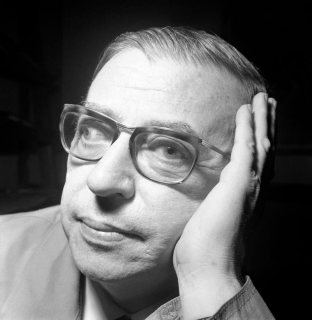
Sartre was one of the key figures in the philosophy of Existentialism (and phenomenology), a French playwright, novelist, screenwriter, political activist, biographer, and literary critic, as well as a leading figure in 20th-century French philosophy and Marxism. His work has influenced sociology, critical theory, post-colonial theory, and literary studies, and continues to do so. He was awarded the 1964 Nobel Prize in Literature despite attempting to refuse it, saying that he always declined official honors….
Introductory Comments
Sartre's famous slogan, "existence precedes essence," turns human life into the ultimate do-it-yourself project. Think of a pair of scissors: someone designs it for a purpose before anyone makes it, so its essence comes first and its existence second. Humans, Sartre argued, work the other way around. With no God to draw up the plans and no fixed human nature to follow, we simply turn up, and only then do we set about making ourselves. At first we are nothing in particular. We are "condemned to be free," obliged to invent who we are through every choice we make, with no chance to stop choosing. You aren’t born a hero or a coward; you become one, act by act, and you can always turn into the other.
Compelling stuff, but the sciences of the past half-century have offered up an impressive counterargument to Sartre. Developmental psychology finds that early attachment, trauma, and schooling help shape the very lens through which we see the world and choose. Twin studies suggest that traits such as aggression, conscientiousness, and even political leanings are heritable. And evolutionary psychologists trace many of our drives and biases to millions of years of natural selection, much of it working below conscious awareness. We arrive on earth, it seems, with considerable luggage, none of it packed by us. Again, compelling stuff. But Sartre was ready with a counter-counterargument: "A man can always make something out of what is made of him."
Some of Sartre's Key Positions
Existence precedes essence. Humans arrive in the world with no fixed nature, no blueprint, and no predetermined destiny. There is no God to have designed us, so there is no definition of humanity, religious or otherwise, to tell us what we are for. We exist first and define ourselves afterward.
That is why we are "condemned to be free." Our past, our bodies, and our circumstances are real. But they don't decide what we do next. We decide what our past means and how to act on it, so it can never serve as an excuse. Freedom therefore brings total responsibility, and with it anguish: in choosing for ourselves, we put forward a picture of what a human being ought to be.
Death isn't a crowning moment that gives life its meaning. It is absurd: an accident that comes from outside and cuts our projects short instead of completing them. Once we're dead, we can no longer reinterpret our lives. Meaning has to be made in the living, not saved up for the end.
Many individuals seek to escape the burden of freedom by living in "bad faith" - a form of self-deception in which they deny their own freedom and responsibility. Consider the café waiter, whose exaggerated gestures and mannerisms suggest that he is playing a character in a play. The problem is not that the man is a waiter but that he acts as though being a waiter exhausts who he is. He mistakes a role for an identity.
Place in the History of Ideas
Sartre's Place in History of Ideas
Casey Scott: One of Sartre’s most controversial contributions to philosophy is his claim that we are "radically free;" radically free to define our essence but also free to choose, act, and even change our emotions. Of course, radical freedom is not exactly a pleasant experience. Realizing we are free to choose means that we are entirely responsible for our lives, which creates angst - a feeling of anxiety or even despair. Nevertheless, to deny our radical freedom is what Sartre referred to as "bad faith." Accordingly, we act in bad faith any time we refuse to take responsibility for our actions, beliefs, or emotions.
A. J. Ayer: [Sartre] insists that it is not the situation itself that provides us with our motives, but rather our interpretation of it, the meaning with which we choose to endow it. But how does it come about that we choose to endow it with this meaning rather than with that? Sartre makes it depend upon a fundamental choice that each of one of us makes of the kind of life he wishes to lead and the kind of man he wishes to be. This is not a very clear concept since the fundamental choice is said to to be liable to change, to admit various courses of action on any given occasion which are consonant with it, and not even to exclude actions which run counter to it. Nor is any empirical evidence provided for the assumption of its universal existence.
Random Thoughts on Sartre
Where did Sartre get the idea that we are absolutely free? One tempting answer is his method. Phenomenology, the careful description of experience as it shows up for us, starts from the first-person point of view. From there, choice can feel limitless: why not quit tomorrow and take up the oboe? Sartre pushed further: even obstacles take their meaning from our projects. A crag is "unclimbable" only to someone who wants to climb it; to someone else, it's scenery. But this risks turning the world's resistance into a matter of interpretation. Poverty, trauma, and genetics don't wait for our projects to give them meaning. They are the bouncers at the door. Yet the method can't be the whole story. Merleau-Ponty, Sartre's friend and fellow phenomenologist, examined the same lived experience and found a body thick with habits and moods, and a freedom real but never absolute. Same method, different verdict.
Still, something survives. We may not be free from our genes or our past, but we may be free with them: free to play the hand we've been dealt. Or to switch metaphors: A sailor need not command the winds to have a hand in charting the voyage. A sailor can work the wind. It's a smaller, less heroic freedom, but probably a more honest and durable one. The twist: the older Sartre reached much the same conclusion. By 1969 he was calling freedom a "small movement" within a life shaped by "facticity." The prophet of absolute freedom ended up sounding remarkably like one of his own critics.
Bakunin (The dictatorship of the proletariat is still a form of tyranny.)
Brentano (Intentionality or "aboutness" is the main characteristic of the mind.)
Camus (We seek clarity and meaning within a world that offers neither.)
de Beauvoir (Each individual conscience is fundamentally a predator to another.)
Fanon (Colonization is an attack on the dignity & self-worth of the colonized.)
Heidegger (Acknowledging one's mortality is a source of anxiety & authenticity.)
Jaspers (Our freedom is absolute. An authentic life requires that we embrace it.)
Thinkers with opposing positions:
Avicenna (The essence of a thing is ontologically prior to its existence.)
Barthes (Human consciousness is constrained by culture & its "structures.")
Bataille (Literature has no moral purpose. It's best when disrupting morals.)
Borges (Man's search for meaning in a seemingly infinite universe is fruitless.)
Buber (Human life is not self-enclosed. Relationships give birth to meaning.)
Epicurus (Don't fear death. Death is nothingness & therefore nothing to us.)
Marcel (Neither the isolated self nor the death of God are existential realities.)
Proust (Appreciating the charm & value of everday life gives meaning to life.)
Tillich (Faith in God is man's ultimate concern, even for the nonbeliever.)
What others said about Sartre
Wilfrid Desan: [For Sartre] consciousness is not-matter [no-thing or nothingness] and by the same token escapes all determinism.
Jason Dawsey: … Sartre exerted enormous influence on such currents as existentialism (with which he is most associated), phenomenology, and philosophical anthropology…. Sartre also became a crucial figure in Marxist thought….
Marcuse: Insofar as [Sartre's] Existentialism is a philosophical doctrine, it remains an idealistic doctrine: it hypostatizes specific historical conditions of human existence into ontological and metaphysical characteristics. Existentialism thus becomes part of the very ideology which it attacks, and its radicalism is illusory.
Jacques Maritain: … I have [no respect] for Jean-Paul Sartre, who seems to me too artful, and who besides (and here he pleases me) would be quite sorry to find himself respected.
Tony Judt: As a rule, philosophers found Sartre slippery; playwrights thought him didactic. But each supposed him a genius at the other activity.
Katharina Eiermann: Jean Paul Sartre has said that all of French Existentialism is to be found in Ivan Karamazov's contention that if there is no God, everything is permitted.
Heidegger: [Sartre] says existence precedes essence. In this statement he is taking existentia and essentia according to their metaphysical meaning, which, from Plato's time on, has said that essentia precedes existentia. Sartre reverses this statement. [But with this reversal] he stays with metaphysics, in oblivion of the truth of Being.
Althusser: He was a... courageous man. He always defended the cause of the unfortunate, of the exploited, and of the oppressed. He always struggled for freedom,... often with the communists and [at times] against them.
Main interests: Alienation, Art and Aesthetics, Autobiography, Biography, Civil Rights, Colonialism, Communication, Consciousness, Death, Desire, Epistemology, Ethics, Free/Unfree Will, Freedom, Freedom of the press, Habits, Happiness, History, Human Will, Journalism, Literary theory, Literature, Love, Memory, Metaphilosophy, Metaphors, Metaphysics, Mind, Perception, Personal Identity, Poetry, Political Activism, Political Philosophy, Psychoanalysis, Psychology, Punishment, Racism, Religion, Salvation, Social Criticism, Social Philosophy, Theatre, Time, Tragedy, War, Will, Wisdom