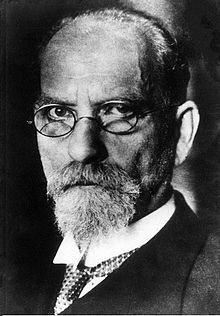
Husserl was an Austrian-German philosopher and mathematician who established the school of phenomenology. In his early work, he elaborated critiques of historicism and of psychologism in logic based on analyses of intentionality. In his mature work, he sought to develop a systematic foundational science based on the so-called phe- nomenological reduction. Arguing that transcen- dental consciousness sets the limits of all possible knowledge, Husserl redefined phenomenology as a transcendental-idealist philosophy.
Introductory Comments
Husserl's path to phenomenology was both circuitous and surprising, beginning far from philosophy's armchair - in mathematics. After earning his doctorate in mathematics, he became an assistant to the eminent mathematician Karl Weierstrass in Berlin. But the decisive turn came when he attended Brentano's lectures in Vienna, where Brentano's concept of intentionality - the idea that consciousness is always consciousness of something - set Husserl off on an epic journey into consciousness itself. He began by asking how mathematical concepts and truths could be understood and justified, but eventually found himself confronting a much larger question: how is knowledge of anything possible?
Husserl came to believe that neither empirical science nor traditional metaphysics could provide philosophy with an unquestionable foundation. Both began with assumptions that philosophy itself was supposed to examine. Someone had to get beneath those assumptions and do the philosophical plumbing, as it were. This required "bracketing" our ordinary assumptions about the existence of the external world, not to deny that world but to examine how it appears to consciousness and acquires meaning. By investigating the structures of experience, Husserl hoped to discover what makes knowledge possible and thereby put philosophy on solid ground - if something as ephemeral as consciousness could be called solid.
Some of Husserl's Key Positions
Consciousness can be studied on its own terms, by describing whatever appears to the mind exactly as it presents itself. This description, phenomenology, is the foundation for making philosophy a "rigorous science," grounded not in experiment but in what is directly evident. Logic, too, rests on such evidence.
Every act of consciousness is intentional, meaning directed toward something. Even imagining a unicorn has an object, though none exists. Each experience thus has two sides: the act itself, such as perceiving or remembering (the noesis), and the object exactly as meant in that act (the noema).
To study these structures, the everyday assumption that the world exists must be suspended. This "bracketing" (the epoché) does not deny the world; it sets the question aside to reveal how the world is given in experience. Varying examples in imagination then discloses their essences, the features a thing cannot lose and remain what it is.
In its mature form, phenomenology investigates how pure consciousness constitutes the meaning of objects and the world. Consciousness is thus a region of "absolute being" on which the world's meaning depends. We should, therefore, return philosophy to "the things themselves" and uncover the structures through which a meaningful world becomes available to us at all.
Place in the History of Ideas
Husserl's Place in History of Ideas
Robert C. Solomon: Phenomenology is the close examination of the essential sructures of con- sciousness, with an eye to deriving (describing) necessary and universal truths of experience. With Husserl's phenomenology philosophy was finally to become a science, but not an empiri- cal science. The object of phenomenological description was to get to the essences of ideas (eidos) that presented themselves to experi- ence, to go beyond the various "facts" of expe- rience and the relativity of theories and prac- tices to those features of experience which are "absolutely given in immediate intuition."
Edward Skidelsky: [Husserl thinks philosophy] must set aside all theories and assumptions… and return to the only source of pure, absolute knowledge: the immediately given…. Positivism, notes Husserl, also regards the immediately given as the source of all knowledge. But it naively imports into its understanding of this given assumptions drawn from the scientific study of nature, such as that of sensory "elements" interacting causally. To guard against such lapses, philosophy must rigorously "bracket" or abstain from all judgments of natural science and common sense, including the judgment that anything exists at all. It must set aside what Husserl calls the "natural attitude," in which attention is directed toward an independently existing world of facts, and focus exclusively on consciousness itself.
Random Thoughts on Husserl
Imagine Husserl wandering into Wonderland where he encounters a wide-eyed Alice sipping tea with the Mad Hatter. "My dear girl," he intones with a scholarly gleam, "the world you see - the teacups, Mock Turtle, March Hare, Duchess - comes wrapped in many assumptions about its existence. We must bracket those assumptions so that we can explore the realm of pure consciousness. Just follow me down the phenomenological rabbit hole." Alice, who has already drunk potions that made her shrink and eaten cakes that made her grow, figures bracketing reality can't be stranger than what she's already endured. "Sure," she says.
At first, Alice finds the experience exhilarating, as if the world has lost its center of gravity. Everything seems still to be there, yet nothing can be assumed to exist. Husserl insists that she examine not whether the cat exists, but how it appears to her, grin and all. The Duchess offers her a teacup, but instead of taking a sip, Alice must examine how she recognizes it as a cup, how its unseen backside is somehow present to her, and how she knows what to expect when she lifts it. One by one, the familiar objects of Wonderland become occasions for philosophical interrogation. Nothing disappears, yet nothing remains quite the same. It's all too much - or too little. Alice grows queasy, her mind adrift in a sea of questions without shores. After mere minutes, she clutches at Husserl's sleeve. "I need to throw up. Please get me a bucket whose existence I don't have to bracket!"
Berkeley (What is immediately perceived are ideas in the mind, not things.)
Bolzano (Thought is intentional. It is by nature directed toward or about objects)
Brentano (Intentionality or "aboutness" is the main characteristic of the mind.)
Brentano (Philosophy should use methods as rigorous and exact as science.)
Heidegger (Philosophy should start with the objects of conscious experience.)
Kant (All our perceptions are held together in a unity of consciousness.)
Ortega (Philosophy must focus on lived experience - the life of each individual.)
Stumpf (Natural sciences yield only hypotheses and never universal truths.)
Thinkers with opposing positions:
Hobbes (All things, including humans and their minds, are entirely material.)
Merleau-Ponty (The body is our site of knowing the world. It's how we know.)
Mill (Logic is not an autonomous discipline, but a branch of psychology.)
Moore (Common sense proves existence of an external world & an abiding self.)
Reid (Common sense proves existence of an external world & an abiding self.)
Schelling (Mythology & religion are true complements to speculative philosophy)
Skinner (Behavior is a matter of stimuli & responses, not psyche or inner states.)
Strawson (Mind and body are united in the primitive concept of personhood.)
What others said about Husserl
Strauss: No one in our century has raised the call for philosophy as a rigorous science with such clarity, purity, vigor, and breadth as Husserl.
Ludwig Landgrebe: [Husserl's method] was what [he] called phenomenological reduction. It focuses the philosopher’s attention on uninterpreted basic experience and the quest, thereby, for the essences of things.
Christian Beyer: Edmund Husserl was the principal founder of phenomenology - and thus one of the most influential philosophers of the 20th century. He has made important contributions to almost all areas of philosophy and anticipated central ideas of its neighboring disciplines such as linguistics, sociology, and cognitive psychology.
Marianne Sawick: Phenomenology can be roughly described as the sustained attempt to describe experiences (and the "things themselves") without metaphysical and theoretical speculations.
R. C. Solomon: Phenomenology had as its aim nothing less than the return of philosophy to scientific status, and of European thought to... rationality.
Colin Wilson: Husserl's philosophy has [this] aim: to show us that, although we may have been thrust into this world without a "by your leave," we are mistaken to assume that it exists independently of us.
David Carr: It is well known that Husserl was always disappointed at the tendency of his students to go their own way, to embark upon fundamental revisions of phenomenology rather than engage in the communal task [as originally intended by his radical new science].
H. Spiegelberg: While outward religious practice never entered his life any more than it did that of most academic scholars of the time, his mind remained open for the religious phenomenon as for any other genuine experience.
Schools: Antipositivism, Common Sense Realism, Continental Philosophy, Neo-Kantianism, Personalism, Phenomenology, Transcendental Idealism
Main interests: Alienation, Communication, Consciousness, Desire, Epistemology, Logic, Mathematics, Metaphilosophy, Metaphysics, Mind, Perception, Personal Identity, Psychology, Science, Semiotics, Time, Universals, Will