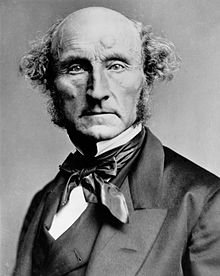
Mill was an English philosopher, political econo- mist, politician and civil servant. One of the most influential thinkers in the history of liberalism and social liberalism, he contributed widely to social theory, political theory, and political economy…. [H]e conceived of liberty as justifying the freedom of the individual in opposition to unlimited state and social control. He advocated political and so- cial reforms such as proportional representation, the emancipation of women, and the development of labor organizations and farm cooperatives.
Introductory Comments
Some fathers hope their sons will become doctors or lawyers. James Mill wanted a philosopher, and he saw no reason to wait. Young John Stuart Mill began Greek at three. By seven he had read six of Plato's dialogues, though he later admitted the last was well over his head. At eight came Latin and algebra, which he taught to his younger siblings as he went. By thirteen he was absorbing Adam Smith and David Ricardo on long walks with his father. Schooled entirely at home, the boy was kept largely apart from other children, lest they infect him with vulgar habits of thought. James Mill, Jeremy Bentham's chief disciple, meant to raise an heir to their radical cause, and he did.
The experiment nearly broke the young Mill. In the autumn of 1826, at twenty, he asked himself whether he would be happy if every reform he worked for came true tomorrow. The answer, he recalled, was an unmistakable "No!" Relief first stirred as he wept over an account of a father's death. The lasting cure was Wordsworth, whose poems taught him that feeling needs cultivating as much as reason does. Mill never abandoned his father's creed, but he widened it, learning from Coleridge, Carlyle, and others his father had little use for. Reserved and morally earnest, he became arguably the most influential British philosopher of his century. And the boy built to a blueprint spent his life arguing that human nature is "not a machine to be built after a model," but a tree that must grow freely on all sides.
Some of Mill's Key Positions
Morality rests on utility: actions are right as they tend to promote happiness, wrong as they tend to produce its opposite. Everyone's happiness counts equally, the agent's own included. But not all pleasures are equal. Those of intellect and moral feeling outrank bodily ones: better Socrates dissatisfied than a fool satisfied.
Coercing an adult is justified only to prevent harm to others. This "harm principle" binds public opinion, not just law, since social pressure can tyrannize more thoroughly than any statute. Others may reason with a person about his own good, but never compel him. Mere offense is not harm.
The principle limits coercion, not public action. The state may require every child's education, relieve destitution, and undertake useful works private enterprise neglects, though it must beware centralizing power.
Free discussion deserves special protection. A silenced opinion may be true, and suppressing it assumes infallibility. It may be false yet partly true. Even a wholly true opinion, unchallenged, hardens into "dead dogma."
The subordination of women is an injustice. It rests on custom, not argument, and since women have never been allowed to develop freely, no one knows their true "nature." Freeing them would double the talent available for progress.
Place in the History of Ideas
Mill's Place in History of Ideas
Joshua Greene: The founding utilitarians, Bentham and Mill, were not just armchair philosophers. They were daring social reformers, intensely engaged with the social and political issues of their day. Indeed, many familiar social issues became social issues because Bentham and Mill made them so. Their views were considered radical at the time, but today we take for granted most of the social reforms for which they fought. They were among the earliest opponents of slavery and advocates of free speech, free markets, widely available education, environmental protection, prison reform, women's rights, animal rights, gay rights, workers' rights, the right to divorce, and the separation of church and state
Stefan Collini: Mill - it is one of the few things about him one can assert with reasonable security against contradiction - was not Nietzsche. He was not, that is, attempting fundamentally to subvert or reverse his society's moral sensibilities, but rather to refine them and call them more effectively into play on public issues. In these circumstances, the moralist runs the risk of priggishness, as he contrasts the consistency of his own position and the purity of his own motives with the logical confusions and self-interested prejudices that he must impute to those who, sharing the same premises, fail to draw the same conclusions.
Random Thoughts on Mill
Bentham once declared that, prejudice aside, the children's game push-pin is as good as poetry. He meant it. If a game and a poem give equal pleasure, nothing else can rank them, because pleasures differ only in amount. And amounts can, in principle, be tallied by intensity, duration, certainty, and a few other measures, a method later writers dubbed "felicific calculus." Young Mill was raised on this arithmetic, and he never abandoned its first premise: actions are right as they tend to promote happiness. What he abandoned was Bentham's arithmetic. Some pleasures, Mill insisted, are higher in kind, not merely larger. The proof is that people who have known both will not trade the higher for any quantity of the lower.
This deeper revision came out of the crisis of 1826. Mill emerged convinced that happiness makes a poor target for direct aim. "Ask yourself whether you are happy," he wrote in his Autobiography, "and you cease to be so." The happy are those whose minds are fixed elsewhere: on the happiness of others, on the improvement of mankind, on some pursuit loved for its own sake. This did not demote happiness to a byproduct. Mill still held it the only thing desirable as an end. But things first sought as means, from virtue to music, can become part of what happiness is. Real happiness, then, is less a sum than a state of character, involving endeavors, values, commitments, and a certain self-forgetfulness. Try running that through a calculus.
Hart (Laws should only proscribe activities that do nontrivial harm to others.)
Humboldt, W. (Freedom should be restricted only to prevent harm to others.)
Nussbaum (Laws that punish should be based on harm done, not disgust felt.)
Ortega (The tyranny of the majority can be a serious threat to our freedom.)
Ricardo (With industrial economies, international trade is always beneficial.)
Thinkers with opposing positions:
Bosanquet (Thoughts in our mind are grouped & interconnected into systems.)
Bradley (Maximizing pleasures should not be the end moral agents aim for.)
Brentano (Logic is not an autonomous discipline, but a branch of psychology.)
Coleridge (The Good is not determined by merely calculating pleasures & pains.)
Foot (Ethics should emphasize internal virtues, not external results.)
Hare (Moral decisions should consider both principles and consequences.)
Hegel (Freedom springs not from within, but from our belonging to a state.)
MacIntyre (God is both the source and the pinnacle of justice and natural law.)
Sidgwick (Subjective intention or good will determines moral value of actions.)
Williams, B. (We can't reduce moral decisions to a few utilitarian algorithms.)
What others said about Mill
Christopher Macleod: [Mill was] the most influential English-speaking philosopher of the nineteenth century.
Tara Westover: Mill claimed that women have been coaxed, cajoled, shoved and squashed into a series of feminine contortions for so many centuries, that it is now quite impossible to define their natural abilities or aspirations.
James Seth: We are far too apt to think of Mill as a technically philosophical writer, because we cannot help thinking of him as the author of the "Logic," and to forget that he, no less than Bentham and the other utilitarians, is primarily dominated by the practical interest of the social reformer.
Chesterton: There shone in him a beautiful reverence for women, which is all the more touching because, in his department, as it were, he could only offer them so dry a gift as the Victorian Parliamentary Franchise.
Carlyle: I never knew a finer, tenderer, more sensitive or modest soul among the sons of men. There never was a more generous creature than he.
Stefan Collini: His systematic account of the nature and methods of "science," in the broadest sense, attained an authority in England that was positively papal.
Mises: Mill is an epigone of classical liberalism and, especially in his later years, under the influence of his wife, full of feeble compromises. He slips slowly into socialism and is the originator of the thoughtless confounding of liberal and socialist ideas that led to the decline of English liberalism and to the undermining of the living standards of the English people.
Chesterton: Though he had to preach a hard rationalism in religion, a hard competition in economics, a hard egoism in ethics, his own soul had all that silvery sensitiveness that can be seen in his fine portrait by Watts.
Main interests: Abolition of slavery, Biography, Causality, Civil Rights, Class Struggle, Commerce, Communication, Death, Democracy, Desire, Economics, Environment/Conservation, Equality, Ethics, Freedom, Freedom of the press, Government, Habits, Happiness, Health, History, Industrialism, International Law, Journalism, Jurisprudence, Just War, Justice, Labor, Law, Logic, Perception, Poetry, Political Philosophy, Political Theory, Power, Probability, Progress, Property, Public Administration, Punishment, Social Criticism, Social Philosophy, Virtue, War, Wealth, Will