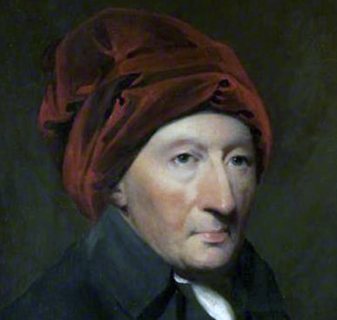
Reid was a religiously trained Scottish philosopher best known for his philosophical method, his theory of perception, and its wide implications on epistemology, and as the developer and defender of an agent-causal theory of free will. He also focused extensively on ethics, theory of action, language and philosophy of mind. He was the founder of the Scottish School of Common Sense and played an integral role in the Scottish Enlight- enment…. A contemporary of David Hume, Reid was also "Hume's earliest and fiercest critic."
Introductory Comments
Hume's Treatise woke Kant from what he later called his dogmatic slumber, and Kant spent the rest of his career building a transcendental philosophy to secure the conditions of human knowledge - dealing with the dragon by rerouting the road around its cave. Reid had drawn his sword two decades earlier and gone straight for the throat - the throat belonging to the "monster of skepticism." He was Hume's countryman, near contemporary, and, in his own estimation, the only philosopher willing to name the disease rather than catch it.
His weapon was An Inquiry into the Human Mind on the Principles of Common Sense (1764), followed by two volumes of Essays in the 1780s. Reid's target was the assumption he found in Locke, Berkeley, and Hume alike: that the mind's immediate objects are ideas, faint copies standing in for a world it never meets directly. He did not deny that we have sensations. He denied that we perceive them. Smell a rose: the sensation resembles nothing in the flower, carries no picture, and yet the moment it occurs we conceive of the rose and believe in it - irresistibly, without argument, before reflection has time to lift a finger. Sensations are signs, not portraits, and like the ink on a page they go unnoticed while we attend to what they mean. No inference, no gap, and so nothing for the skeptic to pry open. Of course Hume could respond: Indeed, common sense makes sense. Its job is to read the ink on the page - not to understand it.
Some of Reid's Key Positions
When a philosopher reasons his way to a conclusion no sane person can believe, the fault lies in the reasoning's premises, not in the belief. erkeley dissolves the material world into ideas; Hume, not to be outdone, dissolves the self that was supposed to be having them. To find out what went wrong, we must look at their starting points.
That starting point entry is the theory of ideas - the assumption that the mind never meets things themselves, only images standing in their place. Once a veil of ideas hangs between mind and world, no one can break through it. Berkeley and Hume merely proved as much.
Sensation is a natural sign that immediately yields both a conception of the object and an irresistible belief in it, a belief built into our constitution. Nor can the skeptic pick and choose among his faculties: reason is taken on trust exactly as the senses are. By common sense, then, we mean not popular prejudice but the first principles everyone must presuppose in order to argue at all.
What philosophers should do is start out with what we already know - what common sense tells us about the world and about ourselves. Not only is this more intellectually honest, it is also more moral: To behave morally towards others, we must accept their existence, our existence, and the existence of the world we share together. To be moral, we must first be sane.
Place in the History of Ideas
Reid's Place in History of Ideas
Marina Folescu: Reid is best known as the father of common sense philosophy. He contends that going back to the principles of common sense will help deal with the problems engendered by the so-called "skeptical views" of his predeces- sors: Descartes, Locke, Berkeley, and Hume. He argues that "the way of ideas" generates undue uncertainty in the theory of knowledge. If the only things that can be known directly and immediately are the contents of one’s mind, there can be no certainty in the knowledge geared toward the external world. Reid believes this goes against the common-sense view that humans do acquire certain knowledge through empirical observation of the external world, and are therefore not confined to know only the contents of their minds.
George Stuart Fullerton: Reid and various other philosophers have tried to come back to "Com- mon Sense" and to stay there. Now, it is a good position to come back to for the purpose of starting out again. The experience of the plain man, the truths which he recognizes as truths, these are not things to be despised. Many a man whose mind has been, as Berkeley express- es it, "debauched by learning," has gotten away from them to his detriment, and has said very unreasonable things. But "Common Sense" cannot be the ultimate refuge of the philoso- pher; it can only serve him as material for inves- tigation.
Random Thoughts on Reid
Reid founded Scottish Common Sense Realism, which makes this a fair moment to ask the question non-philosophers have been asking about philosophers for 25 centuries: why do they say such preposterous things? Why the appetite for paradox, the weakness for the counterintuitive, the cheerful indifference to what everyone knows?
The answer depends on whom you ask, and each school has a ready one. A Platonist would say common sense is at home among appearances, and appearances are the shadows on the cave wall, not the thing casting them. A scholastic would plead the difficulty of the assignment: reason and revelation must be reconciled, and the joinery is bound to look strange. A phenomenologist would say common sense is precisely the habit that has to be suspended - bracketed, in Husserl's term - before the structure of experience can be seen at all. A postmodernist would say common sense is no one's innocent inheritance but a sediment of power and history, and thus not to be trusted.
Notice that each of these is also a defense, and a somewhat convenient one. Perhaps the plainer answer is that defying common sense is fun. It is the intellectual version of children spinning until the room tilts and the ceiling becomes a floor - done not for knowledge but for the pleasure of the vertigo. Which leaves Reid in an awkward position. He was the sober adult in a discipline that rather enjoys being dizzy, and history has not always thanked him for it. No one loves a grinch.
Butler, Joseph (Our conscience naturally rules over our passions and self-love.)
Cousin (Inference allows us to bridge gap between consciousness & world.)
Hutcheson (We have a natural sense by which we perceive virtue and vice.)
Jacobi (Though external world can't be directly known, it can be taken on faith.)
James (An abiding self or pure ego holds together our stream of consciousness.)
Moore (Common sense proves existence of an external world & an abiding self.)
Thinkers with opposing positions:
Berkeley (Essentially the world does not consist of things, but of mental events.)
Bradley (Reality is ideal, whole and one. There are no real separate things.)
Hume (We only really know the immediate impressions of our senses.)
Malebranche (The ideas through which we perceive objects exist in God.)
Nagel (As limited creatures, we will never achieve a unified worldview.)
Sextus Empiri. (Since perceptions disagree, knowledge is not possible.)
Shakespeare (Nothing is certain in life: We change as much as do our judgments)
Socrates (We should question assumed truths to see if they are in fact true.)
Stirner (All "sacred truths" in law, morality & religion are artificial concepts.)
Zeno (The more we understand the world, the more paradoxical it becomes.)
What others said about Reid
J. H. Randall, Jr.: [Reid thought] the simplest act of the mind is already a judgment.... [T]he unit of knowledge is not the sensation, but the judgment.
William Turner: The greatest benefit that Reid conferred on philosophy was the importance which he attached, and succeeded in causing others to attach, to introspection, or self-observation.
Schopenhauer: Thomas Reid's excellent book, Inquiry into the Human Mind... affords us a very thorough conviction of the inadequacy of the senses for producing the objective perception of things, and also of the non-empirical origin of the intuition of space and time. Reid refutes Locke's teaching that perception is a product of the senses.
Windelband: Reid acknowledges that Berkeley's idealism and Hume's skepticism are as correct consequences from Locke's principle as is Hartley's materialism; but just the absurdity of these consequences refutes the principle.
Wallace I. Matson: Reid was one of the first philosophers to lay emphasis on the structure of language as relevant to philosophical conclusions.
Berlin: The principal importance of Reid's philosophical views lies in his bold attempt to rehabilitate the "common sense" view of the external world against the disturbing paradoxes of Berkeley and Hume.
Marina Folescu: In philosophy of mind, Reid is most celebrated today for the arguments he gave in support of the position known as direct realism, which, at its most basic, states that the primary objects of sense perception are physical objects, not ideas in human minds. However, Reid’s philosophy of mind neither begins nor ends with perception.
Patrick Rysiew: Reid insists that the locus of causal power is the agent, and that the self is not merely a material thing being pushed about by laws of nature. Science teaches us about the latter; but [not the] efficient causes of things....
Schools: Common Sense Realism, Empiricism, Enlightenment, Innatism, Intuitionism, Scottish Common Sense, Scottish Enlightenment
Main interests: Art and Aesthetics, Epistemology, Ethics, Free/Unfree Will, Metaphysics, Mind, Perception, Personal Identity, Religion, Will