B. F. Skinner (1904 - 1990)
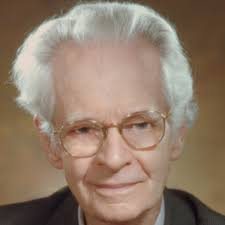
Open Skinner's interactive page (graphs of influences, similar and opposing positions, and quotes)
Background
B. F. Skinner
Born: March 20, 1904 in Susquehanna,
Pennsylvania, U.S.
Died: August 18, 1990 (aged 86) in Cambridge,
Massachusetts
Alma mater: Hamilton College, Harvard
University
Main interests: Psychology, linguistics,
philosophy, literature, education, politics,
operant conditioning
School: Radical Behaviorism
Influences: Charles Darwin, Ivan Pavlov, Ernst
Mach, Jacques Loeb, Edward Thorndike,
William James, Jean-Jacques Rousseau, Henry
David Thoreau, Alfred North Whitehead,
John B. Watson, Bertrand Russell
Influenced: Willard Van Orman Quine, Julian
Rotter, Roberto Refinetti, George C. Homans,
Robert Lanza, Ullin Place
From Wikipedia
Skinner was an American psychologist, behavior- ist, author, inventor, and social philosopher…. Skinner saw human action as dependent on consequences of previous actions, a theory he would articulate as the principle of reinforcement: If the consequences to an action are bad, there is a high chance the action will not be repeated; if the consequences are good, the probability of the action being repeated becomes stronger…. [A] June 2002 survey listed Skinner as the most influential psychologist of the 20th century.
Introductory Comments
B. F. Skinner's behaviorism was, on one level, a perfectly understandable revolt against the extravagant theorizing of what Santayana dubbed "literary psychology." Freud, Jung, and Adler had spun elaborate tales of the psyche, full of unconscious drives, archetypes, and inferiority complexes. Their cast of characters often read more like a Gothic novel than a scientific treatise. Following the path John B. Watson had cleared, Skinner looked at all of it and said, in effect: enough stories, let's measure something. Behavior can be observed, counted, and charted, and so can the circumstances before it and the consequences after it. Build psychology on that, he argued, and it might finally become a real science.
It was a bracing program, and in the laboratory it worked. Pigeons pecked, rats pressed levers, and the curves on the charts rose and fell on cue. The trouble here is a version of the streetlight effect. A man searches for his lost keys under a lamppost, not because he dropped them there, but because that's where the light is. Skinner never denied that thoughts and feelings exist. Unlike some behaviorists, he insisted they were real events inside the skin and fair game for science. But he denied them any role as causes, treating them as byproducts of the same history that produces the behavior. Here the reasoning slides, almost imperceptibly, from "this is hard to observe" to "this can't be doing anything." The keys to human behavior must be where the light is good.
Some of Skinner's Key Positions
Psychology, like every other science, must explain its subject without calling on hidden inner agents. Minds, wills, and drives are explanatory fictions: they name what needs explaining and then pass the name off as the explanation. The proper subject of psychology is behavior.
A scientific psychology must also make no exceptions to cause and effect. Behavior is the product of genetic endowment and environmental history, above all the consequences that followed past behavior. Miracles may belong to religion, but not to science. So free will must go.
The belief in free will imagines an "autonomous" self that steps outside the web of causes and starts action from nothing, like a miracle worker producing effects without causes. This self is a holdover from prescientific thinking, invoked wherever real causes are still unknown. As science uncovers those causes, the autonomous self has less and less left to do.
Consciousness, too, is not a separate, nonphysical realm. Thoughts and feelings are real, but they are physical events inside the skin. They differ from public behavior only in that just one person can observe them. Looking inward reveals not an immaterial mind but one’s own body. And feelings do not cause behavior. They are "collateral products" of the same genetic and environmental histories that produce the behavior itself.
Place in the History of Ideas
Skinner's Place in History of Ideas
Kendra Cherry: In Skinner's operant condition- ing process, an operant referred to any behav- ior that acts on the environment and leads to consequences. He contrasted operant behaviors (the actions under our control) with respond- ent behaviors, which he described as anything that occurs reflexively or automatically such as jerking your finger back when you accidentally touch a hot pan. Skinner identified reinforce- ment as any event that strengthens the behav- ior it follows. The two types of reinforcement he identified were positive reinforcement (favorable outcomes such as reward or praise) and negative reinforcement (the removal of unfavorable outcomes). Punishment can also play a role in the operant conditioning process. A punishment involves presenting a negative reinforcer… or removing a positive reinforcer....
Deborah Skinner Buzan: [My father] believed that, although our genes determine who we are, it is mostly our environment that shapes our personality. A Time magazine cover story ran the headline "BF Skinner says we can't afford freedom." All he had said was that controls are an everyday reality - traffic lights and a police force, for instance - and that we need to organize our social structures in ways that create more positive controls and fewer aversive ones. As is clear from his utopian novel, Walden Two, the furthest thing from his mind was a totalitarian or fascist state.
Random Thoughts on Skinner
In 1959 Chomsky reviewed Skinner’s Verbal Behavior, arguing that language could not be explained as a collection of conditioned responses. Children routinely produce sentences they have never heard, so they could never have been reinforced for saying them. They also master the grammar of their native language with remarkable speed, on scraps of evidence, and with very little correction. Chomsky's generative grammar pointed instead to rules that operate beneath the surface of speech. That was exactly the sort of inner mental machinery Skinner refused to admit into his explanations. Meanwhile, researchers studying memory and reasoning kept finding they couldn't account for what people do without talking about internal processes. Skinner had treated the mind as a black box we need not open. By the late 1950s, people were prying at the lid from every side.
The cognitive revolution was more than a revolt against behaviorism, though. It was fed by ideas from well outside psychology. Just after World War II, Shannon’s information theory and Wiener’s cybernetics gave scientists a new vocabulary: "information," "feedback," "signal," "coding." Most important of all, the computer supplied a fresh metaphor for the mind: a device that takes in information, stores it, transforms it by rules, and produces output. What a wonderful twist! We invent machines that could imitate certain feats of human thought, then began imagining human thought in the image of our machines.
Influences
Skinner was influenced by: Darwin, James, Loeb, Jacques, Mach, Pavlov, Ivan, Rousseau, Russell, Thoreau, Thorndike, E., Watson, J.B., Whitehead
Skinner influenced: Homans, G.C., Lanza, Robert, Place, Ullin, Quine, Refinetti, R., Rotter, Julian
Similar and opposing positions
Thinkers with similar positions:
- Davidson (Mental events are not governed by strict psychological laws.)
- Democritus (Everything is composed entirely of various imperishable atoms.)
- Harris (Free will is not possible in our deterministic world.)
- Hobbes (Since the will is causally determined, it is not free in its choices.)
Thinkers with opposing positions:
- Berlin (Meaningful rational activity rests on the concept of human free will.)
- Brentano (Descriptive psychology rests on understanding inner perceptions.)
- Chalmers (It's possible everything material has some degree of consciousness.)
- Chomsky (An instinctive universal grammar allows us to generate language.)
- Chrysippus (Free will springs from our participation in the deterministic world.)
- Dennett (Free will and determinism become compatible through rationality.)
- Dewey (Stimulus and response is not a simple, one-directional phenomenon.)
- Levinas (Ethics is primary. Everything follows from our ethical duty to others.)
- McGinn (Free will is compatible with mental, not physical, causation.)
- Piaget (Behavior springs more from internal conceptions than external stimuli)
- Sellars ("Manifest images" (intentions, thoughts, etc.) can complement science.)
- Vico (Unlike all other subjects, human behavior must be explained internally.)
What others said about Skinner
- C. Boeree: Both freedom and dignity are examples of what Skinner calls mentalistic constructs - unobservable and so useless for a scientific psychology.
- Kendra Cherry: Skinner referred to his own philosophy as "radical behaviorism" and suggested that the concept of free will was simply an illusion. All human action, he instead believed, was the direct result of conditioning.
- Rand: There are occasions when a worthless... book acquires significance as a scrap of litmus paper exposing a culture's intellectual state. Such a book is "Beyond Freedom and Dignity" by B.F. Skinner… [The book was put together] from the junkyard of philosophy (Pragmatism, Social Darwinism, Positivism, Linguistic Analysis, with some nails by Hume, threads by Russell…).
- C. George Boeree: B. F. Skinner’s entire system is based on operant conditioning. The organism is in the process of "operating" on the environment, which in ordinary terms means it is bouncing around its world, doing what it does.
- Marina Koren: In a realm of science that has given us Sigmund Freud, Carl Jung, and Jean Piaget, Skinner stands out by sheer quirkiness.
- George Dvorsky: Thoughts, emotions, and actions, said Skinner, are exclusively products of the environment. His behaviorism was a deterministic behavioralism, one that considered free will an illusion….
- Alan Moore: B. F. Skinner actually put forward… the idea that consciousness was a weird vibrational by-product of the vocal cords. That we did not actually think. We thought we thought because of this weird vibration caused by the vocal cords. This shows the lengths that hard science will go to to banish the ghost from the machine.
- John Berger: Today behaviourists like Skinner imprison the very concept of man within the limits of what they conclude from their artificial tests with animals.
Schools: Behaviorism, Determinism, Empiricism, Epiphenomenalism, Physicalism
Main interests: Education, Free/Unfree Will, Habits, Literature, Politics, Power, Psychology, Science, Utopia
Skinner's answers to philosophical questions
Education
"Education is what survives when what has been learned has been forgotten."
Teachers should break down tasks into small achievable steps and then give students reinforcements to learn each step.
"We shouldn’t teach great books; we should teach a love of reading."
Ethics
"What is love except another name for the use of positive reinforcement? Or vice versa."
Law
"If you insist that individual rights are the summum bonum, then the whole structure of society falls down."
"... at best, [a person who has been punished] learns how to avoid punishment."
Metaphysics
"The hypothesis that man is not free is essential to the application of scientific method to the study of human behavior."
Nature
"The major difference between rats and people is that rats learn from experience."
Political Philosophy
"Democracy is the spawn of despotism…. It's not the will of the people, remember; it's the will of the majority."
"If the world is to save any part of its resources for the future, it must reduce… consumption [&] the number of consumers."
"It is a mistake to suppose that the whole issue is how to free man. The issue is to improve the way in which he is controlled."
Government should be decentralized and apply scientific knowledge to improve social behavior and solve social problems.
Psychology
We are largely unaware of the true forces at work in human psychology. And none of these forces are themselves "mental."
Our actions are determined through a long history of positive and negative reinforcements, not through abstract reason.
"I don't deny the importance of genetics. However, the fact that I might be altruistic isn't because I have a gene for altruism."
"Give me a child and I'll shape him into anything."
"A failure is not always a mistake. It may simply be the best one can do under the circumstances. [But don't] stop trying."
Human behavior is shaped by environmental forces that either reinforce or discourage numerous types of behavior.
Religion and Theology
"What Jesus offered in return of loving one's enemies was heaven on earth, better known as peace of mind."
Science
"Science is a willingness to accept facts even when they are opposed to wishes."
Society
"Each of us has interests which conflict the interests of everybody else... 'everybody else' we call 'society.'"
"Society attacks early, when the individual is helpless. It enslaves him almost before he has tasted freedom."
Society should be organized upon scientific principles in a way that minimizes social problems and maximizes social welfare.
"By a careful design, we control not the final behavior, but the inclination to behave - the motives, the desires, the wishes."