Wilfrid Sellars (1912 - 1989)
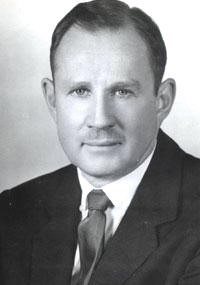
Open Sellars's interactive page (graphs of influences, similar and opposing positions, and quotes)
Background
Wilfrid Sellars
Born: May 20, 1912 in Ann Arbor, Michigan, U.S.
Died: July 2, 1989 (aged 77) in Pittsburgh,
Pennsylvania, U.S.
Alma mater: Univ. of Michigan (BA, 1933),
Oriel College, Oxford (MA, 1940)
School: Analytic
Main interests: Philosophy of mind, Philosophy
of perception, Epistemology, Meaning, Science,
Pragmatism, Behaviorism, History of philosophy
Influences: Ryle, Carnap, Husserl, Kant, Roy
Wood Sellars, Thomas Dewar Weldon, Marvin
Farber, C. S. Peirce, Curt John Ducasse, Ernst
Cassirer
Influenced: Robert Brandom, Paul Churchland,
John McDowell, Rorty, Dennett, Jerry Fodor,
Bas van Fraassen, Ray Brassier, Ruth Millikan,
Annette Baier, Jay Rosenberg, J.P. Moreland,
Laurence BonJour, Hector-Neri Castaneda
From Wikipedia
Sellars is well known as a critic of foundationalist epistemology - the "Myth of the Given" as he called it. However, his philosophical works are more generally directed toward the ultimate goal of reconciling intuitive ways of describing the world... with a thoroughly naturalist, scientific account of reality…. Sellars was perhaps the first philosopher to synthesize elements of American pragmatism with elements of British and American analytic philosophy and Austrian and German logical positivism.
Introductory Comments
Sellars believed philosophy's central task is to reconcile two competing pictures of reality: the "manifest image" - the human world of persons, moral commitments, and lived experience - and the scientific image, which describes reality in terms of particles, forces, and causal laws. Sci- ence, for Sellars, is the ultimate arbiter of what exists, yet it cannot account for the normative dimension of human life - the fact that we make promises, feel guilt, and argue about pizza top- pings. Meaning, for Sellars, isn't a matter of words pointing at things like labels on museum exhibits; it's a matter of the role a concept plays in the vast web of inferences and influences we navigate every time we open our mouths.
What makes Sellars' project so compelling - and so notoriously difficult to read - is his insist- ence that both scientific view and the, if you will, "human" view are indispensable. Science tells us what ultimately exists (he was an una- pologetic scientific realist), but the normative world of reasons, duties, and intentions is not thereby debunked; it has its own irreducible logic. Mental states themselves, he proposed, are theoretical posits we invented to explain each other's behavior - making folk psychology humanity's first and greatest scientific theory, albeit insufficient for certain tasks. The chal- lenge of philosophy, then, is to achieve a "synoptic vision" that does justice to quarks and commitments, neurons and norms.
Some of Sellars' Key Positions
One of the key challenges of philosophy today is to bring together into one "synoptic view" two competing images of man: the scientific image and the "manifest image" - that is, the "framework in terms of which man encoun- tered himself." Though science is the ultimate judge of what exists, it must make room for those dimensions of human experience that seem to contradict or go beyond the scientific understanding of man.
For example, though science describes how people think and act, people themselves have moral convictions as to how people should think and act. Reconciling these two types of under- standing requires a theory of conceptual roles that includes how these roles are transmitted through various social interactions.
In turn, understanding these social interactions requires a type of linguistic nominalism - one that sees words not as representing universal truths, but as mental states or entities linked to linguistic roles people play in different contexts. Or to put the matter more simply: People use words differently depending on the social roles they are currently playing. And these various social roles require various differences in the use of language. The scientific worldview and the everyday worldview (or worldviews) are all part of the natural order and, as such, proper subjects for philosophy.
Place in the History of Ideas
Sellars' Place in History of Ideas
Peter Jackson Olen: Wilfrid Sellars’s work has recently gained prominence in the work of analytic philosophers who are concerned with offering a particular account of the relationship between mind, language, and world. This "particular account" focuses on Sellars’s commitment to a normative conception of language and thought that turns on under- standing linguistic rules and rule-following as concepts inherently bound to standards of correctness relating to patterns of behavior.
Thomas C. Vinci: One of Sellars's most interest- ing applications of this [normative/natural] nexus is to the set of semantical rules that govern appropriate verbal responses to perceptual stimuli ("language entry rules") and to other verbal utterances ("intra-linguistic rules"), and that govern the appropriate actions that follow upon verbalized cognitions ("language exit rules").
James R. O'Shea: To put it in somewhat sweeping historical terms, the empiricist tradition in general defends the view that all factual knowledge derives ultimately from sense experience rather than pure reason. As a result empiricists (and Sellars, too) attempt to give an account of our knowledge that does not rely upon the direct or intuitive grasp of essences, universals, or a priori principles.…
Random Thoughts on Sellars
Sellars came of age intellectually at a moment when logical positivism was the big game in town, and he absorbed its commitment to sci- entific naturalism and conceptual precision - while quietly sawing off the branch it was sit- ting on. The positivists wanted to purify philos- ophy by reducing meaning to verifiable sense-data, but Sellars undermined this project with his critique of the "myth of the given," arguing that there is no pre-conceptual bedrock of raw experience on which knowledge can rest. From analytic philosophy he inherited the tools of philosophy of language, yet rejected the ten- dency to treat language as a self-contained logical system floating free of human practice.
This is where Sellars' pragmatist strain enters. Like Peirce and Dewey before him, he insisted that meaning is not something locked inside individual minds or floating in a Platonic heav- en, but something that lives in social practice - in the inferential moves, normative commit- ments, and communal standards that govern how we actually use language together. He gave this pragmatist intuition the rigorous sys- tematic treatment the pragmatists themselves rarely managed. The result was a philosophy that was, in the best possible sense, too tidy to be purely pragmatist, too humane to be purely positivist, and too radical to be purely analytic - a synthesis so original that philosophy is still, decades later, trying to catch up with it.
Influences
Sellars was influenced by: Carnap, Cassirer, Ducasse, Curt, Farber, Marvin, Husserl, Kant, Peirce, Ryle, Sellars, Roy W., Weldon, T.D.
Sellars influenced: Baier, A., BonJour, L., Brandom, Brassier, Ray, Castenada, H., Churchland, P., Dennett, Fodor, Fraassen, B., McDowell, Millikan, Ruth, Moreland, J.P., Rorty, Rosenberg, J.
Similar and opposing positions
Thinkers with similar positions:
- Brandom (Much of the meaning of words springs from their inferences and uses.)
- Cassirer (We should think of myths as useful or not, rather than true or false.)
- Darwin (Evolution has created the cognitive tools we use to function & survive.)
- Davidson (Though mind springs from matter, it can't be reduced to matter.)
- Fodor (Though mind springs from matter, it can't be reduced to matter.)
- Piaget (Behavior springs more from internal conceptions than external stimuli)
- Pinker (Mental instincts help shape us. The mind at birth is not a blank slate.)
- Quine (There will always be multiple ways to analyze a person's actions.)
- Searle (Intentions deal with the directedness or aboutness of mental states.)
Thinkers with opposing positions:
- Ayer (We only really know the immediate impressions of our senses.)
- Bergson (Utility is not a test of truth, but in fact a synonym for error.)
- Carnap (Meaning of a sentence is equivalent to stating its truth conditions.)
- Collingwood (The mind-body "split" is more semantic than metaphysical.)
- Russell (Language that is not verifiable is not true or untrue but meaningless.)
- Ryle (Science can't attribute so-called "subjective inner experience" to people)
- Schlick (Outside logic & math, the truth of statements must rest on evidence.)
What others said about Sellars
- Brandom: Wilfrid Sellars is... the most profound and systematic epistemological thinker of the 20th Century.
- Daniel Fernandez: [Although inspired by logical positivism,] Sellars views our non-scientific ways of thinking as being indispensable not only for knowledge but as the very basis for perception and thought.
- Willem A. deVries: … he is known for his attack on the "myth of the given" and his development of a coherentist epistemology and... inferentialist semantics, for his distinction between the "manifest image" and the "scientific image" of the world, for his proposal that psychological concepts are like theoretical concepts, and for a tough-minded scientific realism.
- Christopher Gauker: Sellars was one of the first philosophers to advocate a kind of functionalism. (The widely used analogy between words and chess pieces derives from [Sellars], although the debt is seldom acknowledged…).
- David Auerbach: [Sellars replaces] positivism with a broader, more holistic, pragmatic, and fallibilist methodology….
- Willem A. deVries: Sellars takes an unorthodox approach to language, but it is also crucial for his naturalistic metaphysics. The key to his view is that semantic terms and descriptions provide functional classifications of linguistic tokens.
- Christopher Gauker: Foundationalism in epistemology might be defined as the thesis that all of our knowledge rests on a foundation of indubitable truths about sensory experience…. Sellars's best known piece of writing, "Empiricism and the Philosophy of Mind"... is in part a critique of this doctrine. There Sellars refers to this doctrine as the myth of the given.
- Daniel Fernandez: In other words, thought is modeled on speech for Sellars, instead of the other way around. Readers of the later Wittgenstein will certainly see affinities here, as will some readers of Hegel.
Schools: Analytic Philosophy, Common Sense Realism, Eliminative Materialism, Emergentism, Neopragmatism, Post-analytic Philosophy, Post-positivism, Pragmatism, Rationalism
Main interests: Epistemology, History of Philosophy, Logic, Metaphilosophy, Mind, Science
Sellars's answers to philosophical questions
Epistemology
Our normal everyday ways of thinking are as indispensable as are our rigorously logical and scientific ways of thinking.
Reconciling scientific understanding with nonscientific understanding requires a theory of conceptual roles played by each.
Language
Words are pliable. That is, people use words differently depending on the social roles they are currently playing.
Our "thoughts [are] construed on the model of speech" rather than the other way around.
Metaphysics
Though the individual words do not represent universals, semantics in general is a type of map or picture of the world.
Mind
"The interpretation of thought as 'inner speech' has taken different forms, and has been used to clarify a variety of problems."
Philosophy
Philosophy tries "to understand how things in the broadest possible sense hang together in the broadest possible sense…."
Philosophy should play a practical role in guiding our activities, be they theoretical or practical, scientific or everday.
Science
Though science is the ultimate judge of what exists, it must make room for everyday dimensions of human experience.