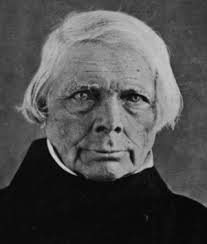
Schelling was a German philosopher. Standard histories of philosophy make him the midpoint in the development of German idealism, situating him between Johann Gottlieb Fichte, his mentor in his early years, and Georg Wilhelm Friedrich Hegel, his one-time university roommate, early friend, and later rival. Interpreting Schelling's philosophy is regarded as difficult because of its evolving nature. Schelling's thought in the main has been neglected, especially in the English-speaking world.
Introductory Comments
Kant's transcendental idealism argues, not implausibly, that the most basic features of experience come from us rather than from the world. Space and time are not containers we discover out there; they are the forms our sensibility imposes on whatever it receives. Causality, necessity, and contingency are not lessons taught by experience; they are categories the understanding brings to it. On this account we never know things as they are in themselves. We know appearances - the world as it must look to minds built like ours.
Then Kant's successors got hold of him. Fichte threw out the thing-in-itself as an incoherent leftover and derived the whole external world from the activity of the absolute Self. Schelling and Hegel found this, well, too subjective, and each built a version of Absolute Idealism in reply. (See Random Thoughts.) Or, to wax metaphorical: Kant had fenced off the unknowable and posted a polite sign. Fichte climbed the fence and announced that the far side was his own handiwork. Hegel climbed it too, and set about charting the stages the Spirit must have passed through to arrive where we are now. Schelling, being a Romantic, just wandered out into the forest instead. Then he came back with reports of what he had found - a storm, a flowering plant, a lump of iron that mysteriously points north. Nature, he insisted, is the Absolute asleep, spirit not yet awake to itself. The woods had been dreaming of us all along.
Some of Schelling's Key Positions
The physical sciences have made real discoveries, but their mechanical picture of nature misses what matters most in it: organic form and organic process. Nature is no mathematical abstraction and no inert machine. It is productive and alive.
So nature philosophy does not compete with transcendental philosophy; it completes it. Fichte reduced nature to the Not-Self, raw material for the striving ego. But there is no subject without an object and no object without a subject. Transcendental philosophy begins with mind and arrives at nature; nature philosophy begins with nature and shows how it climbs, by degrees, to mind. The two sciences meet in the middle.
Kant walled the ideal off from the real and left the thing-in-itself unknowable. In truth the ideal and the real are one at the root, differing in proportion rather than in kind. Mind can grasp reality directly, by intellectual intuition - the very faculty Kant denied it. And what intuition finally discloses is not only a living nature but a living God.
Freedom, too, is felt immediately by everyone. But it is not the bland power to pick between options. Freedom is the capacity for good and evil, and evil is no mere shortfall or absence of good. It is a the creature's own will tearing loose from the whole to make itself the center. That is what makes freedom precious and terrifying at once. It is also what determines a person's deepest character.
Place in the History of Ideas
Schelling's Place in History of Ideas
Andrew Bowie: Schelling’s continuing impor- tance today relates mainly to three aspects of his work. The first is his Naturphilosophie, which, although its empirical claims are largely indefensible, opens up the possibility of a mod- ern hermeneutic view of nature that does not restrict nature’s significance to what can be established about it in scientific terms. The second is his anti-Cartesian account of subjec- tivity, which prefigures some of the most influ- ential ideas of thinkers like Nietzsche, Heideg- ger, and... Lacan, in showing how the thinking subject cannot be fully transparent to itself. The third is his later critique of Hegelian Idealism, which influenced Kierkegaard, Marx, Nietzsche, Heidegger, and others, and aspects of which are echoed by thinkers like T.W. Adorno and... Derrida. Schelling’s focus on humankind’s rela- tionship to nature has gained particular rele- vance as the seriousness of the climate emer- gency has become... apparent in recent years.
Schopenhauer: [Schelling's identity of the subjective and the objective is perverse.] Everything that rare minds like Locke and Kant had separated after an incredible amount of reflection and judgment, was to be again poured into the pap of that absolute identity. For the teaching of those two thinkers may be very appropriately described as the doctrine of the absolute diversity of the ideal and the real, or of the subjective and the objective.
Random Thoughts on Schelling
There's a pattern in German Idealism worth noticing: each thinker built his system out of what he refused in the one before him. Fichte found Kant's thing-in-itself an embarrassment and threw it out. Schelling and Hegel found Fichte's Self too small a peg to hang a world on, and each answered with an Absolute. Then the two of them - once roommates at the seminary in Tübingen - fell out over what the Absolute was like. For Hegel it was Geist, Spirit coming to know itself, and history was the long record of the attempt: reason unfolding, with politics and ethics and religion unfolding alongside it, each stage canceling the last while keeping whatever was worth keeping. Schelling's Absolute was not wlorking itself out in history. It was underfoot and all around, asleep in things. Nature was not the stage on which Spirit performs; nature was Spirit, not yet awake. And whatever stirs in the plant and the storm stirs also in the artist - which is why, for Schelling, a painting could disclose what an argument could not.
Neither system has many defenders today, but read as poetry rather than as proof, both keep their old pull. If you like to think a Rational Process is at work in History, Hegel is your grand storyteller. If you prefer an Animating Force at work in Nature, Schelling is your nature guide. And if you fancy the whole world as an emanation of your own all-creative Self - well, Fichte is your man, though he would be the first to tell you that the Self in question was never yours.
Coleridge (Philosophy should reawaken us to our relationship with God.)
Deleuze (Experience only makes sense when organized by forms of sensibility.)
Emerson (Besides being beautiful, Nature is also a moral & spiritual guide.)
Freud (Much of our behavior springs from unconscious motives and beliefs.)
Goethe (Science & philosophy need to ponder the dynamic character of nature.)
Kant (Judgments based on experience also rely on innate categories of mind.)
Swedenborg (There are links among the physical, spiritual, and divine worlds.)
Thales (The material workings of nature also have an inherent spiritual aspect.)
Thinkers with opposing positions:
Brentano (There is no such thing as an unconscious mental act.)
Cousin ("Absolute" systems based on deductive abstractions are illegitimate.)
Feuerbach (Our concept of God reflects our own traits and deepest wishes.)
Hegel (Freedom springs not from within, but from our belonging to a state.)
Jacobi (Demonstrative reasoning can never lead us to understanding reality.)
Lotze (The world is not made up of mental images, but rather empical facts.)
Royce (Even idealistic postulates must rest ultimately on pragmatic grounds.)
Santayana (Mind has no causal power. All motion has merely physical causes.)
Skinner (Behavior is a matter of stimuli & responses, not psyche or inner states.)
What others said about Schelling
Alan White: Despite Schelling’s aspirations and claims, he was instrumental not in the completion of metaphysics, but rather in its abandonment.
Berlin: [Schelling felt that] life in a work of art is analogous with - is some kind of quality the work has in common with - what we admire in nature, namely some kind of power, force, energy, life, vitality bursting forth.
Andrew Bowie: Schelling is one of the first philosophers seriously to begin the critique of the model of metaphysics based on the idea of true representation, a critique which can be seen as one of the key aspects of modern philosophy from Heidegger to the later Wittgenstein and beyond.
Saitya Brata Das: [Kierkegaard's] anxiety has family resemblance with Schelling’s notion of anxiety of the mortal who constantly flees from the fire of the center and takes shelter in the periphery.
Tillich: ... what I learned from Schelling became determinative of my own philosophical and theological development.
Hegel: Now the philosophy of Schelling from the first admitted the possibility of a knowledge of God, although it likewise started from the philosophy of Kant, which denies such knowledge.
Cassirer: Nature, for [Schelling], is not simply a sum total of geometric arrangements and mechanical laws, but an organic whole of structures and powers. For him, mathematical physics sinks to a mere abstraction, to a shadow. Nature possesses true reality only in the form of organic events and organic structures.
Andrew Bowie: [Schelling has] historical importance for the development of modern philosophy: thinkers like Schopenhauer, Kierkegaard, Feuerbach, Nietzsche and Heidegger owe far more to Schelling than they admit.
Main interests: Art and Aesthetics, Chain of Being, Epistemology, Free/Unfree Will, Human Will, Metaphysics, Mythology, Nature, Personal Identity, Religion, Science, Sublime Nature, Wisdom